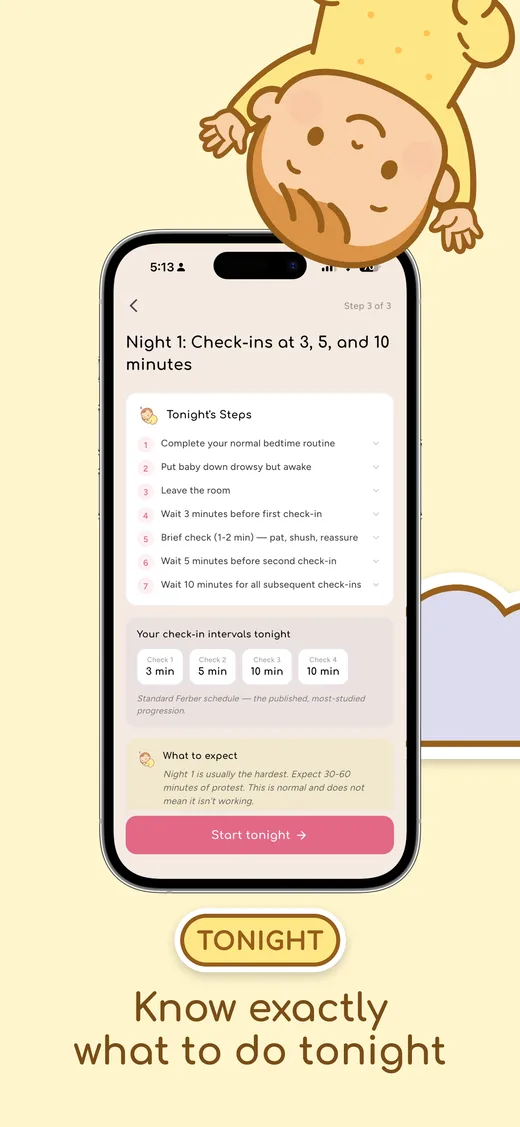
If your 5-month-old has always nursed to sleep, she'll probably cry every time you put her down for the first few nights. That's expected, and it doesn't mean sleep training is failing. What usually holds things up is switching methods before any one has had 3 nights, or a bedtime that comes so late she's overtired.
If you're two nights in and wondering whether any of this is doing anything, you're probably closer than it feels. Below is an example of how this usually goes, what I see when I look at the logs, and what I'd do from tonight.
It's a made-up example, not one family's logs. But if you've been nursing to sleep, already tried two methods and are thinking about a third, it might look familiar.
The example: a 5-month-old, three methods in 36 hours
She's 5 months old, breastfed, and has fallen asleep at the breast for pretty much every sleep since she was born. Her parent decides it's time to start sleep training.
| When | What happened |
|---|---|
| Night 1, bedtime | Timed check-ins. She takes over an hour to fall asleep and cries even when picked up. The check-ins come early, and the last one ends in a feed. |
| Day 2, a nap | Pick up, put down this time. A long settle, then a short nap. |
| Day 2, later | A gradual check-in plan. That's the third approach in a day. |
| Day 2, afternoon | The last nap ends mid-afternoon. The next one never happens. |
| Night 2, bedtime | Nursed to sleep after nearly 4 hours awake. No check-ins. |
| Day 3, early morning | An early wake, nursed back to sleep, so the whole day starts late. |
| Day 3 | Every put-down still ends in tears. The parent can't tell if any of it is working. |
When I look at a log like this, the crying isn't what jumps out. She got a different response at almost every sleep for a day and a half, so there was nothing to get used to yet. The first night of the real plan turned into a nurse-to-sleep bedtime. And she went into it after nearly 4 hours awake.
None of that is bad parenting. Night 1 was awful, so the parent looked for something gentler, then for something with more structure. That's what most of us do at 9pm with a screaming baby.
Made-up example to show a common pattern. Not one family's data.
Why does a 5-month-old cry every time you put her down?
A 5-month-old who has always nursed to sleep cries when you put her down awake because she doesn't know another way to fall asleep yet. A sleep association is whatever a baby links with falling asleep: nursing, a bottle, rocking, your arms. In a large survey of parents of babies and toddlers across several countries, children who fell asleep on their own woke less at night and slept longer than children who fell asleep with a parent feeding or holding them (Mindell et al., 2010). It's a link, not proof of cause. Still, it's why so many sleep plans start with the feed.
So she protests. And the protest often gets louder before it fades. Behavior researchers call this an extinction burst: a short rise in a behavior right after it stops getting the old result (Lerman & Iwata, 1995). It doesn't happen to every baby. When it does, night 2 can be worse than night 1.
Crying even when she's picked up, like on night 1 in the example, is the old habit loosening. Nights 1 and 2 are usually the loudest. It's the hardest stretch to sit through, and it's also where a lot of parents give up on a method that was working.
Does switching sleep training methods make it worse?
Switching sleep training methods in the first few nights usually slows things down, because every method works by repetition. Your baby learns what happens at bedtime by seeing it happen the same way, night after night. Check-ins one night, pick up, put down the next morning, nursing to sleep the next night: that's three different answers to the same question.
No single method is the clear winner in the research. A review of 52 studies found that 94% of them reported behavioral sleep methods worked, and more than 80% of the children improved, using a range of different methods (Mindell et al., 2006). In a trial of 43 babies aged 6 to 16 months, two quite different approaches (timed check-ins and a later, then gradually earlier, bedtime) both cut the time it took babies to fall asleep compared with a control group (Gradisar et al., 2016). If several methods work, the one you'll do the same way every night is the one to pick.
Babies learn from repetition, not from any one night. So pick the method you can follow on a bad night, not the one that sounds fastest. If you know you'll go in at minute 3, a gentler method you'll stick with beats a faster one you'll drop by night 2. Our sleep training methods comparison lays out what each one asks of you.
How long should a 5-month-old be awake before bed?
Most 5-month-olds do best with 2 to 2.5 hours awake between sleeps (see our wake windows by age guide). The stretch before bed can run a bit longer, but nearly 4 hours, like night 2 in the example, is a lot. An overtired baby fights the put-down harder, whatever method you're using.
22%
of bedtimes logged sad after under 3 hours awake (60 bedtimes)
41%
of bedtimes logged sad after 3 hours or more awake (32 bedtimes)
Both numbers come from the same 8 babies, aged 3 to 9 months, who had bedtimes on both sides of the 3-hour mark. So it's each baby compared with herself, not fussy babies vs easy ones. It's a small sample. Take it as a hint, not a finding.
Methodology: bedtimes logged in our app with a mood (happy, meh or sad) between October 15 and November 9, 2026, for babies aged 3 to 9 months. Last wake window = time from the most recent logged wake (within 8 hours) to the bedtime. Only babies with at least one bedtime under 3 hours and one at 3 hours or more were included (n=8 babies, 92 bedtimes). Test accounts excluded. Aggregate, anonymized data only.
What I'd do instead: a 3-night plan
For a 5-month-old who cries at every put-down, I'd fix the timing of bedtime first. Then do one method the same way for 3 nights before deciding whether it's working. Here's how I'd start tonight.
- 1
Put her down about 2.5 to 3 hours after her last nap ends
Go by when the last nap ended, not by the clock. If she wakes from her afternoon nap at 4pm, start the wind-down around 6:15 and have her in the crib by 6:45 or 7. If a nap gets skipped, bedtime comes earlier that day. It may feel early, but after a short day of naps it helps a lot.
- 2
Pick one method for bedtime and do it the same way 3 nights in a row
Same routine, same order, same response when she cries. If the plan says check in at 5 minutes, go in at 5, not at 2. Put the intervals in your phone so you're not making it up at 9pm.
- 3
Leave naps and early-morning feeds alone for now
Bedtime is usually the easiest place to start, because she's sleepiest then. Keep nursing for naps and the early-morning wake the way you have been. Work on those once bedtime is going well.
- 4
Move the feed to the start of the routine
Feed first, then bath or pajamas, a song, and into the crib. She still gets a full feed, but she's awake when you lay her down.
- 5
Time each bedtime and judge on night 3
Write down when she went into the crib and when she fell asleep. If night 3 is shorter than night 1, it's working, even if night 2 was rough.
A note on age: most sleep training studies, including the Gradisar trial, started at 6 months. At 5 months, gentler, gradual methods are the usual choice, and plenty of babies still need a night feed. Our post on when to start sleep training covers the signs she's ready.
How do you know if sleep training is working?
Sleep training is working when the minutes from put-down to asleep go down over the first 3 nights of the same method. How loud one night was tells you much less. It's natural to judge by how bad the first night or two felt, but those are usually the worst nights of the whole thing. So judge on night 3, not night 1.
| What to watch | Working | Stuck |
|---|---|---|
| Minutes to fall asleep | Falls across nights 1 to 3 | Flat or rising after 5 to 7 nights |
| Crying | Shorter stretches, longer gaps between them | Same length every night |
| Your check-ins | Happening on schedule | Often early, often ending in a feed |
| Bedtime routine | Same order, same response, 3 nights running | Different method or response most nights |
If the numbers stay flat after 5 to 7 nights of one method done the same way, look at timing before you change anything else. A bedtime that's too late (or too early) is one of the usual reasons a method stalls. And if things get worse around night 4 after a good start, read our post on sleep training regression before you quit.
How an app can help with a case like this
When you're in the middle of it, what you remember is the crying. What you need to see is the pattern: three methods in two days, a 4-hour stretch before bed, check-ins that came early. That's much easier to spot in a log than at 9pm.
- →Cocoo's bedtime session timer records how long she took to fall asleep and each check-in, including the early ones, so you can compare night 3 with night 1 by the numbers.
- →When you tell it what's going wrong (“cries when I put her down”), it looks for likely causes in your baby's own logs, such as a feed-to-sleep association or a long last wake window, and builds one plan to follow. For babies 3 to 5 months, its plans use only gentle or gradual methods.
- →If you're stuck, you can message me through the in-app chat. I look at your baby's logs before I reply.
An app can't sit with you at 9pm, and it can't tell you if your baby is unwell. But in a case like the one above, the method was never the problem. The timing and the switching were, and both are fixable from tonight.
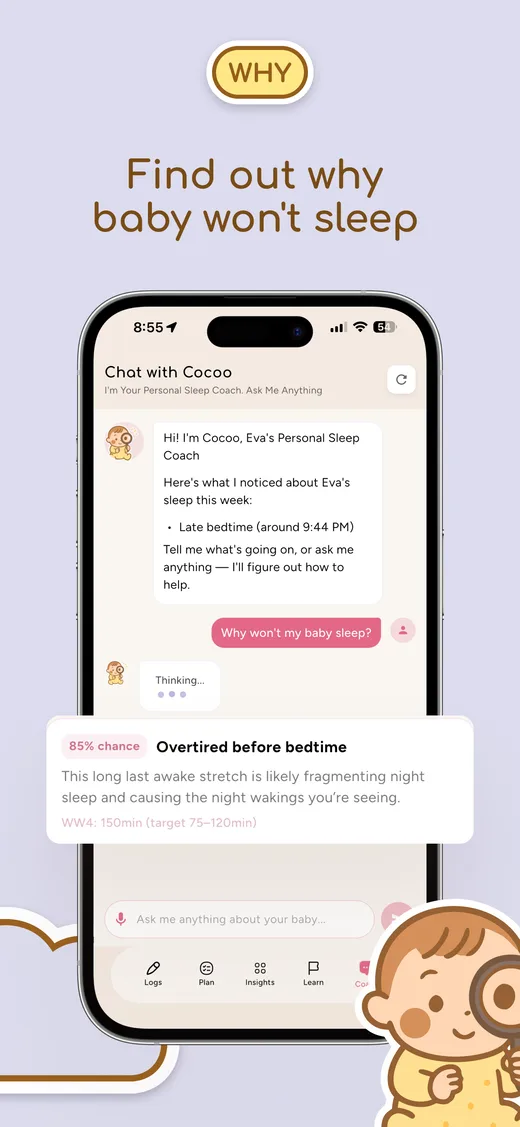
Not sure what's behind the crying at put-down?Cocoo reads her logs, ranks the likely causes, and gives you one plan to follow from tonight.
When crying at put-down isn't about sleep habits
Talk to your pediatrician before sleep training if your baby isn't gaining weight well, arches or seems in pain when lying flat, spits up a lot, has a fever, or cries in a way that sounds different from her usual protest. This guide is general information, not medical advice.
Related questions
Can I sleep train a 5-month-old who nurses to sleep?
Many families start with bedtime only: feed earlier in the routine, then put her down awake, and keep nursing for naps and night feeds for now. Most research on sleep training was done with babies 6 months and older, so at 5 months gentler, gradual methods are the common choice. Check with your pediatrician that she's growing well and ready to drop feeds.
Keep reading
Sources
Gradisar M, Jackson K, Spurrier NJ, Gibson J, Whitham J, Williams AS, Dolby R, Kennaway DJ. Behavioral interventions for infant sleep problems: a randomized controlled trial. Pediatrics. 2016;137(6):e20151486. Full text
Lerman DC, Iwata BA. Prevalence of the extinction burst and its attenuation during treatment. Journal of Applied Behavior Analysis. 1995;28(1):93–94.
Mindell JA, Kuhn B, Lewin DS, Meltzer LJ, Sadeh A. Behavioral treatment of bedtime problems and night wakings in infants and young children. Sleep. 2006;29(10):1263–1276. PubMed
Mindell JA, Sadeh A, Kohyama J, How TH. Parental behaviors and sleep outcomes in infants and toddlers: a cross-cultural comparison. Sleep Medicine. 2010;11(4):393–399.
Aggregate sleep data: 92 bedtimes with a logged mood from 8 babies aged 3 to 9 months, logged in our app October 15 to November 9, 2026. Within-baby comparison.
Not sure if it's working? Time tonight's bedtime
Log three bedtimes with the same method. Cocoo shows you whether the minutes to sleep are falling from night 1 to night 3.