Sleep Training · Age-by-Age Guide
Gentle Sleep Training Works — But It Looks Different at 4 Months Than at 12
Gentle sleep training (teaching babies to fall asleep without extended crying) works across all ages from 4 to 18 months. The catch is that the method that gets results at 5 months can actively backfire at 8 months, and what works at 8 months is too passive at 13 months. The developmental window matters more than most sleep advice admits.
This guide breaks down what gentle sleep training looks like at each stage, why the approach has to change as your baby's brain develops, and what the data from 1,741 tracked nights shows about night wakes and sleep onset across each age band.
4–6 months: The first real window to start
Before 4 months, babies don't have a stable circadian rhythm. Sleep is driven almost entirely by hunger and fatigue. There's no consolidation to work with yet. By 4 months, that changes. The sleep-wake cycle starts to follow a predictable pattern, naps begin to organize around wake windows, and the brain is finally ready to learn.
What's normal at this age: most babies still wake once or twice per night. In data from 321 complete tracked days at 4 months, the average was 1.25 night wakes, with a median of 1. That's not a problem to solve: it's developmentally expected. What gentle sleep training targets at this age is not zero wakes, but reducing the time it takes to fall back asleep, and building a sleep onset pattern that doesn't require feeding or rocking every single time.
What the data shows · 4–6 months
1.25
avg night wakes at 4mo
(n=321 days)
18.8
avg minutes to fall asleep at 4mo
11.9
avg minutes to fall asleep at 5mo (best of all ages)
Source: Cocoo aggregate data, complete tracked days (is_complete_day = true), 4–5 months. Sample sizes: 321 days (4mo), 336 days (5mo). Individual data is never used or shared.
The gentle methods that fit this age best:
- Fading (SLIP method). You gradually move bedtime earlier and reduce the amount of active help at each step (rocking less, patting less) over 7–10 nights. This works well at 4–6 months because babies at this age respond to slow changes without protest escalating.
- Pick-up-put-down. Popularized by Tracy Hogg, this method has you put the baby down drowsy but awake, pick them up when they cry until calm, then put down again. Hall et al. (2015) found it works for a subset of 4–8 month olds, but requires high parental effort: sometimes 30+ pick-ups in a single night.
What's a red flag at this age: if bedtime onset latency is consistently above 25 minutes, check the schedule before the method. Overtired babies at 4–6 months fight sleep harder. Try moving bedtime 20 minutes earlier for 3 nights before changing anything else.
7–9 months: When the gentle approach you used at 5 months stops working
Something shifts around 7 months. Object permanence is developing, which means your baby now understands you exist when they can't see you. They want you back. This is healthy development, not sleep regression. But it means the same pick-up-put-down routine that calmed a 5-month-old can now reinforce the cycle: cry → parent appears → baby learns crying works.
The data reflects this directly. Average sleep onset latency jumped from 11.9 minutes at 5 months to 28.6 minutes at 7 months. Babies didn't suddenly become bad sleepers: separation anxiety and cognitive development made the old approach less effective.
What the data shows · 7–9 months
28.6
avg minutes to fall asleep at 7mo
(n=272 days)
27.2
avg minutes at 8mo
(n=138 days)
8.9
avg minutes at 9mo (drops sharply)
Source: Cocoo aggregate data, complete tracked days. The spike at 7–8 months aligns with object permanence development; the drop at 9 months reflects stabilization in babies with consistent bedtime routines. Individual data is never used or shared.
The chair method and graduated check-ins outperform purely responsive methods for 7–9 month olds. The key difference is predictability: your baby still knows you're there, but they also learn that your arrival follows a consistent pattern rather than tracking their crying intensity.
- Chair method (Sleep Lady Shuffle). You sit next to the crib night 1–2, move to the middle of the room nights 3–4, then toward the door nights 5–6, then outside. Your presence is reassuring but decreasing. This takes 2–3 weeks and suits babies who escalate quickly when left alone.
- Graduated check-ins with longer spacing. Check in at 5 minutes, then 10, then 15, staying to the same schedule regardless of cry intensity. The consistent timing matters more than the duration of the visit. Keep check-ins brief (30–60 seconds) and calm.
What's a red flag: if your baby has 3+ night wakes and they all end with feeding, check whether the nighttime hunger is real. Babies 7–9 months can usually go 10–12 hours without feeding, but habits from earlier months often persist. This is where tracking becomes useful. Apps like Cocoo can detect whether the waking pattern is habitual or hunger-driven by analyzing the timing across multiple nights.
10–12 months: The sweet spot most parents finally crack it
By 10 months, the brain architecture for independent sleep is largely in place. Circadian rhythm is well established, naps have consolidated to two (usually), and the cortical development that makes self-soothing possible has matured. The data reflects this: median night wakes drop to 0 from 9 months onward.
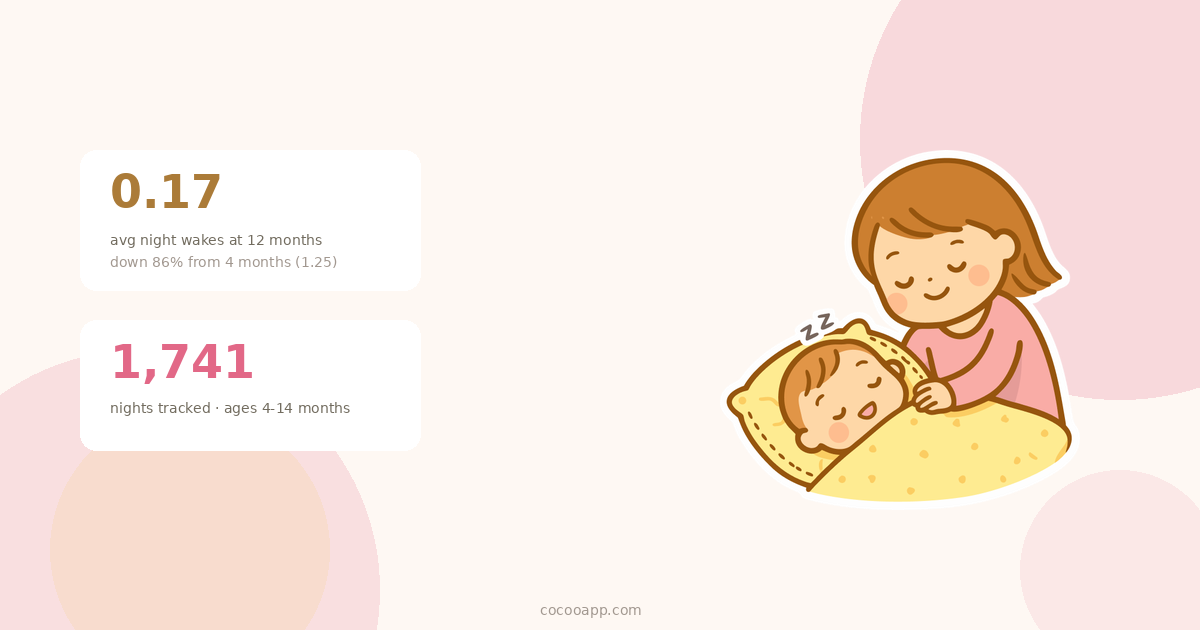
At 12 months specifically, average night wakes hit 0.17 in this dataset: a nearly 86% drop from the 4-month average of 1.25. That doesn't mean every baby sleeps through. But it means the majority can, developmentally, and the ones who aren't usually have an identifiable cause: a sleep prop they still depend on, a schedule that's drifted too late, or a nap count that hasn't transitioned.
What the data shows · 10–12 months
0.17
avg night wakes at 12 months
(n=23 days)
86%
drop in avg night wakes from 4mo (1.25) to 12mo (0.17)
Source: Cocoo aggregate data, complete tracked days. Sample sizes by age: 10mo n=91, 11mo n=26, 12mo n=23. Individual data is never used or shared.
Gentle methods at 10–12 months can be faster than at 7–9 months because developmental readiness is higher. The fading approach works well: over 5–7 nights, reduce your time in the room from full presence → sitting at the door → out of sight. Many parents who tried the chair method at 8 months and found it slow are surprised how quickly it moves at 11 months.
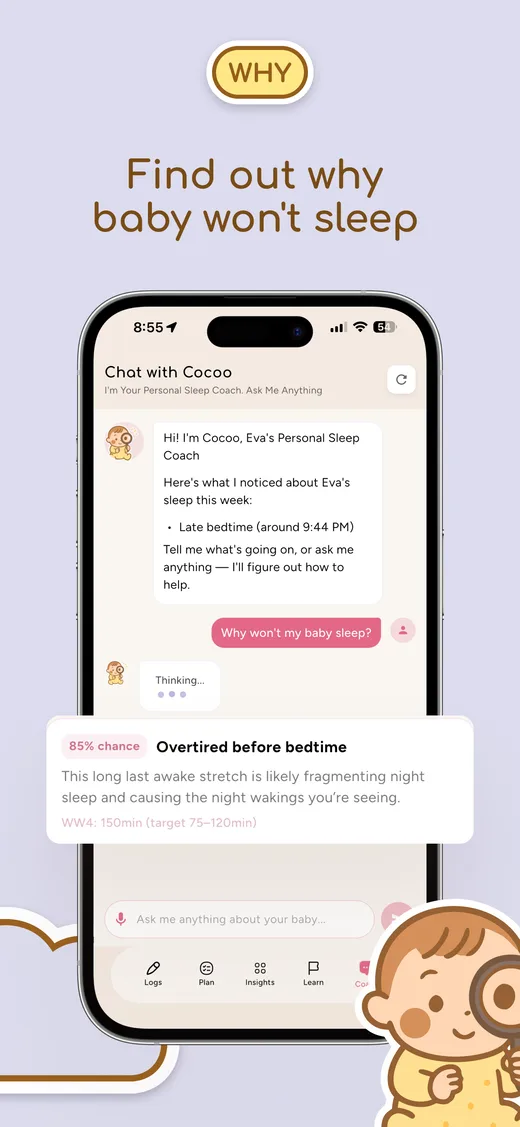
A sleep consultant would look at this age and ask: is there still a prop at play (nursing, rocking, pacifier that falls out), or is this a schedule issue? Cocoo's AI debugger does exactly this, using your logged data across multiple nights to flag whether the remaining night wakes are prop-dependent or schedule-driven, before you pick an approach.
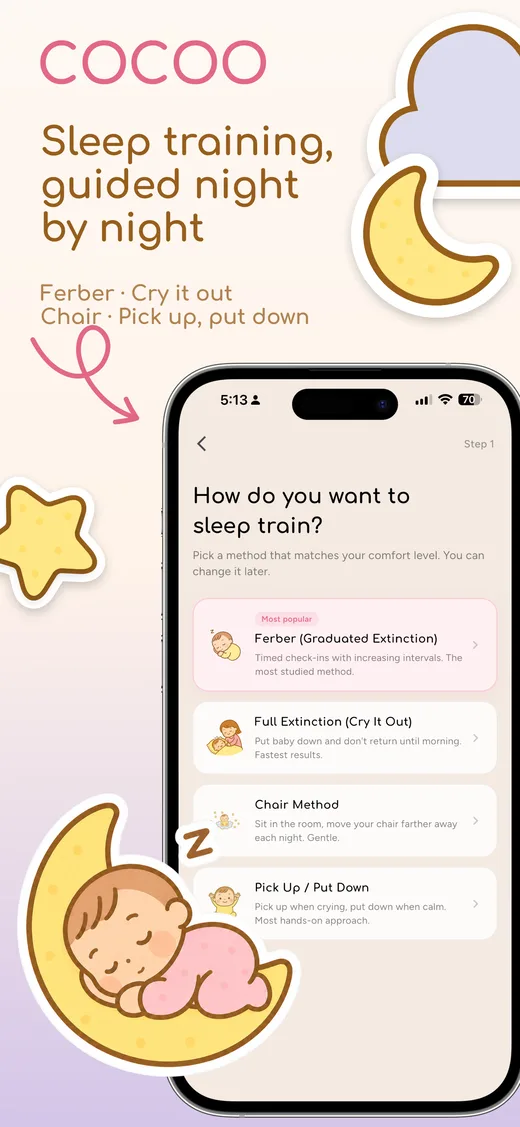
Not sure which gentle method fits your baby's age?Cocoo shows the gentle methods that suit your baby's age and walks you through the one you pick, night by night.
13–18 months: The second wave (don't be surprised when sleep gets bumpy again)
Just when you've got sleep locked in, 13–14 months can bring a new disruption. The data shows onset latency spiking again: 42.1 minutes at 13 months and 38.5 minutes at 14 months, after the relative calm of 10–12 months. Night wakes tick back up at 14 months too, averaging 1.34 per night.
This isn't a failure of gentle sleep training. It's toddler autonomy. At 13–14 months, most babies are pulling to stand, learning to walk, and testing limits in every area including bedtime. The 18-month sleep regression, which we've written about here, follows a similar pattern.
What changes at this age: gentle sleep training looks more like consistent boundaries than gradual fading. This is not a contradiction. "Gentle" doesn't mean unlimited responsiveness: it means calm, consistent, predictable responses that don't involve ignoring distress.
- Consistent routine with a firm goodbye. Mindell et al. (2009) found that a consistent 3-step bedtime routine (bath, book, song or equivalent) reduced night waking in 7–18 month olds by 37% over 3 weeks, without any formal sleep training method. At 13–18 months, the routine itself is often the missing piece, not the response strategy.
- Limit-setting with verbal acknowledgment. Unlike a 5-month-old, a 15-month-old understands simple language. "It's sleep time. I'll see you in the morning" said calmly and consistently across multiple nights is itself a sleep intervention. Keep the response the same whether the protest is 2 minutes or 20.
Which gentle method by age: quick reference
| Age | What's happening | Best gentle method | Avoid |
|---|---|---|---|
| 4–6 mo | Circadian rhythm establishing; 4-mo regression | Fading / pick-up-put-down | Graduated check-ins (too intense for young nervous systems) |
| 7–9 mo | Object permanence; separation anxiety spike | Chair method / graduated check-ins | Pick-up-put-down (can reinforce calling out) |
| 10–12 mo | Developmental readiness peaks; median wake = 0 | Fading presence / chair method (moves faster now) | Starting a new prop (nursing, rocking) if you removed one |
| 13–18 mo | Toddler autonomy; 18-mo regression; second onset spike | Consistent routine + limit-setting | Resuming extended soothing that was already faded |
One thing the gentle sleep training community gets wrong
The framing of "gentle vs cry-it-out" creates a false binary. The research doesn't support it. Gradisar et al. (2016) compared faded bedtime and graduated extinction head-to-head and found both produced similar sleep improvements by 12 months, with no difference in infant stress hormones, attachment security, or behavioral outcomes. The methods differ in how much crying happens on the front end, not in long-term outcomes.
The real predictor of whether gentle sleep training works is not the method: it's consistency. Hiscock et al. (2007) found that parent follow-through on bedtime routines was a stronger predictor of sleep improvement than which specific behavioral strategy they used. A "gentle" method you give up on night 3 produces worse outcomes than a slightly more intensive method you stick to.
The practical takeaway: pick the method you can actually do at 11pm when you're exhausted and your baby has been crying for 20 minutes. That consistency is more important than finding the "best" approach on paper.
Not sure which cause is behind your baby's night wakes?
Track for 5 days and Cocoo's AI sleep debugger tells you whether the waking pattern is habit, hunger, or schedule-driven, and which gentle method fits your baby's specific data.


Frequently asked questions
What is gentle sleep training?
Gentle sleep training teaches babies to fall asleep independently by gradually reducing parental help at bedtime, rather than leaving the baby to cry alone. Methods include fading (slowly stepping back your involvement night by night), pick-up-put-down (responding to cries but encouraging independent settling), and the chair method (staying in the room but reducing contact over time). Most gentle approaches take 2–4 weeks longer than extinction-based methods but involve little or no extended crying.
When should you start gentle sleep training?
Most pediatric sleep researchers recommend starting no earlier than 4 months corrected age, when babies develop enough circadian rhythm to have predictable sleep windows (Mindell et al., 2006). The 4–6 month window is widely considered the most responsive period for gentle methods.
Does gentle sleep training work without any crying?
Some protest is likely with any method, including gentle ones. The goal isn't zero crying: it's brief, managed protest rather than extended distress without response. Gradisar et al. (2016) found that faded bedtime produced similar sleep improvements to graduated extinction with significantly less crying. "No crying at all" is not a realistic standard for most babies.
Why does gentle sleep training stop working around 8 months?
Object permanence and separation anxiety develop around 7–9 months. Pick-up-put-down can inadvertently reinforce calling out at this age. Tracking data shows onset latency spiking from 12 minutes at 5 months to nearly 29 minutes at 7 months. Graduated check-ins with predictable spacing work better at this age than purely responsive methods.
Is the 5-3-3 rule for sleep training gentle?
The 5-3-3 rule is a variation of graduated extinction, gentler than full extinction because you check in, but involves more crying than pure fading or the chair method. For parents who want minimal crying, fading or chair method is a gentler starting point.
More from the Cocoo blog
Sources
- Mindell JA, Kuhn B, Lewin DS, Meltzer LJ, Sadeh A. Behavioral treatment of bedtime problems and night wakings in infants and young children. Sleep. 2006;29(10):1263–1276.
- Gradisar M, Jackson K, Spurrier NJ, et al. Behavioral interventions for infant sleep problems: A randomized controlled trial. Pediatrics. 2016;137(6):e20151486.
- Hall WA, Hutton E, Brant RF, et al. A randomized controlled trial of an intervention for infant behavioral sleep. BMC Pediatrics. 2015;15:181.
- Mindell JA, Telofski LS, Wiegand B, Kurtz ES. A nightly bedtime routine: impact on sleep in young children and maternal sleep and mood. Sleep. 2009;32(5):599–606.
- Hiscock H, Bayer J, Gold L, Hampton A, Ukoumunne OC, Wake M. Improving infant sleep and maternal mental health: a cluster randomised trial. Arch Dis Child. 2007;92(11):952–958.