
The typical recommendation is 4 to 6 months. That's when the brain has developed enough to sustain longer sleep stretches and learn independent sleep. But age is a floor, not a timer — and starting on the right day matters less than starting when your specific baby is actually ready.
Most sleep training guides give you an age and a method. What they don't give you is a way to read your own baby. This post covers the 5 signals that tell you readiness has arrived — and 2 that tell you to wait another week.
Why 4–6 months is the developmental window
Before 4 months, babies sleep in short, shallow cycles with no clear circadian rhythm. They wake on biological cues alone — hunger, discomfort, light — and the brain simply doesn't yet have the architecture for sustained consolidated sleep. Sleep training before this point isn't just ineffective; it's working against developmental biology.
Around 4 months, two things change. First, the circadian system matures enough that nighttime darkness becomes a genuine biological signal for sleep. Second, sleep cycle architecture reorganizes into a more adult-like pattern — alternating between lighter and deeper stages — creating, for the first time, the capacity to link cycles independently.
Henderson et al. (2010) tracked 75 infants through their first year and found that sleep consolidation — the ability to string cycles together — emerged most rapidly between 5 and 9 months. Gradisar et al. (2016) found behavioral sleep interventions starting at 6 months produced durable improvements in sleep without measurable harm to the infant-parent attachment relationship.
The reason 6 months often works even better than 4 is that the 4-month regression — which is caused by the same developmental shift — has typically settled by then. Some families find the window between 5 and 7 months the smoothest entry point.
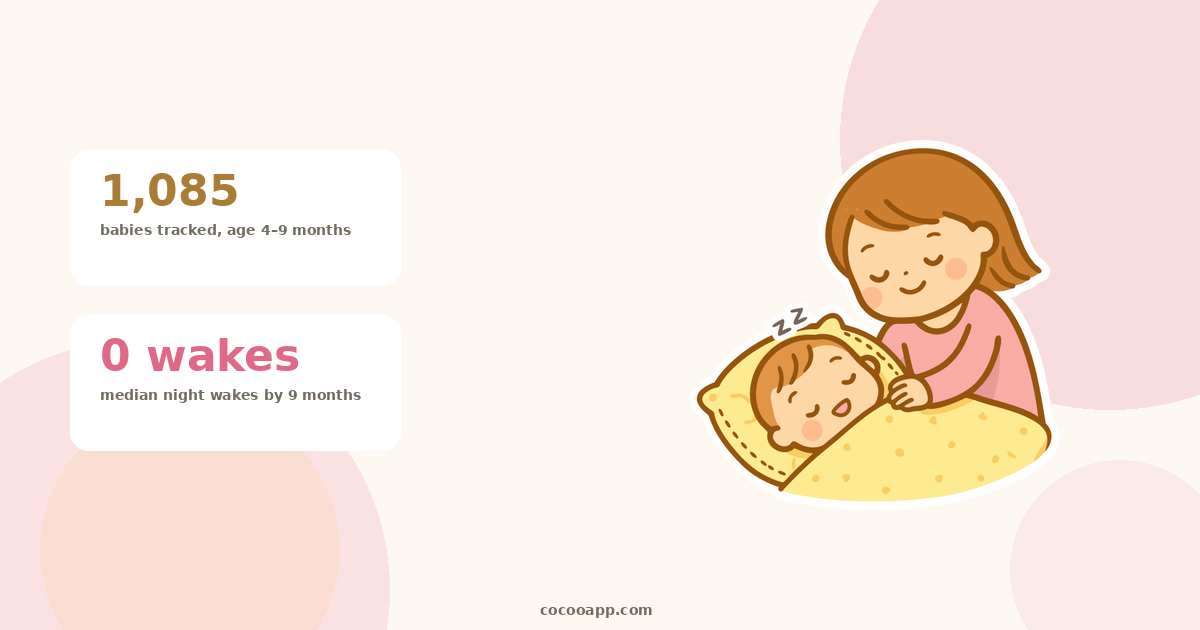
What 1,085 tracked babies show about this window
Cocoo analyzed complete tracked days from babies aged 3–9 months to understand how night wake patterns change across the developmental window. The picture is clearer than any single study:
1.1
avg night wakes at 4 months
0
median night wakes by 9 months
| Age | Avg night wakes | Median night wakes | Avg night sleep |
|---|---|---|---|
| 3 months | 1.1 | 1.0 | 11.3 hrs |
| 4 months← training window | 1.1 | 1.0 | 10.7 hrs |
| 5 months← training window | 1.0 | 1.0 | 10.7 hrs |
| 6 months← training window | 1.2 | 1.0 | 10.1 hrs |
| 7 months | 1.0 | 1.0 | 10.4 hrs |
| 8 months | 1.0 | 0.0 | 10.5 hrs |
| 9 months | 0.9 | 0.0 | 10.6 hrs |
| 10 months | 0.5 | 0.0 | 11.4 hrs |
Methodology: complete tracked days (is_complete_day = true), ages 3–10 months. Sample sizes: 3mo n=203, 4mo n=231, 5mo n=297, 6mo n=234, 7mo n=142, 8mo n=118, 9mo n=93, 10mo n=96. Source: Cocoo aggregate data, anonymized. Individual data is never used or shared.
The most striking shift is in the median, not the average. At 4–6 months, the median baby wakes once per night. By 9 months, the median drops to zero — meaning half of tracked 9-month-olds are sleeping through with no night wakings at all.
This is the developmental trajectory sleep training is designed to accelerate. Babies trained at 4–6 months are working with the arc of development, not against it.
The 5 readiness signals to look for
Check these before you pick a method. A baby who clears all five will respond to sleep training in days. One who's missing two or three will resist for two weeks — and you'll both be miserable.
Wake windows are becoming predictable
A readiness signal isn't "my baby is tired at 8pm." It's "my baby gets tired roughly 2 hours after waking, consistently, for several days in a row." When wake windows stabilize — even roughly — the internal clock is maturing. Random tiredness that changes daily is a sign the circadian rhythm isn't there yet.
At least one night feed has disappeared or consolidated
If your baby was waking at 1am, 3am, and 5am, and has recently dropped to 1am and 4am without you doing anything — that's the biology doing the work. It means they can sustain a stretch. You're not forcing anything; you're extending what's already happening. Babies still waking every 60–90 minutes all night are often not ready, or there's a feeding need that needs addressing first.
Stable weight gain on their growth curve
Sleep training at 4 months is appropriate for most full-term babies who are gaining weight normally. But if your baby has had any weight concerns, dropped a curve, or your pediatrician has asked you to feed more frequently, get clearance first. Hunger is a legitimate reason to wake at night — and sleep training doesn't solve a feeding problem, it buries it.
No major transition in the last 2 weeks
Returning to work, a house move, starting daycare, a new caregiver — these don't make sleep training impossible, but they make it harder. Your baby's nervous system handles one new thing well. Two at once is harder. If a transition is coming in a week, wait until after, or start now and expect a slower response.
You can handle 2–5 nights of harder sleep
This is the one nobody says out loud: sleep training is temporarily harder before it gets permanently better. Even gentle methods have a phase where your baby protests. That phase typically lasts 2–5 nights. If you're already running on nothing, or a work deadline is in 3 days, give yourself a clear window. Starting and abandoning after night two teaches your baby that protesting works.
Tracking helps here — not because you need an app, but because readiness signals are patterns, not single events. One predictable day doesn't mean ready; five predictable days in a row does. Cocoo's pattern detection flags when your baby's wake windows have stabilized and their night feeds are consolidating — making it easier to see readiness building rather than having to watch for it yourself.
2 signs it's worth waiting another week
These don't mean your baby can't be sleep trained — they mean your success rate goes up if you give it a week.
Wait if...
Active illness or teething spike
A baby in pain needs responsive care — that's not a sleep association problem. Training through active teething or illness usually fails, teaches nothing, and leaves everyone worse off. Give it 3–5 days after symptoms resolve.
Wait if...
Active sleep regression
The 4-month regression is the exception — it's caused by the same developmental shift that enables sleep training, so many families train right through it. For later regressions (6, 9, 12 months), wait 7–10 days for the acute disruption to settle before starting.
Contrary to popular advice, starting “when they're exhausted enough” is overrated. An extremely sleep-deprived baby doesn't learn faster — they just cry harder. The best starting point is after a relatively normal day, not after a terrible one.
Quick readiness check — 5 questions
If you can answer yes to 4 out of 5, your baby is likely ready. Three or fewer — give it another week and recheck.
Is your baby at least 4 months old (corrected age for preemies)?
Developmental floor
Has your baby dropped at least one night waking in the last 2 weeks?
Feeding consolidation
Are wake windows somewhat predictable (even roughly) on most days?
Circadian maturity
Is your baby healthy and not currently teething acutely?
No pain interference
Do you have 5 evenings where you can be consistent and not travel?
Parent readiness
If you scored 5/5: pick your method and start this week. 3–4/5: give it 7 days, recheck. Under 3: there's likely a readiness gap — check which signals are missing and address those first. Starting before readiness typically leads to a longer, harder process with more crying, not less.
Once you know your baby is ready: choosing the right method
Readiness tells you WHEN. Your baby's specific situation tells you WHICH method. A quick guide:
| Your situation | Method to consider |
|---|---|
| Strong sleep associations (nursing, rocking) | Graduated extinction (Ferber) or chair fading |
| You want minimal crying | Pick-up put-down or fading |
| Baby is older (7+ months), associations are deeply set | Graduated extinction tends to be faster — fewer total nights |
| Two parents with different approaches | Chair method — both can be present, easier to stay consistent |
| You've tried before and it didn't work | Identify why it failed before picking — often a readiness issue, not a method issue |
Gradisar et al. (2016) found that all behavioral sleep training methods produced similar outcomes. The “best” method is the one you can actually stay consistent with — inconsistency teaches a baby that protesting eventually works.
For a deeper look at each method, see our guide to sleep training methods compared.
Track first, train second
Most parents start sleep training by picking a date on the calendar. The smarter move is to track for 5–7 days first. After a week of data, you'll see whether wake windows are stabilizing, how many night feeds remain, and whether the 5 readiness signals are actually there.
Cocoo flags the pattern shift automatically — when your baby's data shows stable wake windows and consolidating night sleep, you'll see it in the schedule view. Instead of wondering if it's time, you'll know.
Track free — see your baby's readiness signalsiOS and Android
Frequently asked questions
When should you start sleep training?
The developmental window opens around 4 months and stays open. Most research suggests 4–6 months for the easiest experience, but sleep training works at any age from 4 months onward. Age is a floor, not a deadline — look for the 5 readiness signals rather than starting on a specific birthday.
Is 3 months too early to sleep train?
Yes, for most babies. Before 4 months, the circadian system isn't mature enough to sustain consolidated sleep, and babies still have genuine nutritional need for night feeds. The 4-month mark is when sleep cycle architecture shifts to an adult-like pattern — creating the actual capacity for independent sleep.
Is 6 months too late to start sleep training?
No. Sleep training works at any age from 4 months onward. Some families find 5–7 months easier because the 4-month regression has passed. Babies trained at 8 or 10 months respond a bit more slowly (3–5 nights vs. 1–3 nights), but the outcome is the same.
Do I have to use cry-it-out?
No. Cry-it-out is one method, not the definition of sleep training. Graduated extinction (Ferber), chair fading, and pick-up-put-down all teach independent sleep with varying amounts of parental presence. Gradisar et al. (2016) found the methods produce similar outcomes — the best one is whichever you can stay consistent with.
Should I sleep train during a sleep regression?
The 4-month regression is caused by the same developmental shift that enables sleep training, so you can train through it. For later regressions (6, 9, 12 months), wait 7–10 days for things to settle before starting. Training during active teething or illness is harder — wait until symptoms resolve.
Want to understand the research behind Cocoo's sleep training guidance? See how Cocoo uses sleep science to build personalized schedules.
More from the Cocoo blog
Sources
- 1.Gradisar, M., Jackson, K., Spurrier, N. J., Gibson, J., Whitham, J., Williams, A. S., ... & Kennaway, D. J. (2016). Behavioral interventions for infant sleep problems: a randomized controlled trial. Pediatrics, 137(6), e20151486.
- 2.Henderson, J. M. T., France, K. G., Owens, J. L., & Blampied, N. M. (2010). Sleeping through the night: The consolidation of self-regulated sleep across the first year of life. Pediatrics, 126(5), e1081–e1087.
- 3.Mindell, J. A., Kuhn, B., Lewin, D. S., Meltzer, L. J., & Sadeh, A. (2006). Behavioral treatment of bedtime problems and night wakings in infants and young children. Sleep, 29(10), 1263–1276.
- 4.Galland, B. C., Taylor, B. J., Elder, D. E., & Herbison, P. (2012). Normal sleep patterns in infants and children: A systematic review of observational studies. Sleep Medicine Reviews, 16(3), 213–222.
- 5.Paruthi, S., et al. (2016). Recommended amount of sleep for pediatric populations: a consensus statement of the American Academy of Sleep Medicine. Journal of Clinical Sleep Medicine, 12(6), 785–786.
- 6.American Academy of Pediatrics. (2022). Safe sleep recommendations. Pediatrics, 150(1), e2022057990.
- 7.Jenni, O. G., & Carskadon, M. A. (2007). Sleep behavior and sleep regulation from infancy through adolescence: normative aspects. Sleep Medicine Clinics, 2(3), 321–329.
- 8.Cocoo internal aggregate data. (2026). Night wake count and sleep metrics by age, 3–10 months, 1,085 complete tracked days. Anonymized and aggregated. cocooapp.com.