Sleep training gets worse on night 3 or 4 because your baby is pushing back: after one or two better nights, they test whether crying harder still brings back the old rocking or feeding. This push-back usually lasts one night, and it often comes right before the crying drops off. Behavioral researchers call it an extinction burst.
It looks exactly like failure. That's why night 4 is when it's most tempting to quit or switch methods, and quitting then teaches the one lesson you don't want: cry longer and the rules change. Below is how to tell the push-back from the two things that should change your plan (illness and overtiredness), and what to do tonight in each case.
What this guide covers
- 1What the first week of sleep training normally looks like
- 2The push-back: why night 3–4 gets worse and why it's a good sign
- 3Four things that look like a regression (and which ones should change the plan)
- 4How to judge the trend instead of one night
- 5A real setback after illness or travel: how to restart
- 6What to check before switching methods if it still isn't working
What does a normal first week of sleep training look like?
In a normal first week of sleep training, night 1 has the most crying of the whole plan, and 20 to 45 minutes is common. Night 2 is a little better or about the same, often with faster settling but an extra waking. Night 3 or 4 is the push-back. Nights 5 to 7 are where most babies settle within about 15 minutes with little crying, with night wakings shortening first and then stopping.
The line has a bump in it. Parents who expect a straight line read night 4 as proof the method failed. Parents who expect the bump read it as the method working.
Why does sleep training get worse on night 3 or 4?
Sleep training often gets worse on night 3 or 4 because your baby is checking whether crying still works. For months, crying reliably produced a parent who rocked or fed. For two nights, it produced a brief, boring check-in instead. A baby doesn't conclude "the rules changed" after two data points. They run the experiment harder: cry longer, cry louder, add a new waking at 1am. If the response is still the same short check-in, the experiment ends and the behavior drops off, often sharply.
Behavior analysts call this an extinction burst: a short rise in a behavior right after it stops getting the old result. It's been studied for decades, and it doesn't show up in every case (Lerman & Iwata, 1995). If it does show up, it isn't a sign of harm. A five-year follow-up of babies whose parents used behavioral sleep techniques found no lasting effects on emotional health, stress or the parent–child relationship (Price et al., 2012).
What to do on the push-back night
- Exactly what you did last night. Same routine, same waits, same 30–60 second check-ins.
- Same response at every waking, including the new one at an odd hour.
- Don't change the waits or switch methods tonight. Decide nothing at 2am.
- Write down what happened (or let your timer log it) so tomorrow you're judging a trend instead of how 2am felt.
What else looks like a sleep training regression?
Four things look like a sleep training regression: the push-back, illness, overtiredness and a developmental leap. Illness and overtiredness should change what you do tonight. None of the four should make you switch methods.
The push-back (extinction burst)
What it looks like
Night 3 or 4, after a better night. Longer crying, louder protest at the first check, maybe a new waking at an odd hour. Baby is otherwise well.
Do this
Nothing new. Same routine, same waits, same response at every waking. It usually breaks the next night.
Illness
What it looks like
Fever, ear pulling, a new cough, vomiting, or a medicine entry in your log. Crying sounds different: more distressed, less protesting.
Do this
Pause the plan. Comfort as needed, keep the routine, restart after a full well day at the same night number.
Overtiredness
What it looks like
A skipped or short nap earlier, then a wired, frantic bedtime. Falls asleep eventually but wakes 30–45 minutes later, or very early.
Do this
Fix the daytime schedule. Move bedtime earlier to match the sleep pressure, and keep the night response the same.
A developmental leap
What it looks like
Rolling, sitting, standing in the crib, a burst of babbling. Practising the new skill at 2am.
Do this
Give plenty of floor time for the skill during the day. Same response at night. Usually two or three bumpy nights.
How do you tell a bad night from sleep training not working?
To tell one bad night from sleep training that isn't working, compare the last three nights with the three before them. The lines usually improve in a set order. Crying per night falls first, usually within the first three nights. Time to fall asleep follows. Night wakings are last; they get shorter before they get fewer. Bedtime itself should barely move.
So on the morning after a bad night, skip "was last night worse?" and ask whether the last three nights, taken together, were worse than the three before. One bad night inside a falling line is noise. Three worsening nights in a row is a signal.
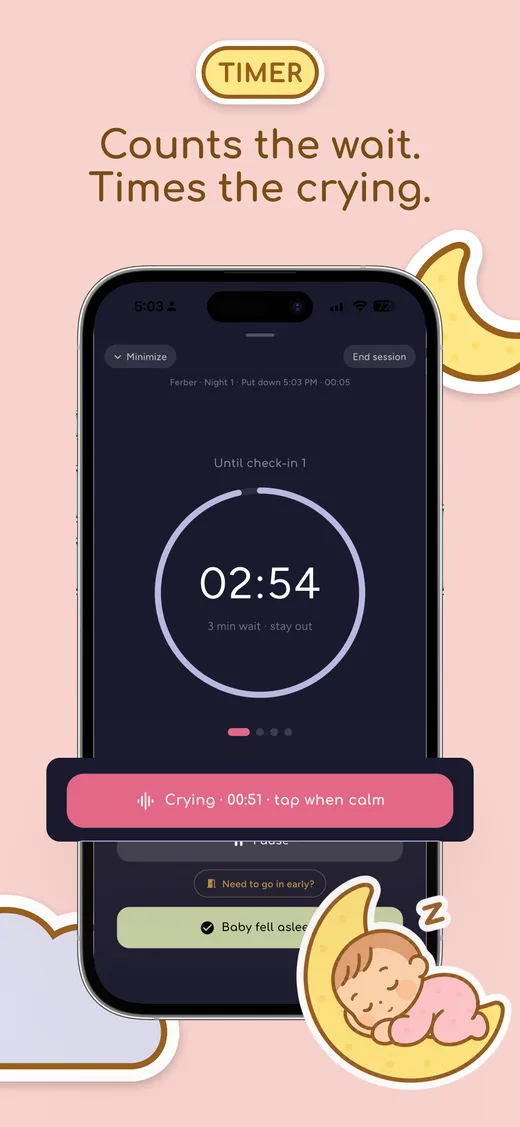
Cocoo logs each session through its check-in timer and plots crying and time-to-sleep night by night, with the plan nights marked, so on night 4 you see the whole line. On the final planned night it reads the trend for you: done, extend a few nights because the line is still moving, rethink because nothing moved, or too few logged nights to judge.
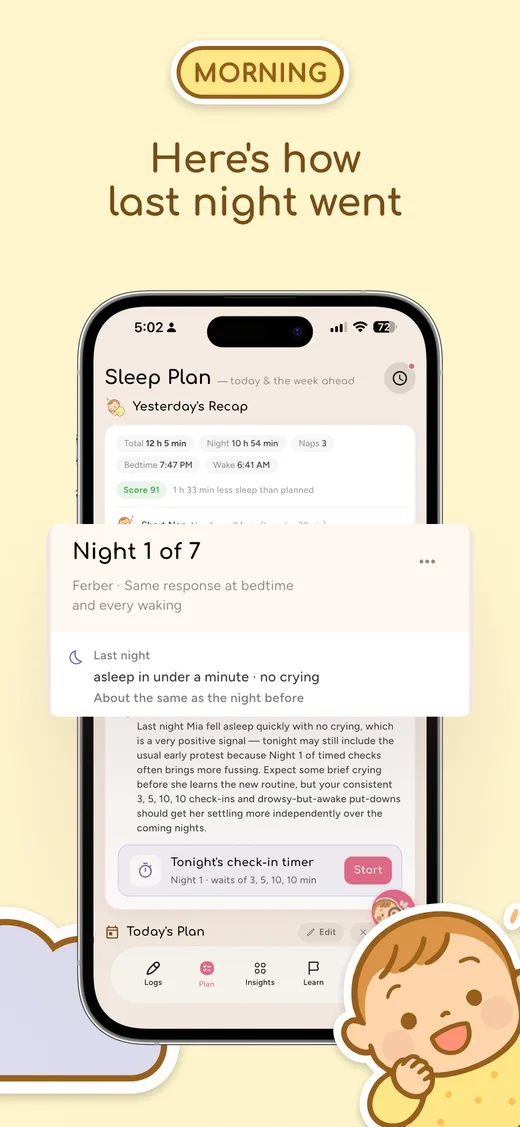
Was last night worse, or just louder?Cocoo times each check-in and gives you a morning recap of last night next to the nights before, so you judge the three-night trend.
How do you restart sleep training after illness or travel?
Restart sleep training after illness at the same night number, once your baby has had a full well day. A sick baby can't learn and shouldn't have to, so pause and comfort however they need. Keep the bedtime routine going as the one steady signal. Travel and visitors aren't automatic pauses, but if you know you can't hold the response in a shared hotel room, a clear pause and a clear restart is easier for your baby than a week of mixed signals.
Don't go back to night 1. Paused nights don't erase what your baby learned. Expect one noisier night, then the trend usually resumes.
In Cocoo, logging illness or medicine prompts a pause, the night counter freezes, and the plan resumes at the same night when you tap resume. Nothing to recalculate.
What if sleep training still isn't working by night 7?
If sleep training still brings long crying every night on nights 5 to 7 and the lines aren't moving, the method is rarely the problem. Check these four things first. They sink more plans than the choice of Ferber or chair does.
- Bedtime timing. Is the awake time before bed right for your baby's age? Overtired and undertired both look like protest. Check this one first.
- Naps. Are they capped so bedtime arrives with real sleep pressure? A 90-minute nap that ended at 5pm will beat any method.
- The routine. Same steps, same order, same length, every night?
- The response at wakings. Is 2am getting the same treatment as 7pm? One 'just this once' feed resets night wakings.
Fix those, extend a few nights, and judge again. If you do switch methods, decide in the morning, for a reason you can name, and give the new one a full week. Switching at 2am costs you the week.
Related questions
Should I stop sleep training if my baby gets sick?
Pause sleep training while your baby is sick instead of abandoning it. Comfort your baby however they need, keep the bedtime routine, and restart after a full well day at the same night of the plan. Paused nights don't erase what your baby already learned. Expect one noisier night when you resume.
Should I switch methods if night 4 is bad?
No. Switching sleep training methods on the worst night teaches your baby that crying longer changes the rules, the opposite of what you're teaching. Hold the same response through night 5. If nights 5 to 7 still show long crying, check bedtime timing and naps before you change anything about the method.
How long does a sleep training regression last?
A sleep training regression caused by an extinction burst usually lasts one night, occasionally two. A setback after illness, travel or a developmental leap usually settles within two or three nights of the same consistent response. If it runs longer than that, recheck wake windows and nap timing.
Keep reading
Sources
Mindell, J. A., Kuhn, B., Lewin, D. S., Meltzer, L. J., & Sadeh, A. (2006). Behavioral treatment of bedtime problems and night wakings in infants and young children. Sleep, 29(10), 1263–1276.
Gradisar, M., et al. (2016). Behavioral interventions for infant sleep problems: A randomized controlled trial. Pediatrics, 137(6), e20151486. publications.aap.org
Lerman, D. C., & Iwata, B. A. (1995). Prevalence of the extinction burst and its attenuation during treatment. Journal of Applied Behavior Analysis, 28(1), 93–94.
Ferber, R. (2006). Solve Your Child's Sleep Problems (revised ed.). Fireside.
Price, A. M. H., Wake, M., Ukoumunne, O. C., & Hiscock, H. (2012). Five-year follow-up of harms and benefits of behavioral infant sleep intervention. Pediatrics, 130(4), 643–651.
Stuck on night 4 right now?
Cocoo runs tonight's check-ins, logs the crying, and shows you tomorrow morning whether the three-night line is still falling. It pauses for illness and tells you on the last night whether to stop, extend, or rethink.