
A baby's wake window is how long they can comfortably stay awake between sleeps. Too short and they won't have enough sleep pressure to fall asleep easily. Too long and they become overtired — which makes falling asleep even harder.
Getting the wake window right is often the single biggest lever for better naps and nights. And it changes every few weeks as your baby grows.
Here's the complete breakdown — by age, with the signs to watch for.
What is a wake window, exactly?
It's the window of time between when your baby wakes up and when you start the next sleep. Sleep science calls this sleep pressure — the build-up of adenosine in the brain that makes sleep feel irresistible.
Borbély's Two-Process Model (1982) describes this as Process S — sleep pressure builds during wake time and dissipates during sleep. For babies, this window is very short at birth and gradually lengthens as their nervous system matures.
Wake windows by age
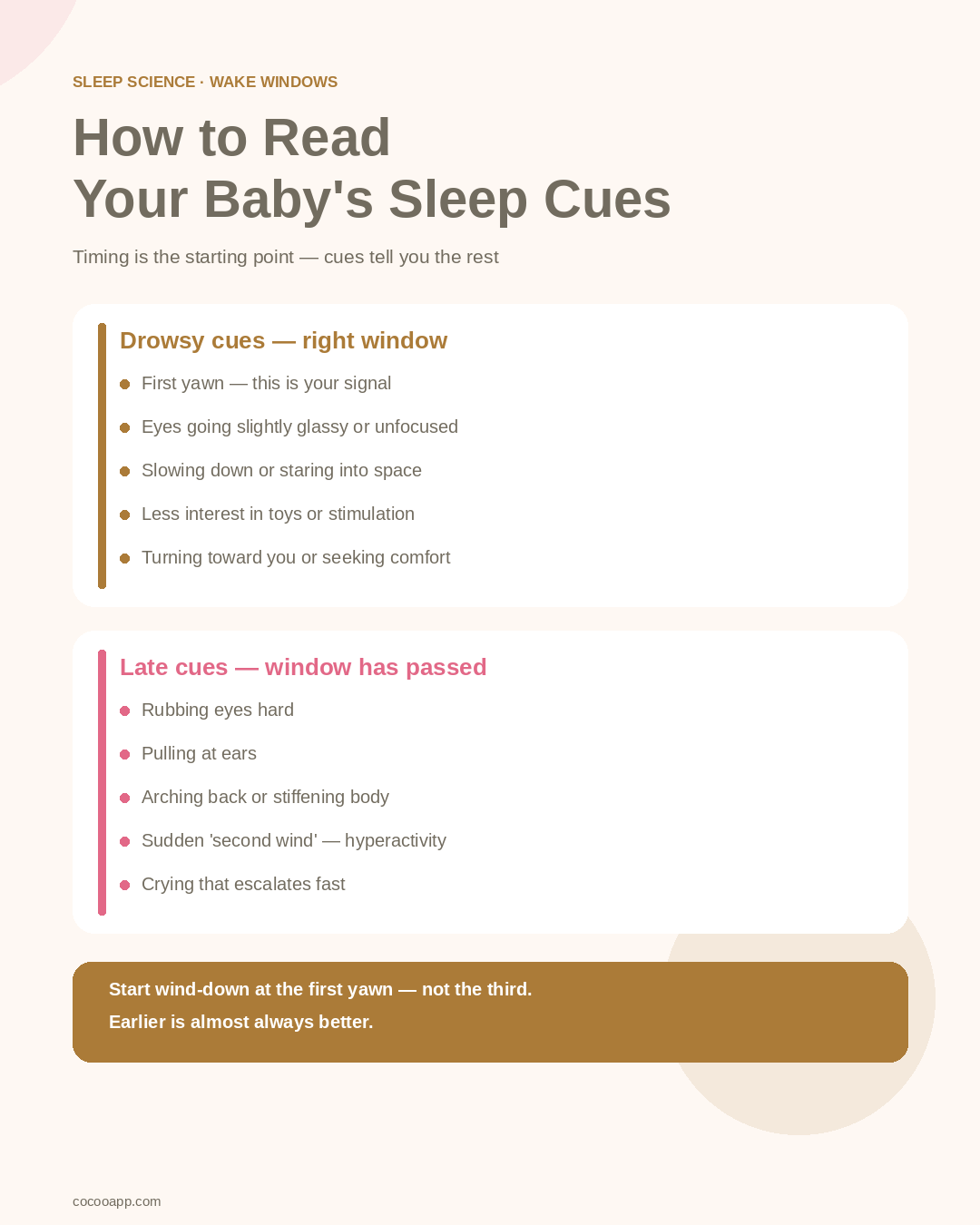
These are typical ranges based on Galland et al. (2012) and Jenni et al. (2005). Your baby may fall slightly outside these ranges — use sleepy cues alongside timing.
Newborn (0–4 weeks): 45–60 minutes
Newborns have almost no circadian rhythm. Their sleep is driven almost entirely by sleep pressure — and they build it very quickly. Most newborns can only handle 45–60 minutes awake before they need to sleep again.
The challenge: by the time you see tired cues, you may already be late. Watch for the first yawn or eye rubbing and start the wind-down immediately.
Tips for newborns
- Start wind-down at 40 minutes awake, not 60 — don't wait for big tired cues.
- Darkness + white noise at ~65dB are your best tools. Swaddle tightly.
- Don't try to 'stretch' a newborn's wake window — it backfires almost every time.
2–4 months: 60–120 minutes
This is where wake windows start to matter more — and where the infamous 4-month sleep regression hits. Around 3–4 months, your baby's sleep architecture shifts to adult-like cycles (Jenni et al., 2005), and their circadian rhythm begins maturing.
Wake windows at this age are still fairly short — 75 to 120 minutes — but there's more variation across the day. The first window of the morning is usually the shortest.
Tips for 2–4 months
- First morning wake window: aim for 75–90 min. Last window before bed: 90–120 min.
- Consistent bedtime routine (10–15 min) starting at the same time each night — Mindell et al. (2009) found routines improve sleep onset significantly.
- If baby fights sleep, check the clock. Overtiredness at this age looks like a 'second wind' — hyperactivity, not tiredness.
4–6 months: 1.5–2.5 hours
Wake windows grow noticeably in this window. By 5 months, most babies are comfortably awake for 2–2.5 hours. This is also when many babies drop from 4 naps to 3.
The last wake window of the day — before bedtime — is the most important. Too short leads to early morning waking. Too long leads to overtiredness and frequent night waking.
Tips for 4–6 months
- Last window before bed: aim for ~2–2.5 hours. This one matters more than any daytime window.
- If naps are short (under 45 min), extend the next wake window by 10–15 min — don't compensate by starting the next nap sooner.
- Try moving bedtime 15 min earlier for 3 nights if baby is consistently overtired at night.
6–12 months: 2.5–4 hours
By 6 months, most babies are on 2–3 naps and wake windows extend to 2.5–3 hours. At 9 months, the majority are solidly on 2 naps with windows of 3–3.5 hours.
Galland et al. (2012) found that by 9 months, most babies sleep a 5-hour consolidated stretch at night (Henderson et al., 2010 define “sleeping through” as 5 hours). Keeping wake windows consistent is key to building that long overnight stretch.
Tips for 6–12 months
- Morning nap: start ~2.5–3 hrs after wake. Afternoon nap: 2.5–3 hrs after morning nap ends.
- If baby is waking at 4–5am, the last window before bed is often too short. Extend it by 15 min.
- White noise running all night helps babies re-settle between sleep cycles without fully waking.
12–24 months: 3.5–6 hours
The 2-to-1 nap transition typically happens between 14–18 months. Before the transition, wake windows are 3.5–4.5 hours. After, they stretch to 5–6 hours.
This transition is often bumpy — some days one nap, some days two. It can take 4–6 weeks before the single nap is consistently solid.
Tips for 12–24 months
- On 1-nap days, shift the single nap to around 12:30–1pm. Too early and they'll still be tired at bedtime.
- Bedtime may temporarily need to be earlier during the 2-to-1 transition to prevent overtiredness.
- Consistent daily schedule (even on weekends) is more important at this age than strict wake windows.
Sleep cues to watch for
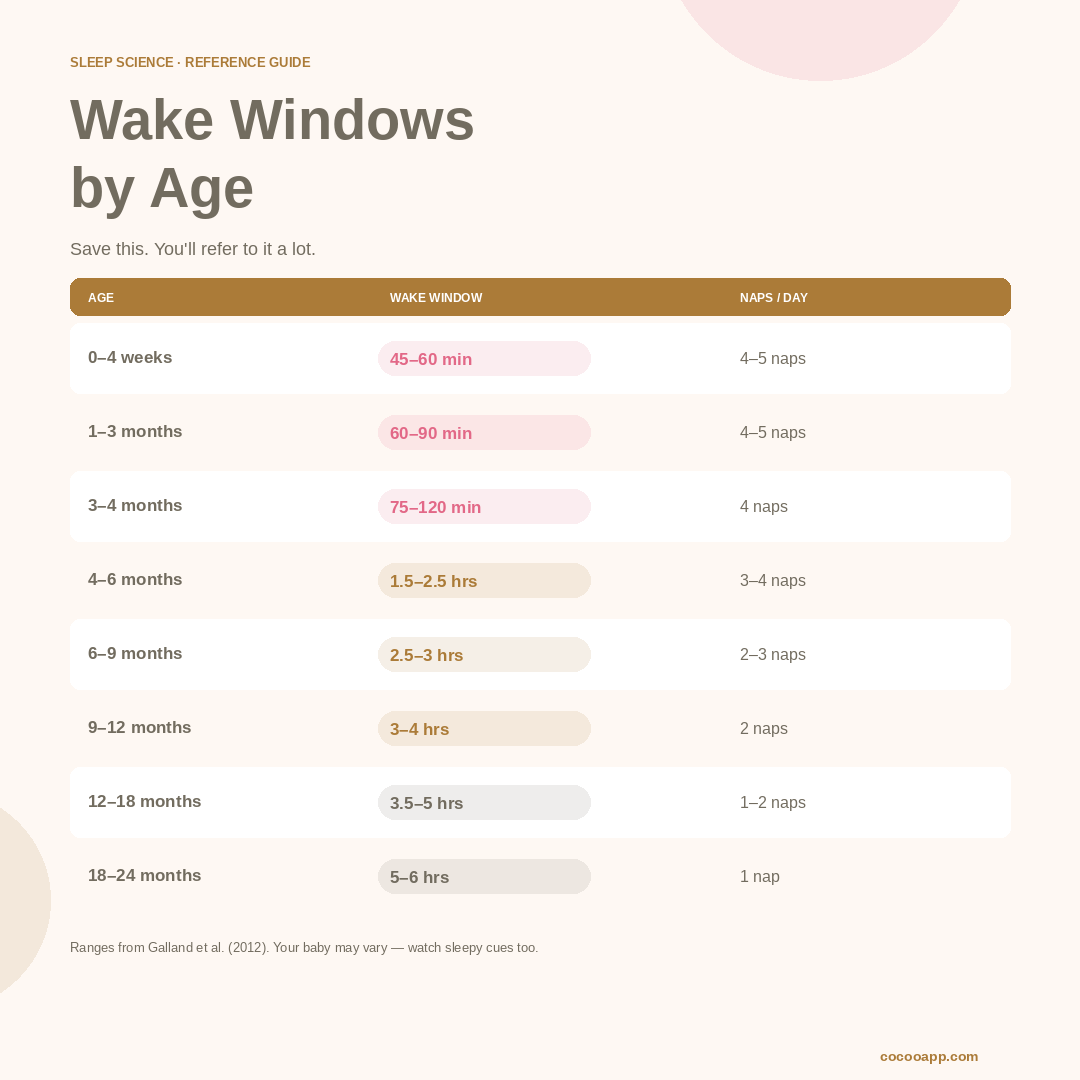
Use timing as a starting point, then watch your baby
Early cues (right window)
- First yawn
- Eyes going slightly glassy
- Slowing down or staring
- Less interest in toys
- Seeking comfort (turning toward you)
Late cues (overtired)
- Rubbing eyes hard
- Pulling ears
- Arching back or stiffening
- Sudden 'second wind' (hyperactivity)
- Crying that escalates fast
Why generic charts only get you partway there
These charts are real ranges based on research. But here's what they can't tell you: your baby's personal optimal window.
A chart might say “3–3.5 hours” for a 9-month-old. But your specific baby might do best at 3h10m for the morning wake window and 3h25m for the afternoon one. That 15-minute difference often determines whether the nap is 40 minutes or 90 minutes.
That's exactly why we built Cocoo. It analyzes your baby's actual logged sleep data and finds their personal optimal wake windows — so you're not guessing from a generic chart. Start tracking free.
Frequently asked questions
What is a wake window for a baby?
A wake window is the amount of time a baby can comfortably stay awake between sleeps before they build enough sleep pressure to fall asleep easily. Too short and they're not tired enough. Too long and they become overtired — which paradoxically makes falling asleep harder due to cortisol release.
What are wake windows for a 3 month old?
At 3 months, most babies have wake windows of 75–120 minutes. The first wake window of the day is usually the shortest (75–90 min) and they get progressively longer throughout the day. Your baby's specific window may be slightly different — watch for sleepy cues rather than watching the clock alone.
What are wake windows for a 6 month old?
At 6 months, wake windows are typically 2.5–3 hours. Most 6-month-olds take 2–3 naps per day. The last wake window before bedtime is usually the longest and most important to get right — too short leads to early morning waking, too long leads to overtiredness and frequent night waking.
How do I know if my baby's wake window is too long?
Signs of an overtired baby: hyperactivity or a 'second wind,' arching the back, rubbing eyes aggressively, crying that escalates quickly, and difficulty settling even when clearly tired. If your baby fights sleep but is showing tired cues, the wake window has likely gone too long.
Do wake windows change as baby grows?
Yes — wake windows increase gradually as babies grow. A newborn can only handle 45–60 minutes awake, while a 12-month-old can stay awake for 3–4 hours between sleeps. Wake windows also shift after sleep regressions and nap transitions. Use these charts as a starting point and adjust based on your baby's cues.
Sources
- •Borbély, A. A. (1982). A two process model of sleep regulation. Human Neurobiology, 1(3), 195–204.
- •Jenni, O. G., & O'Connor, B. B. (2005). Children's sleep: an interplay between culture and biology. Pediatrics, 115(1 Suppl), 204–216.
- •Galland, B. C., Taylor, B. J., Elder, D. E., & Herbison, P. (2012). Normal sleep patterns in infants and children: A systematic review of observational studies. Sleep Medicine Reviews, 16(3), 213–222.
- •Mindell, J. A., Telofski, L. S., Wiegand, B., & Kurtz, E. S. (2009). A nightly bedtime routine: impact on sleep in young children and maternal sleep and mood. Sleep, 32(5), 599–606.
- •Henderson, J. M., France, K. G., Owens, J. L., & Blampied, N. M. (2010). Sleeping through the night: the consolidation of self-regulated sleep across the first year of life. Pediatrics, 126(5), e1081–e1087.
- •American Academy of Pediatrics (2022). Safe sleep guidelines. healthychildren.org.
More from the Cocoo blog
Further reading:
Curious about the science behind wake windows and sleep pressure? Learn about the science behind Cocoo's approach.
Find your baby's personal wake windows
Generic charts give ranges. Cocoo finds your baby's exact window by analyzing their real sleep data — so you nail the timing every time.
Download Cocoo — it's free to startAvailable on iOS and Android