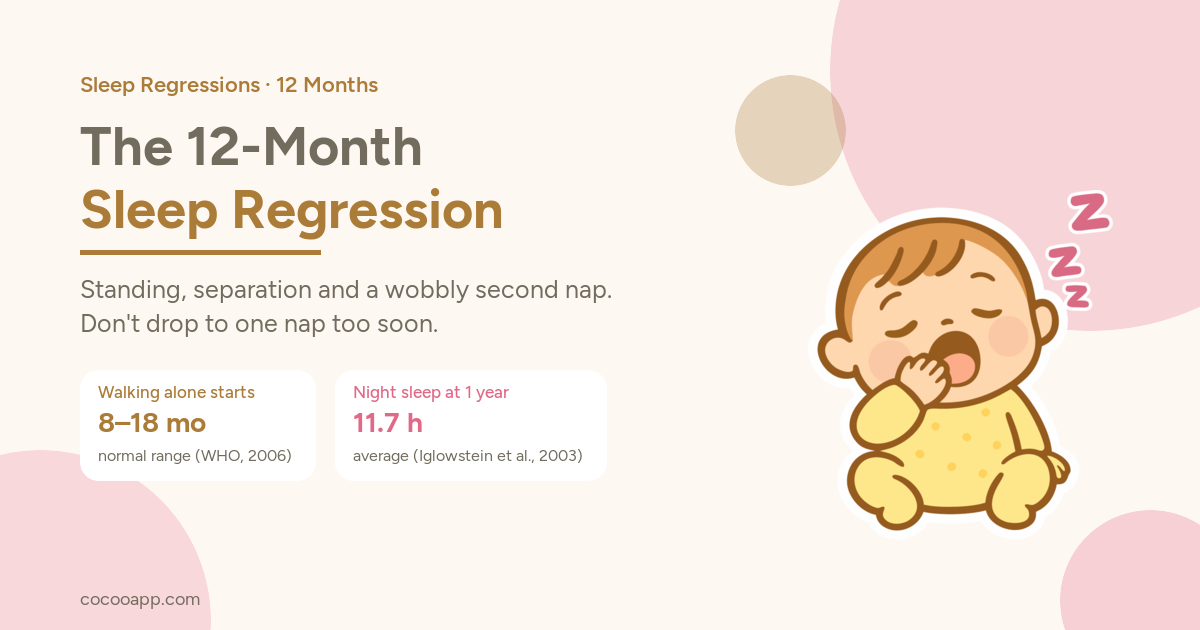
The 12-month sleep regression isn't one thing. It's a few changes that land around the first birthday (standing, walking, separation anxiety and a second nap that starts to wobble), and any one of them can break sleep for a week or more. Most 12-month-olds still need two naps, so the most common mistake is dropping to one nap too soon.
If your baby was sleeping well at 11 months and now fights every nap and calls for you at 2am, nothing is broken. Below is how I'd work out which change you're dealing with, and what I'd do tonight.
If it's 2am right now
- Standing and crying? Lay them down once, say your usual goodnight line, and keep it short.
- Keep the lights low and skip new habits you don't want to keep, like a bottle you'd dropped.
- Don't decide on one nap tonight. Look at the last two weeks tomorrow.
- Fever, ear pulling or a cough? Treat it as sick, not a regression.
Is the 12-month sleep regression real?
The 12-month sleep regression is a parent term, not a research one. No study defines a regression at 12 months. What the research does show is that big motor milestones and sleep are linked. In a study that followed 20 babies from 7 to 12 months with sleep monitors, pulling to stand lined up with a stretch of disrupted sleep, most clearly in babies who learned it early (Atun-Einy & Scher, 2016).
And the timing of those milestones varies a lot. Healthy babies start walking alone anywhere from about 8 to 18 months (WHO Multicentre Growth Reference Study Group, 2006). So “the 12-month regression” can show up at 10 months for one baby and 15 for another.
A note on our own data. We have fewer than a dozen babies with complete logs at 12 months, and fewer after that. That's too few to say anything about this age, so this post leans on published research instead.
What causes sleep to fall apart around 12 months?
- Standing and walking. A baby who just learned to pull up will do it in the crib, often half asleep, and then can't get back down. It usually eases once the skill is old news.
- Separation anxiety. Around the first birthday, many babies notice when you leave and protest it. Bedtime is the biggest goodbye of the day.
- A second nap that's getting harder. Night sleep at 1 year averages about 11.7 hours, and daytime sleep keeps shrinking through toddlerhood (Iglowstein et al., 2003). As daytime sleep need drops, the second nap gets harder to start, well before your baby is ready to lose it.
- A bedtime that hasn't moved. A 1-year-old can often handle 3 to 4 hours awake before bed. If bedtime is still set for a 9-month-old, they lie there wide awake.
What you see, what it likely is, what I'd try
| What you see | Most likely | What I'd try |
|---|---|---|
| Stands up in the crib at bedtime or at 2am and cries | Practicing a new motor skill | Practice sitting down from standing during the day. At night, lay them down once, then keep your response short and boring. |
| Cries the moment you leave, settles fast when you come back | Separation anxiety | Same short goodbye every night. Stay close for a few nights if you need to, then fade out over a week. |
| Plays through the second nap, then melts down by 5pm | Second nap getting harder, not gone | Cap the morning nap at about an hour and push the afternoon nap a little later. Move bedtime earlier on skipped-nap days. |
| Takes 30+ minutes to fall asleep but naps were fine | Bedtime too early for their wake window | Try 3 to 4 hours from the end of the last nap to bedtime and keep it for a week. |
| Fever, ear pulling, cough or loud snoring | Something medical | Call your pediatrician. Don't change the sleep plan until they're well. |
Is my 12-month-old ready for one nap?
Most 12-month-olds aren't ready for one nap yet. The switch usually happens somewhere between 12 and 18 months, and I'd wait until most of these are true for about two weeks:
- ✓The second nap is refused, or takes 30+ minutes to start, on most days for about two weeks
- ✓On days with both naps, bedtime keeps sliding later than you want
- ✓Your toddler handles a 4 to 5 hour stretch awake without falling apart
- ✓The morning nap is solid and long, and they wake from it happy
One refused nap isn't a signal. Three bad days during a cold aren't either. And don't let one nap slide into none: in a review of napping studies, fewer than 2.5% of children stopped napping before age 2 (Staton et al., 2020).
How do you keep two naps working a little longer?
You keep two naps working by leaving room for the second one. Cap the morning nap at about an hour, and start the afternoon nap 3 to 3.5 hours after your baby wakes from it. Then aim for 3 to 4 hours between the end of that nap and bedtime. Our wake windows by age chart has the ranges.
On days the second nap doesn't happen, move bedtime earlier, even by 30 to 45 minutes. It feels backwards. But a later bedtime rarely buys a later morning (we looked at this in 2,081 tracked nights), so an overtired toddler just loses sleep at the front of the night.
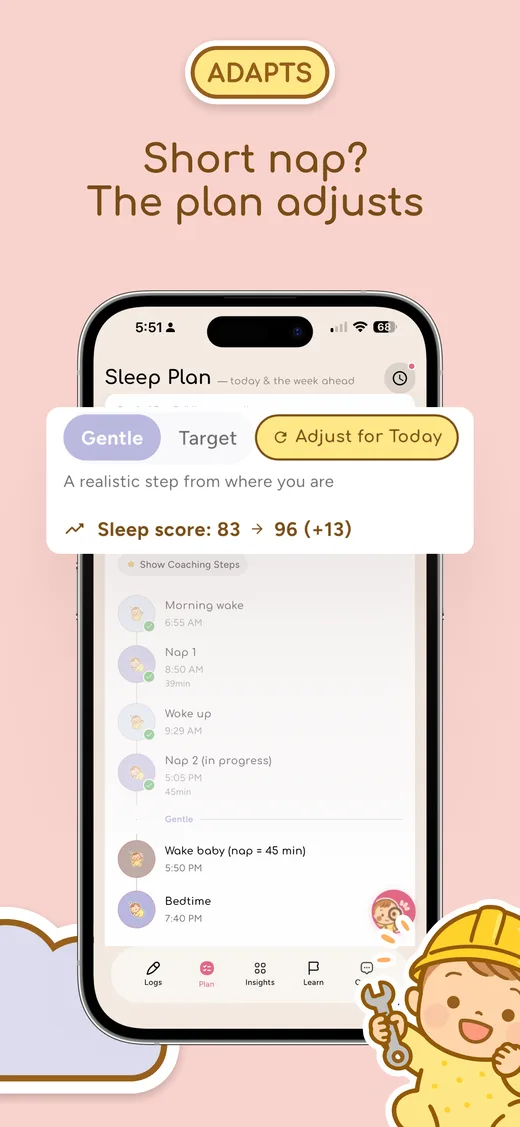
This is where a log helps. After two weeks you can see whether the second nap is fading or just had a bad week. Cocoo times naps and bedtime from your baby's own logs, which takes the guessing out of the wake windows.
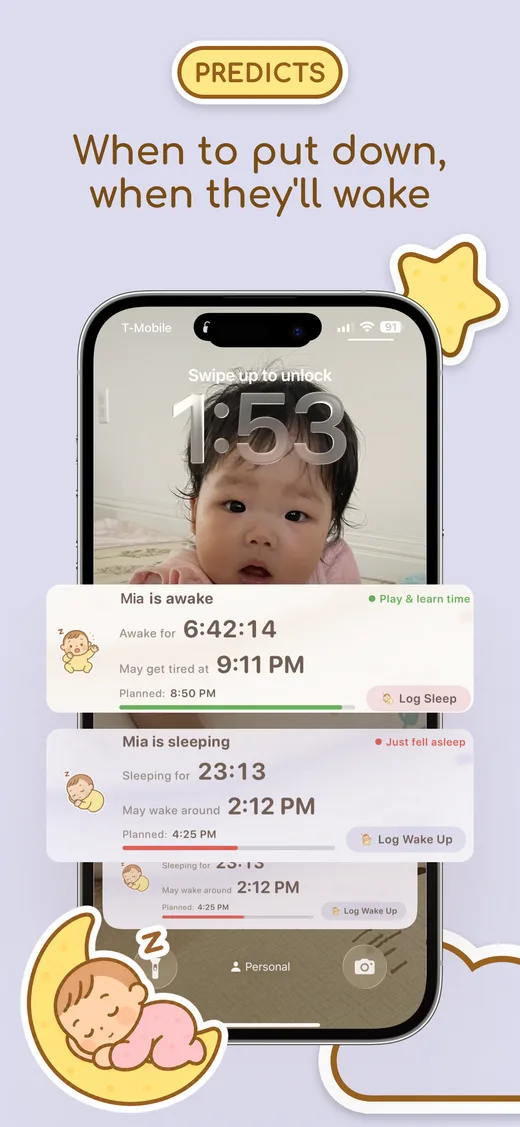
Not sure when the second nap should start?Cocoo predicts when your baby will be tired for the second nap and for bedtime, based on their own logs.
When it isn't a regression
Call your pediatrician if night waking comes with fever, ear pulling, vomiting, a cough that's worse lying down, loud snoring or pauses in breathing. Same if your toddler seems unwell during the day. This post is general information, not medical advice.
Related questions
How long does the 12-month sleep regression last?
Usually a few weeks. Sleep disruption from a new motor skill tends to ease once the skill is practiced and familiar. Nap trouble lasts longer if you drop to one nap at the first refusal, because a 12-month-old on one nap often gets overtired. Keeping two naps (shortened if needed) until the second one is refused most days for about two weeks shortens the rough patch.
Why is my 12-month-old suddenly fighting bedtime?
The most common reasons are a bedtime that's too early for the longer wake windows a 1-year-old can handle (often 3 to 4 hours before bed), separation anxiety, and practicing standing in the crib. If your baby stands up and can't get down, practice sitting back down during the day. Keep the bedtime routine the same so it stays predictable.
Is my 12-month-old waking at night because of teething or illness?
It can be. A fever, pulling at an ear with crying when lying down, a cough, or loud snoring point to something medical, not a regression. Call your pediatrician for those. If your baby is well during the day and the wakes come with standing or calling for you, it's more likely developmental.
Keep reading
Sources
Atun-Einy O, Scher A. Sleep disruption and motor development: Does pulling-to-stand impacts sleep-wake regulation? Infant Behavior and Development. 2016;42:36–44.
Iglowstein I, Jenni OG, Molinari L, Largo RH. Sleep duration from infancy to adolescence: reference values and generational trends. Pediatrics. 2003;111(2):302–307. PubMed
Staton S, Rankin PS, Harding M, et al. Many naps, one nap, none: A systematic review and meta-analysis of napping patterns in children 0–12 years. Sleep Medicine Reviews. 2020;50:101247.
WHO Multicentre Growth Reference Study Group. WHO Motor Development Study: windows of achievement for six gross motor development milestones. Acta Paediatrica Supplement. 2006;450:86–95. PubMed
Not sure if the second nap is going?
Log naps in Cocoo for two weeks and look back: is the second nap fading, or did it just have a bad week?