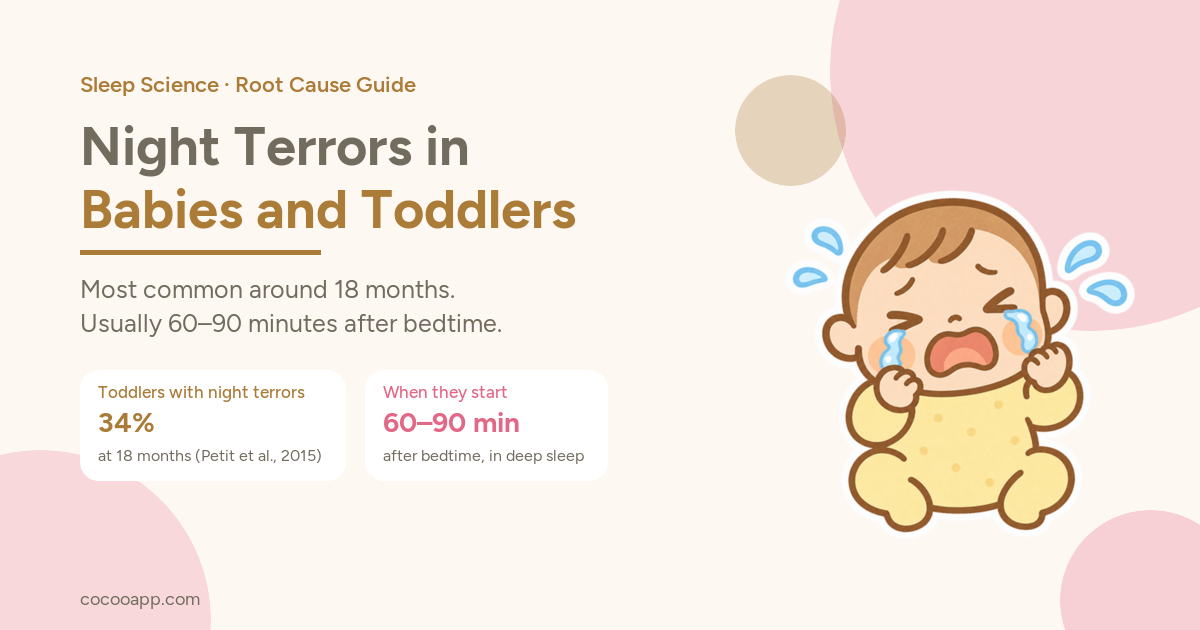
A night terror is a partial waking from deep sleep. Your baby screams, thrashes, or stares blankly, still unconscious, unresponsive, unable to recognize you. It ends on its own in 2–10 minutes. Your baby won't remember it in the morning.
What most parents don't realize: night terrors have specific, findable triggers. The terror itself isn't the problem. It's a symptom. The underlying cause is almost always one of three things, and knowing which one applies to your baby tells you what to change, if anything.
If your baby is having one right now
- Stay nearby — don't hold, restrain, or try to wake them
- Clear anything they could bump into; keep it safe, not soothing
- No bright lights, no loud reassurance
- It'll end on its own. Don't bring it up in the morning.
Night terror vs. nightmare: how to tell them apart
This distinction matters because the right response is different for each.
A nightmare happens during REM (dream) sleep in the second half of the night. Your baby wakes fully, is scared, recognizes you, and wants to be held. It ends when you comfort them.
A night terror happens during slow-wave (deep NREM) sleep, usually 60–90 minutes after bedtime. Your baby seems awake but isn't. Their eyes may be open and they may be screaming your name, but they can't see you. Picking them up often makes it worse. It ends when the arousal cycle completes, not when you intervene.
The clearest test: does your baby recognize you during the episode? If yes, it's not a night terror.
Trigger 1: The nap transition sleep debt
The most common night terror trigger between 12 and 18 months is sleep debt from a nap schedule that's stuck between two naps and one. The baby seems fine during the day, so parents miss it.
Here's what happens. Your toddler is transitioning from two naps to one. Some days they take both fine. Some days they refuse the second one. By bedtime on a one-nap day, they might be running 1–2 hours behind on daytime sleep. That sleep debt deepens the first slow-wave sleep cycle of the night. Deeper slow-wave sleep means a harder, more disorienting arousal at the transition point. That's a night terror.
That timing lines up with when night terrors are most common. Petit et al. (2015) followed 1,940 children in Quebec from 18 months to 13 years. Sleep terrors were most common at the very first check-in, 18 months, when 34% of children had them. By the end of the study, 56% had had them at some point.
What to try: On days when the second nap doesn't happen, offer a short 20–30 minute “safety nap” in the late afternoon. It won't lock in a schedule, but it reduces the sleep debt that deepens slow-wave sleep at night.
Trigger 2: Bedtime is running too late
The second major trigger is simpler: bedtime has drifted late enough that your baby arrives overtired. Overtiredness deepens slow-wave sleep in the first third of the night, the same window where night terrors happen.
This one is counterintuitive. A later bedtime doesn't produce a later morning. It usually produces the same wake time, while cutting night sleep from the front end. We looked at this directly in an analysis of 2,081 tracked nights. A one-hour delay in bedtime moved the morning wake about four minutes later while taking 56 minutes of night sleep. The result is a baby who starts the night already in deficit.
Leung et al. (2020), in a review of the sleep terror research, list sleep deprivation among the most common triggers, along with fever and an irregular sleep schedule.
What to try: Move bedtime 30 minutes earlier for one week. This is worth testing if your baby's night terrors happen consistently around 60–90 minutes after bed; that timing suggests they're right in the first deep-sleep cycle. Keep everything else the same and track whether frequency changes.
Trigger 3: Something disrupted the sleep pattern
The third trigger covers everything that temporarily disrupts a toddler's sleep architecture: illness with fever, travel, starting daycare, a new sibling, or a significant schedule change.
Any of these can produce a cluster of night terrors over a few days even in a baby who's never had them. Fever drives deep slow-wave sleep, which is one reason febrile nights are associated with both night terrors and sleepwalking (Leung et al., 2020). The terror is real; the cause is temporary.
This trigger usually resolves once the disruption passes and sleep cycles normalize. The intervention isn't a schedule fix.
One thing to watch: if you bring your baby into bed, rock them, or do anything unusual during the terror, that routine can outlast the terrors themselves. The behavior associated with the response sticks around long after the trigger is gone.
Why night terrors happen exactly 60–90 minutes after bedtime
Night terrors aren't random. After falling asleep, babies descend into slow-wave (N3) sleep rapidly. At the transition between that first deep cycle and the next lighter stage, there's a brief partial arousal. Most of the time it's silent. When the transition is too abrupt (deepened by sleep deprivation, disrupted by illness, or amplified by a full bladder), it becomes a night terror.
So the same baby can have a terror at 10:30pm on an overtired night and sleep through perfectly on a rested one. Same person, different slow-wave depth. Young children spend more of the night in slow-wave sleep than older kids and adults, which is part of why toddlers get night terrors far more often (Leung et al., 2020).
Find your trigger
If:
Night terrors happen on days with a short or skipped nap
Likely: Nap transition sleep debtOffer a short 20–30 min 'safety nap' on no-nap days; watch bedtime for signs of overtiredness
If:
Night terrors happen when bedtime runs past 7:30–8pm
Likely: Overtired bedtimeShift bedtime 20–30 minutes earlier for one week; track whether frequency changes
If:
Night terrors started suddenly during illness, travel, or a major change
Likely: Sleep pattern disruptionNo schedule changes during the disruption; wait for the pattern to stabilize, usually within 1–2 weeks
If:
Episodes happen multiple times per night, every night, or include leaving the room
Likely: Worth a pediatrician checkIn rare cases, frequent night terrors in young children indicate an underlying sleep disorder or airway issue (Leung et al., 2020)
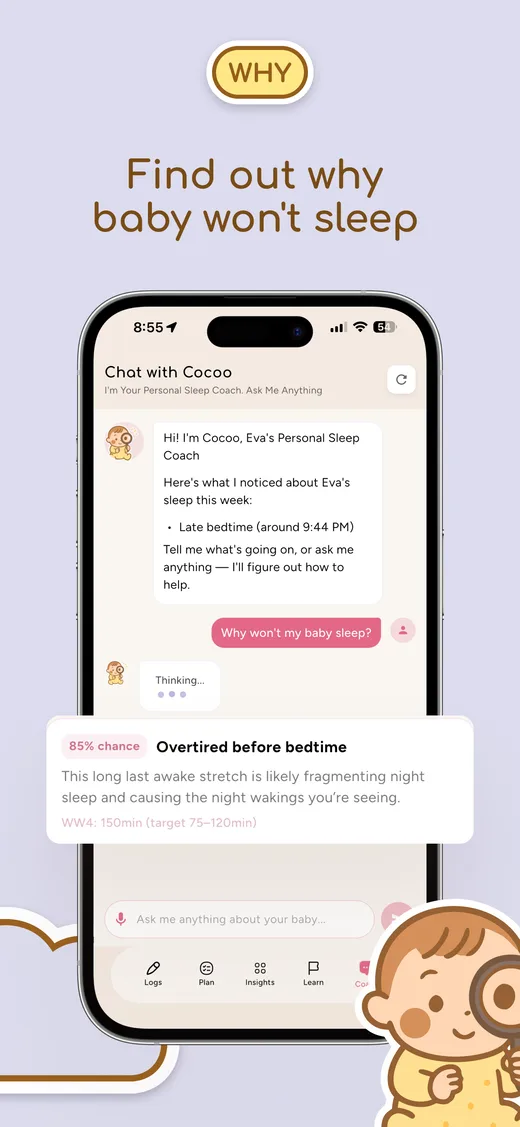
Not sure which trigger fits?Log naps and bedtimes for a few weeks, and Cocoo's coach reads the logs and ranks the likely reasons your baby's sleep is off.
The one thing that makes diagnosis faster
Night terrors are hard to diagnose from memory. The pattern (which nights they happen, how long after bedtime, whether they correlate with short naps or late bedtimes) only becomes visible when you're tracking consistently.
Sleep logs give you something a one-off pediatrician visit doesn't: the actual data from your baby's nights. When you can see that terrors happen on days when nap duration dropped below 30 minutes, or on nights when bedtime was after 7:45pm, the trigger becomes unambiguous.
If you've been tracking for a few weeks and terrors keep showing up, reviewing nap duration and bedtime data for each affected day shows the correlation directly, rather than guessing at 3am.
You can also read more about related root causes in our posts on baby fighting sleep, false start bedtimes, and the 11-month sleep regression, when the move from two naps toward one often starts.
When to bring it up with a doctor
- Episodes happen more than once a night, consistently
- Your child is injured during an episode
- Episodes include sleepwalking or leaving the room
- Your child snores loudly, mouth-breathes, or seems to pause breathing during sleep
- You've addressed the schedule and terrors continue for more than 4 weeks
Occasional night terrors in a healthy, well-rested toddler aren't a medical concern. Frequent, escalating, or injury-causing episodes deserve a pediatric sleep evaluation. The American Academy of Pediatrics has guidelines on when to refer.
Track the pattern. Find the trigger.
The trigger is easier to spot with a few weeks of logs. Cocoo records naps, bedtime and how long your baby takes to fall asleep, so you can line up each terror night against the day before it.


More from the blog
Related questions
What is a night terror in a baby?
A night terror is a partial arousal from deep NREM (slow-wave) sleep, usually happening 60–90 minutes after bedtime. Your baby may scream, thrash, or stare blankly, though they're not fully awake and won't remember it. Night terrors differ from nightmares, which happen during REM sleep in the second half of the night.
When do night terrors start in babies?
Night terrors are most common in toddlers. In a study that followed 1,940 children from 18 months to 13 years, 34% had sleep terrors at 18 months, the highest rate at any age measured, and 56% had them at some point during childhood (Petit et al., 2015). Most children grow out of them by school age.
What triggers night terrors in toddlers?
The three most studied triggers are: (1) overtiredness from skipped or shortened naps, (2) a bedtime that's running too late, and (3) sudden changes like illness, travel, or starting daycare. The 2-to-1 nap transition, which usually happens between 12 and 18 months, is a high-risk stretch because toddlers often run a sleep deficit on the days they skip the second nap.
Should I wake my baby during a night terror?
No. Waking a baby mid-terror typically makes them more confused and distressed. Stay nearby, keep it safe, and let the episode end on its own. Most episodes resolve in 2–10 minutes. Don't bring it up in the morning. Your baby genuinely doesn't remember it.