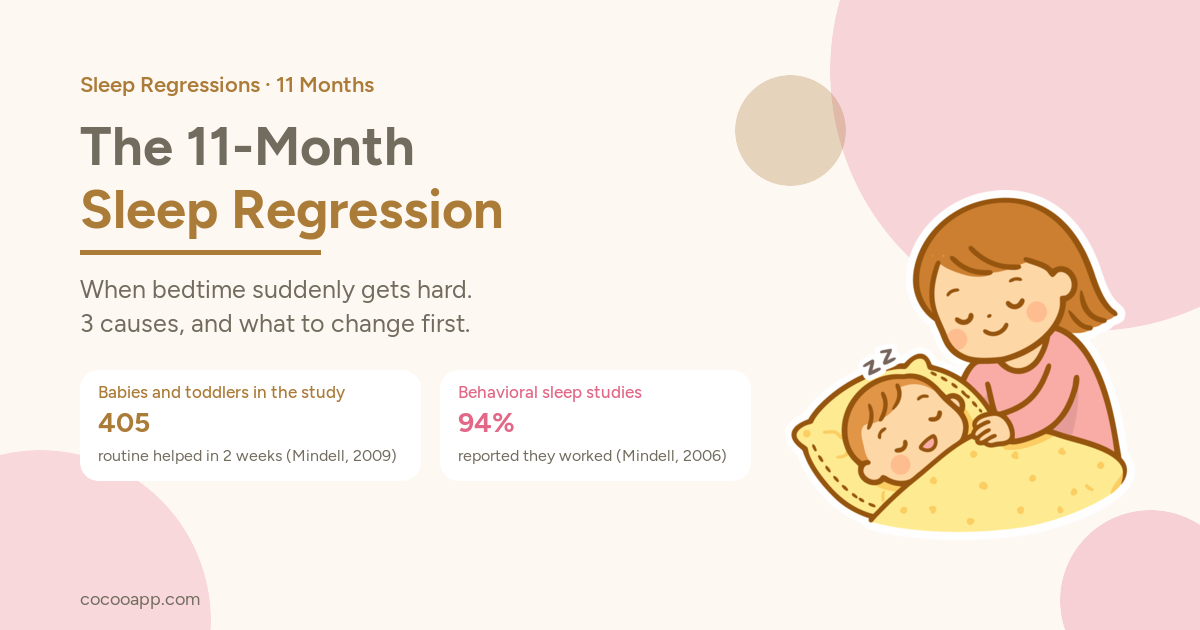
The 11-month sleep regression usually shows up at bedtime. A baby who settled in 10 minutes starts taking 30 or more, and the cause is most often one of three things: a second nap that ends too late, louder protest when you leave, or a sleep habit that now takes longer to work.
Each one has a different fix, so it's worth a few minutes to work out which you have. Here's how I'd do it, and what I'd change first.
If bedtime is going badly right now
- Standing in the crib? Lay them down once, say your goodnight line, and keep your visits short.
- Don't start a new habit tonight you'll have to undo next week.
- Tomorrow, write down when the second nap ended. That one number tells you a lot.
Is the 11-month sleep regression real?
The 11-month sleep regression isn't a defined stage in sleep research, but harder bedtimes around this age are common. A lot is changing at once. Many babies are pulling to stand and cruising, and in a study that tracked 20 babies from 7 to 12 months with sleep monitors, pulling to stand lined up with a stretch of disrupted sleep (Atun-Einy & Scher, 2016).
An earlier version of this post reported a bedtime spike in our own logs at 11 months. When I rechecked it, that number came from too few babies to stand behind, so I took it out. We only have a few dozen babies with complete logs between 9 and 12 months, so this version relies on published research.
Cause 1: the second nap ends too late
A second nap that runs late is the most common reason an 11-month-old isn't sleepy at bedtime. If nap 2 ends at 5pm, a 7pm bedtime leaves only two hours awake. Your baby isn't tired, so bedtime turns into rolling, standing and calling for you.
The giveaway: on days the second nap is short or skipped, bedtime goes fine. If that matches, move the second nap earlier and cap it at 30 to 45 minutes, so it ends by about 3 to 3:30pm. Most babies this age still need two naps, so shorten it before you drop it. Our 12-month regression post covers when one nap makes sense, and the wake windows by age chart has the ranges.
Cause 2: separation protest and a new skill
Around this age, babies notice more clearly when you leave, and bedtime is the longest goodbye of the day. Add a new skill like pulling to stand, and you get a baby who stands up and cries the moment the door closes.
- →Keep the bedtime routine short and identical every night. In a study of 405 babies and toddlers, a consistent three-step routine helped them fall asleep faster and wake less within two weeks (Mindell et al., 2009).
- →Practice sitting down from standing during the day, so they can get themselves back down at night.
- →Use the same short goodbye line every time, and keep your visits brief and predictable.
If it started suddenly with a new skill, give it two to three weeks before changing more. If it's been over a month, look at the other two causes.
Cause 3: a sleep habit that takes longer to work
If your baby falls asleep while feeding, being rocked or with you in the room, that may have worked smoothly for months. At 11 months it can start taking much longer, and your baby may protest as soon as you try to leave.
Research supports the link. In a large survey of parents across several countries, babies and toddlers who fell asleep on their own woke less at night and slept longer than those who fell asleep while being fed or held (Mindell et al., 2010). It's a link, not proof of cause, but it's why a gradual change at bedtime often helps.
Start at bedtime, when your baby is sleepiest. Feed earlier in the routine, then put them in the crib awake and use timed check-ins or sit nearby and move further away over a week. Our stop holding baby to sleep and sleep training methods guides go through the options.
Which cause is yours?
| Ask yourself | If yes |
|---|---|
| On days the second nap is short or skipped, is bedtime easier? | Likely the second nap ending too late. Move it earlier and cap it at 30 to 45 minutes. |
| Did it start suddenly, alongside pulling to stand or cruising, and does your baby cry mostly when you leave? | Likely separation protest and a new skill. Keep the routine identical and wait two to three weeks before changing anything else. |
| Has bedtime been getting slowly harder for a month or more, and does your baby fall asleep fine with help but not without it? | Likely a sleep habit that now takes longer to work. A gradual method at bedtime is the direct fix. |
| More than one of these? | Start with nap timing. It's the quickest to change and you'll know within a week whether it helped. |
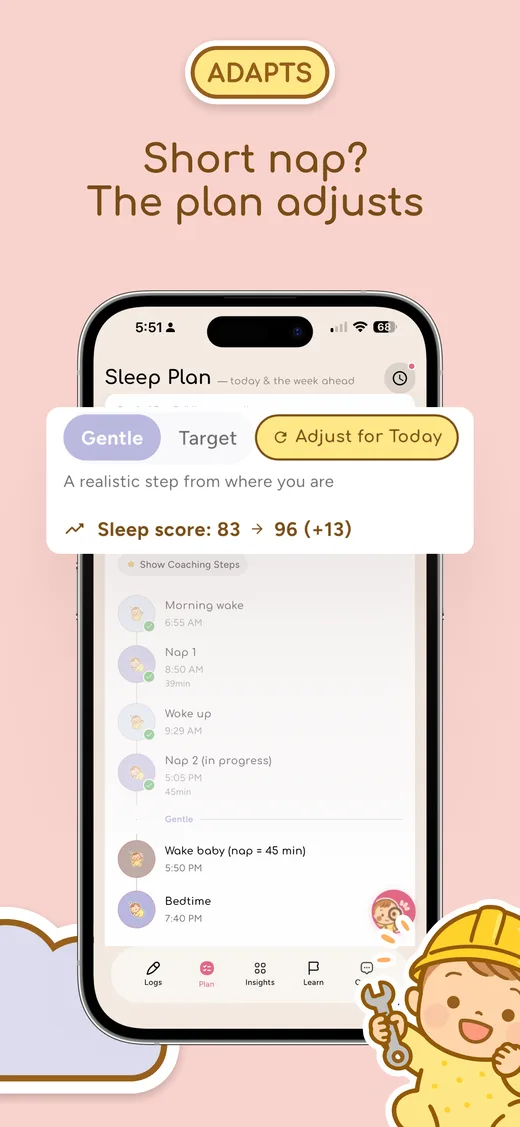
A week of logged nap end times and bedtimes makes this much easier to answer than memory. Cocoo times naps and bedtime from your baby's own logs.
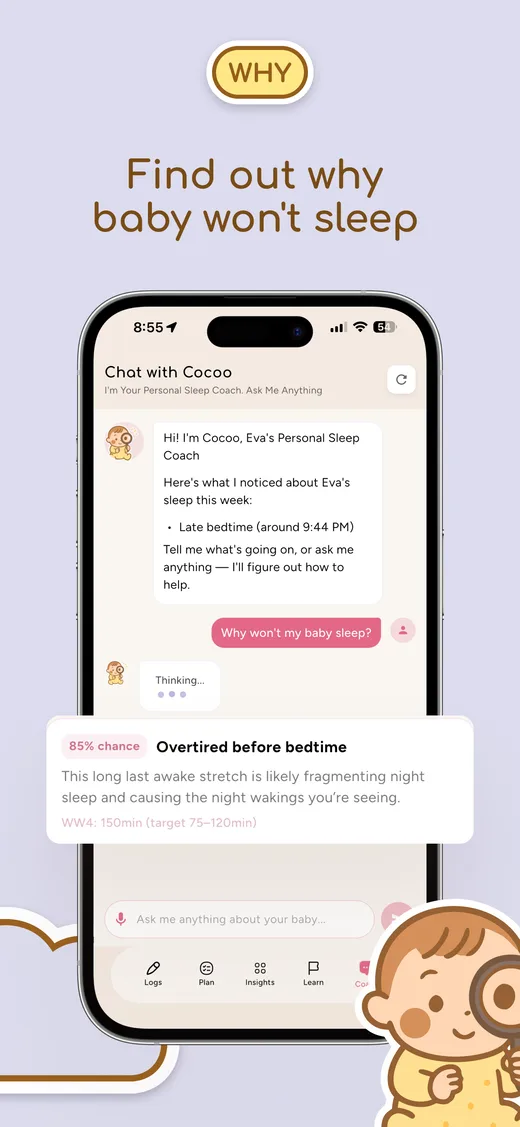
Can't tell if it's the nap or the habit?Log a week of naps and nights in Cocoo and its sleep coach ranks the likely causes from your baby's own data.
When it isn't a regression
Call your pediatrician if night waking comes with fever, ear pulling, vomiting, a cough that's worse lying down, loud snoring or pauses in breathing. This post is general information, not medical advice.
Related questions
How long does the 11-month sleep regression last?
It depends on the cause. Disruption around a new motor skill like pulling to stand tends to ease once the skill is practiced. A late second nap lasts until you move or shorten it, and that usually helps within a week. A sleep habit that now takes longer to work won't change until you change the habit.
What wake windows should an 11-month-old have?
Most 11-month-olds do well with about 3 to 4 hours awake between sleeps, with the longest stretch before bed. On two naps, that often means the second nap ends by about 3 to 3:30pm for a 7pm bedtime. Watch your baby more than the clock: a long, fussy settle at bedtime often means the last stretch was too short.
Is my 11-month-old ready for one nap?
Probably not. Most babies move to one nap somewhere between 12 and 18 months. At 11 months, a fight over the second nap usually means it needs to be shorter or earlier, not gone. Look for the second nap being refused on most days for about two weeks before you drop it.
Should I sleep train at 11 months?
It's a reasonable age for it if the hard part is a sleep habit, like needing to be fed or rocked all the way to sleep. A review of 52 studies found 94% reported behavioral sleep methods worked (Mindell et al., 2006). Fix nap timing first, because a method won't work well on a baby who isn't tired at bedtime.
Keep reading
Sources
Atun-Einy O, Scher A. Sleep disruption and motor development: Does pulling-to-stand impacts sleep-wake regulation? Infant Behavior and Development. 2016;42:36–44.
Mindell JA, Kuhn B, Lewin DS, Meltzer LJ, Sadeh A. Behavioral treatment of bedtime problems and night wakings in infants and young children. Sleep. 2006;29(10):1263–1276. PubMed
Mindell JA, Sadeh A, Kohyama J, How TH. Parental behaviors and sleep outcomes in infants and toddlers: a cross-cultural comparison. Sleep Medicine. 2010;11(4):393–399.
Mindell JA, Telofski LS, Wiegand B, Kurtz ES. A nightly bedtime routine: impact on sleep in young children and maternal mood. Sleep. 2009;32(5):599–606. PubMed
Is it the nap or the habit?
Log a week of naps and bedtimes in Cocoo, then compare short-nap days with the rest.