
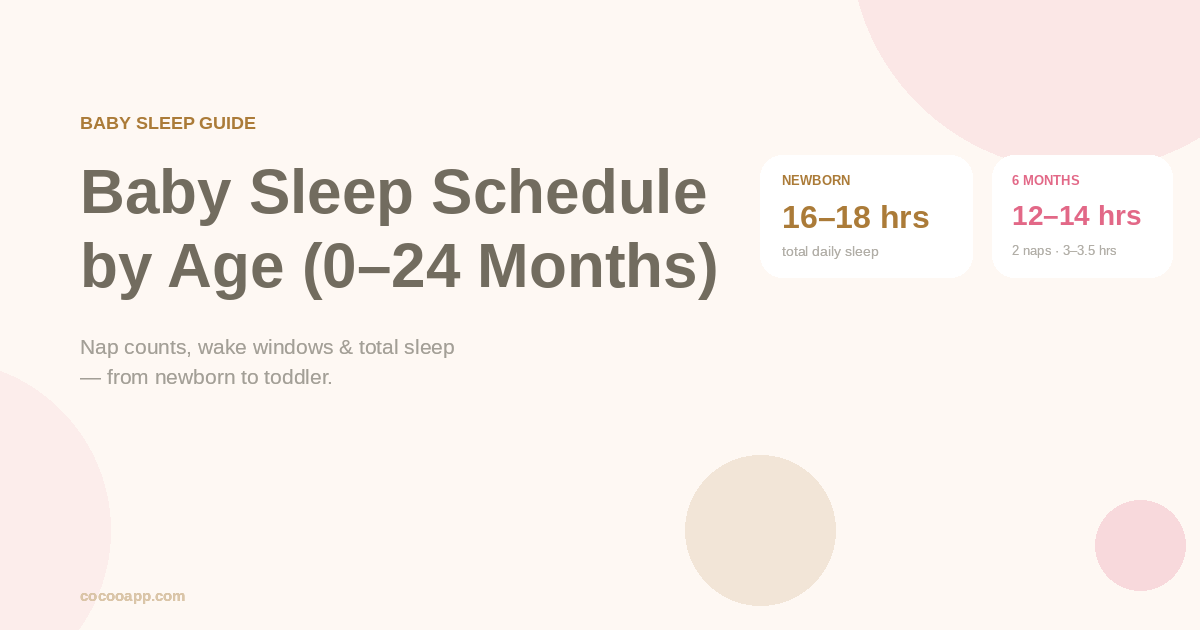
Babies need 11–17 hours of total sleep per day depending on age, spread across night sleep and naps. The number of naps drops from 4–5 at birth to 1 by 18 months — and the wake windows between each sleep stretch from 45 minutes for newborns to 5–6 hours for toddlers.
Here's the frustrating truth: there's no single “correct” baby sleep schedule. Every baby is different. But there are age-appropriate ranges that work with your baby's biology — and when you work with those ranges instead of against them, sleep gets dramatically easier.
Below is everything you need: total sleep needs, nap counts, wake windows, and sample schedules — from the newborn stage through 24 months.
What this guide covers
- 1Total sleep needs at every age (based on AAP + Paruthi et al.)
- 2How many naps babies need — and when to drop them
- 3Wake windows: how long your baby can be awake between sleeps
- 4Sample schedules you can adapt for your baby
- 5Signs the schedule isn't working — and what to do
Why baby sleep changes so dramatically in year one
A newborn has no circadian rhythm. Their brain hasn't developed the internal clock that tells them the difference between day and night. They sleep in 2–4 hour chunks, driven almost entirely by hunger.
Around 6–8 weeks, melatonin production begins and a circadian rhythm starts to emerge (Jenni et al., 2005). Babies start sleeping longer at night and consolidating naps.
By 4 months, the brain shifts to adult-like sleep cycles — which is why so many babies who were great sleepers suddenly start waking every 45 minutes. This is the infamous 4-month sleep regression, and it's permanent — the sleep architecture has changed for good.
What this means for schedules: what worked last month won't work this month. A schedule that kept your baby happy at 3 months may be completely wrong at 6 months. That's not failure — it's development.
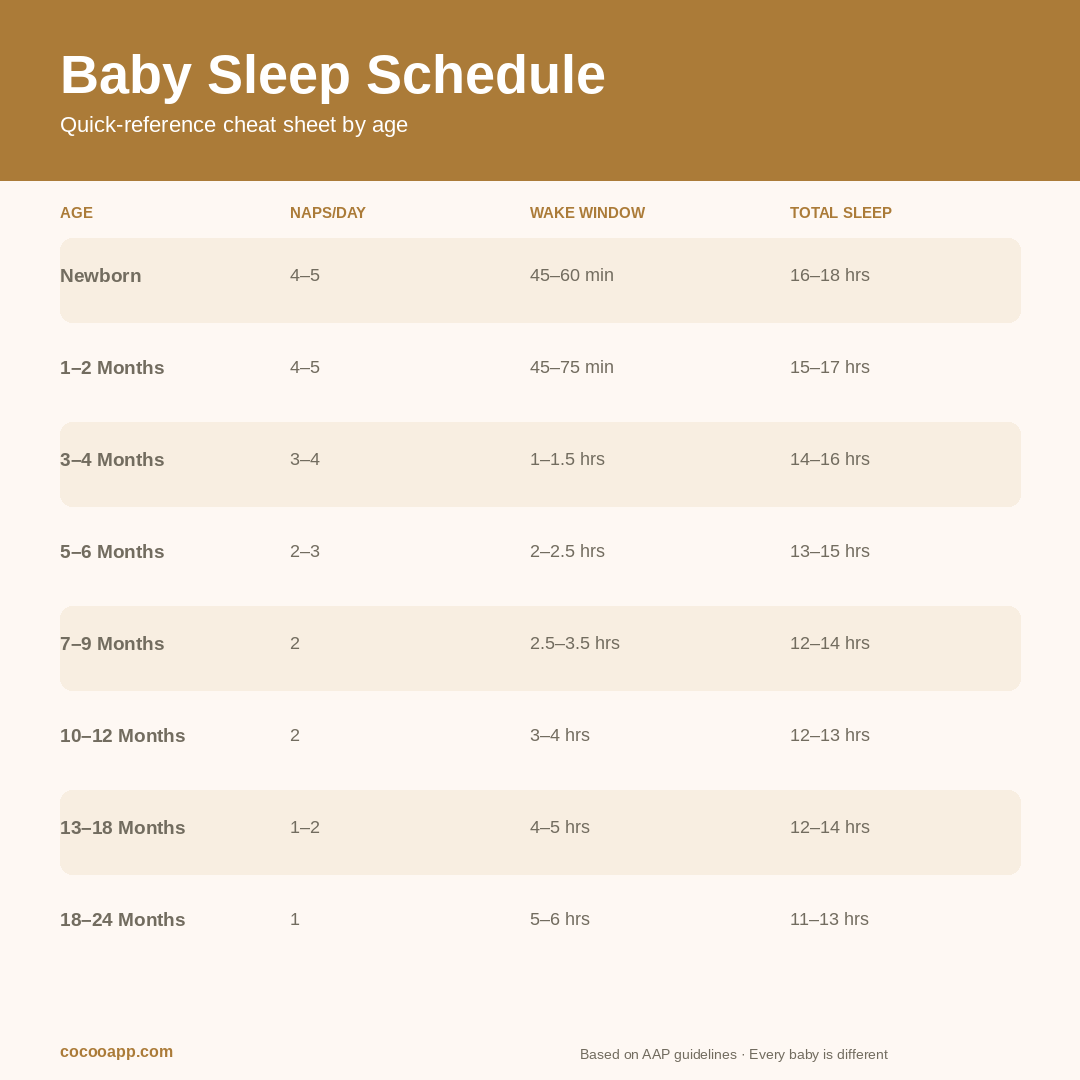
Baby sleep schedule by age
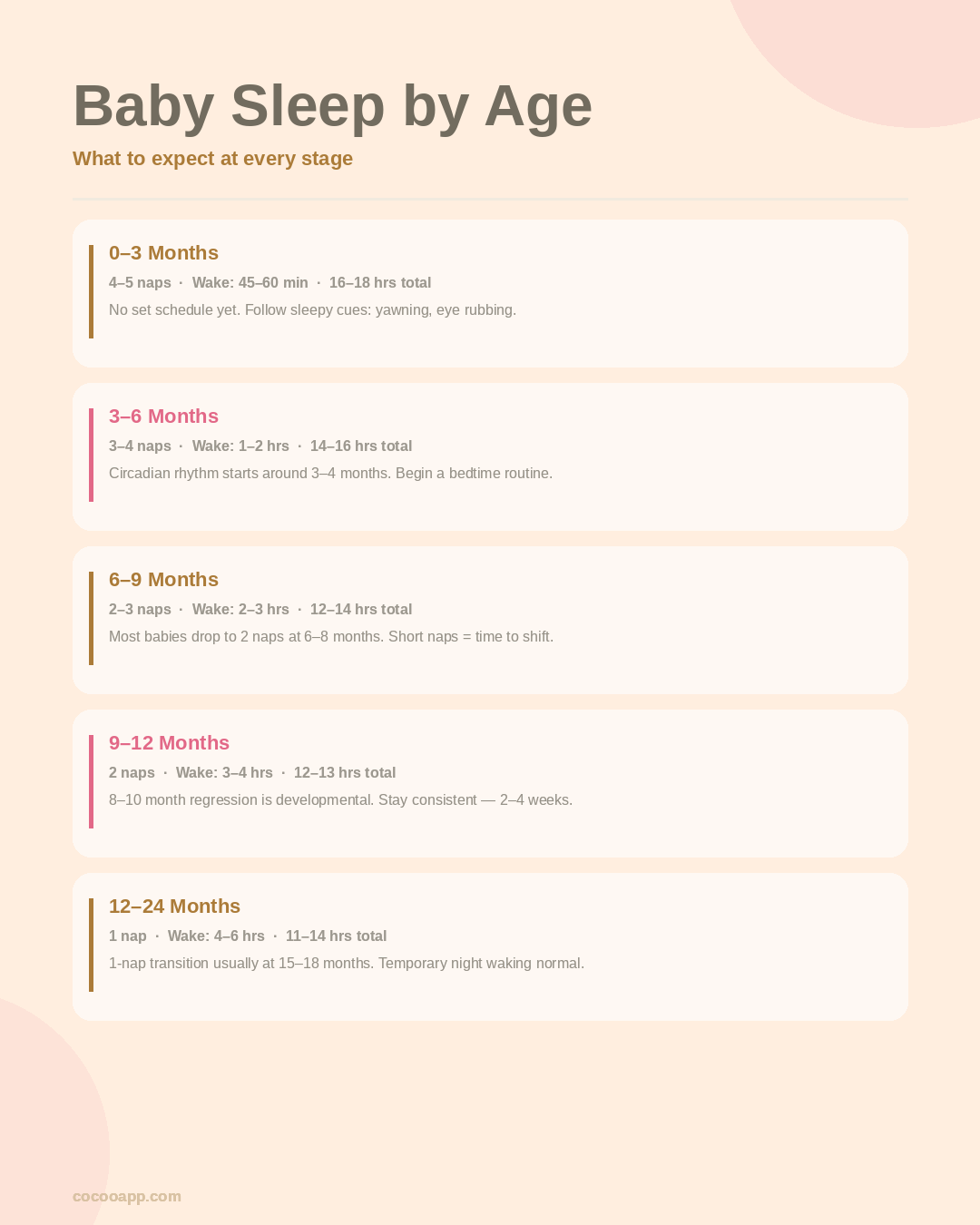
Newborn (0–6 weeks)
No true circadian rhythm yet. Sleep is driven entirely by hunger — expect feeds every 2–3 hours around the clock. Sample timing is not useful at this stage; follow hunger cues.
6–12 Weeks
The first hints of a circadian rhythm begin around 6–8 weeks. Aim for a consistent first morning wake time (7am works well). Bedtime starts moving earlier — 8–9pm is common.
Sample schedule
3–4 Months
The 4-month sleep regression hits here — sleep cycles mature to adult-like patterns, causing more frequent night wakings. This is NOT permanent. Bedtime moves earlier: 7–7:30pm.
Sample schedule
5–6 Months
Many babies start consolidating naps here. Third nap often gets shorter (20–30 min catnap). Bedtime: 6:30–7:30pm. Start watching for the 3→2 nap transition.
Sample schedule
6–9 Months
Most babies drop to 2 naps between 6–9 months. Once on 2 naps, wake windows grow. Many babies also start sleeping through the night during this window (Henderson et al., 2010 define this as 5+ continuous hours).
Sample schedule
9–12 Months
Solidly on 2 naps. Some babies start pushing toward 1 nap near 12 months but most aren't ready until 14–18 months. Watch for the 8–10 month sleep regression.
Sample schedule
12–18 Months
The 2→1 nap transition happens most commonly between 14–18 months. Transition period is bumpy — some days 2 naps, some days 1. Offer 1 nap on days they're fighting nap 2.
Sample schedule
18–24 Months
Firmly on 1 nap by 18 months for most toddlers. Nap time shifts to after lunch (12–1pm). As wake windows lengthen, keep bedtime consistent — a late nap + late bedtime cycle is common here.
Sample schedule
Signs the schedule isn't working
Schedules aren't static. Your baby is constantly changing — and the schedule needs to change with them. Here's what to watch for:
- Takes forever to fall asleep at nap time: Usually a sign of undertiredness — the wake window is too short. Try extending it by 15–20 minutes.
- Extremely overtired at bedtime: Wake window is too long. Move bedtime or the last nap earlier by 15–30 minutes.
- Short naps (30–45 min) on every nap: Often tied to an off wake window or a sleep association issue. See our guide on short naps for root cause diagnosis.
- Nap refusal for 2+ weeks: Strong signal that a nap transition is coming. If it's 3→2, extend wake windows. If it's 2→1 and baby is 14+ months, try offering 1 nap.
- Night wakings increase after working schedule: Often a sign of a developmental leap, growth spurt, or teething — not a schedule problem. Give it 5–7 days before changing anything.
3 things you can try tonight
Cap the last wake window
If bedtime is a battle, try moving it 15 minutes earlier for 3 nights. Most parents are surprised how much this helps — an overtired baby fights sleep harder, not less.
Watch for sleepy cues in the window, not the clock
Age-based charts give ranges. Your baby's actual window may be 20 minutes shorter or longer than average. Signs to watch: slower blinks, zoning out, rubbing eyes. Put them down when you see 2–3 of these, not when the timer hits.
Keep the first morning wake time consistent
This is the anchor of the whole day's schedule. A consistent 7am wake time regulates everything downstream — nap 1 timing, nap 2 timing, bedtime. Even on rough nights, resist letting baby sleep in past 7:30am.
The hardest part of schedules: knowing when to adjust
Sample schedules give you a starting point. But your baby's actual optimal wake windows may be 15–30 minutes different from the average — and they shift as your baby grows. Cocoo tracks your baby's real sleep patterns and detects when their windows shift — so you can update the schedule before it breaks down, not after.
Frequently asked questions
What is a good sleep schedule for a 3-month-old?
A 3-month-old typically needs 14–16 hours of total sleep per day. They usually take 3–4 naps with wake windows of 1–1.5 hours. A sample schedule: wake at 7am, nap 1 at 8:30am, nap 2 at 11am, nap 3 at 1:30pm, short catnap at 3:30pm, bedtime at 7pm.
What is a good sleep schedule for a 6-month-old?
A 6-month-old typically needs 12–16 hours of total sleep per day across night sleep and 2–3 naps. Wake windows are 2–2.5 hours. A sample schedule: wake at 7am, nap 1 at 9:15am (45–90 min), nap 2 at 12:30pm (45–90 min), bedtime at 7pm.
When do babies drop from 3 naps to 2?
Most babies transition from 3 to 2 naps between 6–9 months. Signs they're ready: the third nap is getting harder to achieve, they're pushing back bedtime, or they're sleeping well through a 2-nap day. The transition typically takes 2–4 weeks.
When do babies drop to 1 nap?
Most babies transition from 2 naps to 1 between 14–18 months. Signs they're ready: consistently refusing the second nap, taking a long time to fall asleep at nap 1, or falling asleep very late at night after two naps. Moving too early (before 12 months) usually backfires.
How many hours should a 12-month-old sleep?
According to the AAP and Paruthi et al. (2016), toddlers 1–2 years old need 11–14 hours of total sleep per 24 hours including naps. At 12 months, most babies sleep 11–12 hours at night plus a 1–2 hour nap.
Sources
- Paruthi, S. et al. (2016). Recommended amount of sleep for pediatric populations. Journal of Clinical Sleep Medicine, 12(6), 785–786. sleepfoundation.org
- American Academy of Pediatrics (2022). Safe Sleep Recommendations. healthychildren.org
- Jenni, O. G., & O'Connor, B. B. (2005). Children's sleep: An interplay between culture and biology. Pediatrics, 115(1), 204–216.
- Henderson, J. M. T., France, K. G., & Blampied, N. M. (2010). The consolidation of infants' nocturnal sleep across the first year of life. Sleep Medicine Reviews, 14(4), 211–220.
- Mindell, J. A. et al. (2009). A nightly bedtime routine: Impact on sleep in young children. Sleep, 32(5), 599–606.
More from the Cocoo blog
Want to understand the biology behind wake windows? Learn about the science behind Cocoo's approach.
See your baby's actual sleep patterns
Sample schedules are a starting point. Cocoo's AI tracks your baby's real data to find their personal wake windows — so you always know when to adjust, not just where to start.
Download Cocoo — it's free to startAvailable on iOS and Android