Wake a sleeping baby when her nights are rough, when you're sleep training, or when your day runs on a clock. If bedtime is easy and she sleeps 10 hours or more at night, let her sleep. When you do wake her, the usual limits are 2 hours for a single nap and the same wake-up time, within 30 minutes, every morning.
“Never wake a sleeping baby” and “always cap naps at 2 hours” are both too simple. And the question isn't only about naps. If you have to wake her most mornings, that's okay too. She doesn't need to be waking by herself. Below is how I'd decide, for mornings and for naps.
If she's asleep right now and you're deciding
- →Nap past 2 hours (3 if it's her only nap) and bedtime has been a fight this week: wake her.
- →Morning, 30 minutes past her usual wake-up, and you're sleep training or shifting her schedule: wake her.
- →Nights have been good and nothing depends on the clock today: leave her.
When should you wake a sleeping baby?
You should wake a sleeping baby when her day sleep is taking from her nights, or when you need her day to hold a shape. Start with her nights, not the nap in front of you.
Swipe the table sideways to see every column →
| Your situation | Wake her? | What to do |
|---|---|---|
| Bedtime is easy and she sleeps 10+ hours at night | No | Let her nap and wake on her own. There's nothing to fix. |
| Bedtime takes a long time, she's awake for a long stretch at night, or she's up very early | Yes | Cap each nap and the day total at the limit for her age (table below). |
| You're sleep training, or moving a late bedtime earlier | Yes | Same morning wake time every day, naps capped, even after a bad night. |
| Daycare, work or a sibling's pickup sets the clock | Yes | Wake her at the set times so naps land where you need them. |
| She's sick | Mostly no | Let her sleep more. Call the doctor if she's much sleepier than usual or hard to wake. |
| Newborn, or any baby with weight-gain concerns | Ask your doctor | Feeds come first. Your pediatrician tells you when you can stop waking her. |
Should you wake your baby in the morning?
Waking your baby in the morning is fine, and a set wake-up time is what holds her naps and bedtime in place. Every nap and bedtime is counted from when she got up. If she sleeps in 45 minutes, the whole day slides 45 minutes later, bedtime included.
We saw this in one 8-month-old's logs. She was waking between 8:30 and 9:30 and not settling for the night until 10pm. Her mom moved the morning to 7:45 in 15-minute steps, and by night 10 she was asleep at 8:24pm with no wake-ups. The full story is in how to get your baby to sleep earlier. The 7:45 wake is what keeps that schedule from drifting back.
A baby who needs waking isn't short on sleep by default. Add it up. That 8-month-old sleeps about 11 hours 20 minutes at night plus about 2 hours of naps, a little over 13 hours a day. The recommended range at 4 to 12 months is 12 to 16 hours including naps (Paruthi et al., 2016).
One thing to watch. If she's very hard to wake, or stays grumpy for a long time most mornings, she may need a bit more night. Move bedtime 15 minutes earlier and keep the morning where it is.
Letting her sleep in after a late night rarely pays off anyway. In an actigraphy study of 24 infants, each hour of later sleep onset moved the next morning's wake by only 8.4 minutes (Adams et al., 2020). Our own logs show about 4 minutes per hour, across 2,081 nights from 50 babies. Her body clock gets her up near the usual time either way.
I couldn't find a trial that tests a fixed morning wake against letting babies wake on their own. This part is practice and logs, not a proven rule. If her wake-up already lands within the same 30 minutes and nights are good, you don't need to wake her at all.
Should you wake your baby from a nap?
Wake your baby from a nap when long or late naps are showing up as bad nights. The signs I'd look for over a week: bedtime drags, she's awake for a long stretch in the middle of the night, she's up for the day before 6am, or her nights run under 10 hours.
The best study I know is in toddlers. In 50 children around 18 months old wearing activity trackers for a week, longer naps and later naps both went with a later bedtime and a shorter night (Nakagawa et al., 2016). That's a correlation in toddlers. For babies under 12 months I haven't found a study that tests nap limits directly.
How to wake her: open the door, let the light and normal house noise in, and give her 5 minutes before you pick her up.
How long should you let a baby nap, by age?
Let a baby nap up to 2 hours at a time, or up to 3 hours once she's on one nap a day, and keep total day sleep under the limit for her age. These are the limits Cocoo's schedules are built on.
| Age | Wake from one nap at | Day sleep, keep under | Night sleep, at least |
|---|---|---|---|
| 3–4 months | 2 hours | 5 hours | 9.5 hours |
| 5 months | 2 hours | 4.5 hours | 10 hours |
| 6 months | 2 hours | 4 hours | 10 hours |
| 7–9 months | 2 hours | 3.5 hours | 10 to 10.5 hours |
| 10–12 months | 2 hours | 3 hours | 10.5 hours |
| One nap (13 months and up) | 3 hours | 2.5 to 3 hours | 10 to 10.5 hours |
From Cocoo's schedule targets, November 2026. On a 3-nap day from 4 months, the targets keep each nap to 90 minutes. They sit in the same range sleep consultants publish. No pediatric body sets a nap limit, so treat these as starting points and adjust to her nights.
Should you wake your baby during sleep training?
During sleep training, wake your baby at the same time every morning and cap her naps, even after a bad night. She has to arrive at bedtime tired, or she'll have the energy to protest for an hour. That's standard practice in sleep training programs. I haven't seen it tested on its own in a trial.
The hard morning is the one after she was up from 2 to 4am. Wake her anyway, within 30 minutes of her usual time. A long lie-in pushes the first nap and bedtime later, and the next night starts from behind.
Once she falls asleep on her own and nights are steady, you can loosen up. If you haven't started yet, here's how to tell she's ready.
When should you let a sleeping baby sleep?
Let a sleeping baby sleep when her nights are good, when she's sick, and at night once your pediatrician is happy with her weight.
Good nights means an easy bedtime, no long wake in the middle and at least 10 hours. A baby like that who takes a 2.5-hour nap on Saturday doesn't have a problem. Leave it.
Newborns are the exception at the other end. The American Academy of Pediatrics says most healthy full-term babies can be fed on hunger cues, with breastfed newborns nursing about every 2 hours. For a baby who is having trouble gaining weight, its advice is “don't wait too long between feeding, even if it means waking your baby” (Jain and Bunik, 2024). When you can stop waking for feeds is your pediatrician's call.
How do you know when a nap has gone on long enough?
A nap has gone on long enough when she's rested and the next sleep is at risk. Doing that sum at 4:50pm with a monitor in your hand is the annoying part.
While a nap is running, Cocoo's home screen shows how long she's been asleep. As she recharges, the line under it changes from the time she may wake to “Consider waking her up” and then “Wake her up”. It works from her energy level and today's plan. It doesn't look at how her nights have been before it says so. That judgment is still yours.
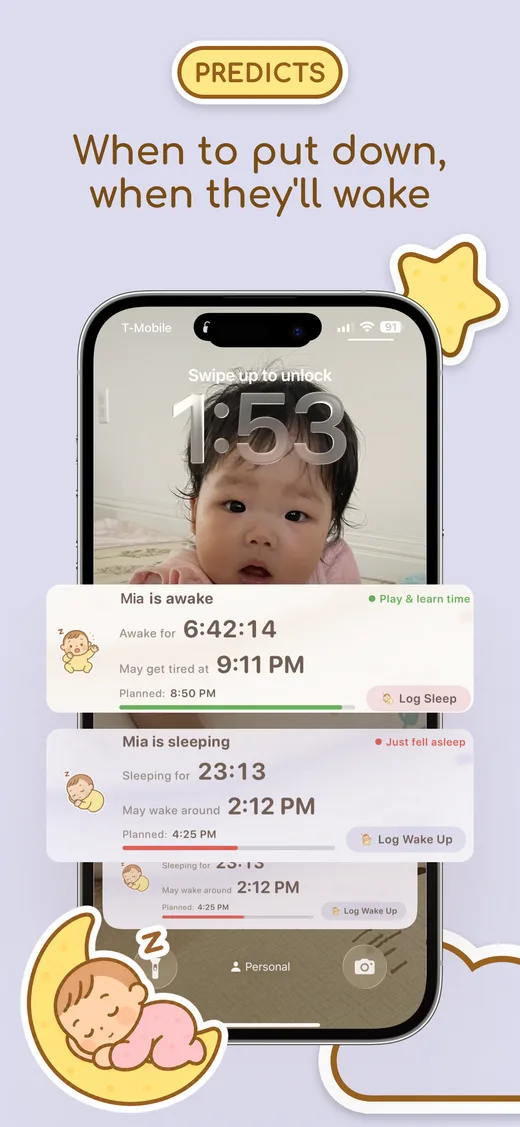
Not sure this nap has gone on long enough?Cocoo predicts when she'll wake from each nap and tells you when it's time to wake her, based on today's plan.
When to call the doctor
Call your pediatrician if she's much sleepier than usual, hard to wake, or too sleepy to feed. Snoring or pauses in breathing are worth a visit too.
Related questions
When can I stop waking my baby to feed?
Ask your pediatrician, because the answer depends on her weight gain. The American Academy of Pediatrics says most healthy full-term babies can be fed on hunger cues, and that a baby who is having trouble gaining weight shouldn't go too long between feeds, even if it means waking her.
Should I wake my baby at the usual time after a bad night?
If you're sleep training or fixing a late bedtime, yes: wake her within 30 minutes of her usual time so she's tired enough at the next bedtime. If neither applies and it was one bad night, letting her catch up is fine. If she's sick, let her sleep and call the doctor if she's hard to wake.
Keep reading
Sources
Adams EL, Savage JS, Master L, Buxton OM. Time for bed! Earlier sleep onset is associated with longer nighttime sleep duration during infancy. Sleep Medicine. 2020;73:238–245. PubMed
Jain S, Bunik M. How Often and How Much Should Your Baby Eat? American Academy of Pediatrics, HealthyChildren.org. Updated April 2024. HealthyChildren.org
Nakagawa M, Ohta H, Nagaoki Y, et al. Daytime nap controls toddlers' nighttime sleep. Scientific Reports. 2016;6:27246. PubMed
Paruthi S, Brooks LJ, D'Ambrosio C, et al. Recommended amount of sleep for pediatric populations: a consensus statement of the American Academy of Sleep Medicine. Journal of Clinical Sleep Medicine. 2016;12(6):785–786. PubMed
Our data: the nap and day-sleep limits are the schedule targets in our app as of November 2026. The 2,081-night figure is from our analysis of 50 babies' logs, and the 8-month-old's numbers are from her logs, shared with her parent's permission. Both are written up in the posts linked above.
Standing at the nursery door, not sure whether to go in?
Log the nap and the app tells you when she's had enough, with tonight's bedtime to match.