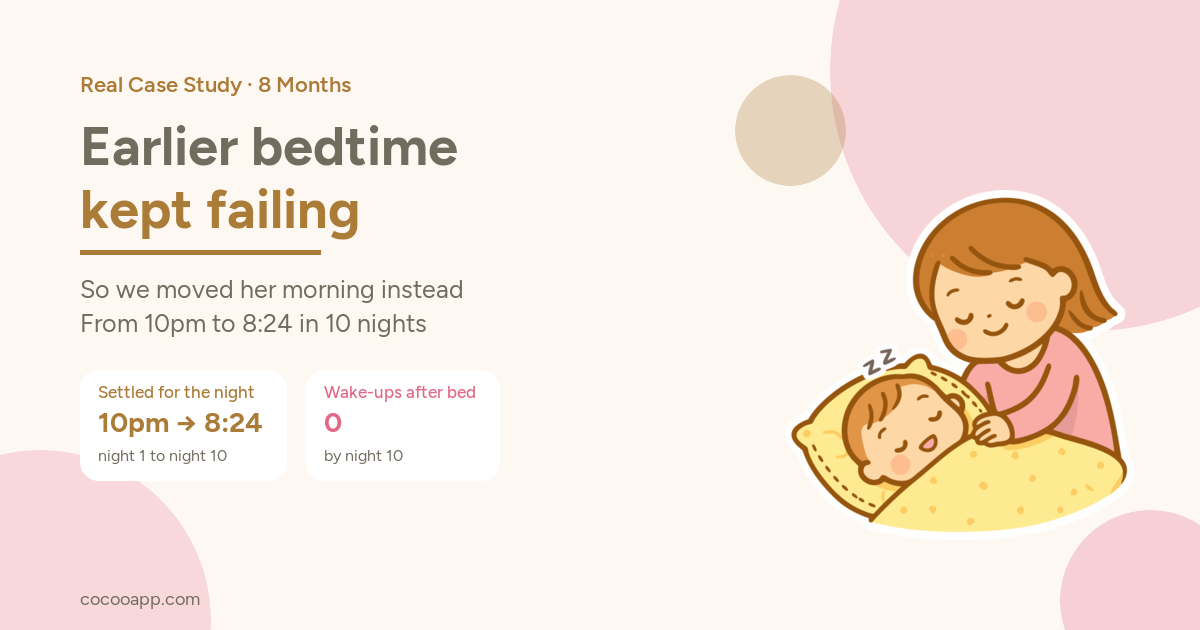
If an earlier bedtime keeps failing, move the morning instead. Wake your baby 15 minutes earlier every 2 to 3 days and let naps and bedtime follow. One 8-month-old went from settling at 10pm to asleep at 8:24pm with no wake-ups in 10 nights.
Her mom had tried 8pm, 8:30, even 9. Every night, 30 to 40 minutes later, the baby was wide awake and babbling, and it took until 10 or 11 to get her back down. Then she slept straight through and had to be woken at 8:30 the next morning.
Ten nights later, her mom wrote: “never expected her sleep to get so much better.” Here's what we did, with her real logs, shared with her permission.
If she's babbling in the cot 40 minutes after bedtime tonight
- →Keep the room dark and dull. Short, calm visits, no play.
- →Don't try an even earlier bedtime tomorrow. A happy wake usually means she wasn't tired yet.
- →Tomorrow, wake her 15 minutes earlier than usual and get her into daylight.
Why does an earlier bedtime backfire?
An earlier bedtime backfires when your baby's body clock isn't ready for night yet, so the first sleep is only a nap. My first read was the opposite. Her naps were short, so I guessed overtiredness and suggested asleep by 8.
Her mom's reply changed my mind. She was “playful and babbling” when she woke. Overtired babies usually wake crying. A chatty one is more often a baby whose clock still says evening.
In 45 toddlers, those put to bed close to the evening rise of melatonin (the hormone that signals night) took longer to fall asleep and fought bedtime more (LeBourgeois et al., 2013). That's toddlers, not babies, so I hold it loosely.
How do you shift a baby's schedule earlier?
You shift a baby's schedule earlier by moving the morning wake in small steps and letting the rest of the day follow. This is the plan we started on November 8.
- 1
Wake her 15 minutes earlier
She'd been waking 8:30 to 9:30. Step one was 8:15, with curtains open and a feed soon after.
- 2
Hold each step 2 to 3 days
8:15, then 8:00, then 7:45. Daily moves are too fast for her clock.
- 3
Move naps by the same amount
Nap 1 went from about 11:20 to about 10:40. Nap 2 settled around 3:15.
- 4
Set bedtime from her last good night
About 15 minutes before when she really fell asleep, not an age-chart number.
It's a cousin of bedtime fading, which cut the time to fall asleep by about 10 minutes in a trial of 43 babies aged 6 to 16 months (Gradisar et al., 2016).
What happened night by night?
Swipe the table sideways to see every column →
| Night | Plan: asleep | In the cot | Asleep | False start | Settled |
|---|---|---|---|---|---|
| Before (late Oct)up 8:30–9:30 | None | 8–9pm | Not logged | 30 to 40 min laterplayful | 10–11pm |
| Nov 8 (night 1)up 8:16 | 8:45–9:00 | – | 8:22pm | 8:49pm2 wakes, 26 min | 10:06pm |
| Nov 9up 8:18 | 8:00 (her call) | 8:00pm | 8:03pm | 8:37pm3 wakes, 87 min | 10:12pm |
| Nov 10up 8:17 | 8:45–9:00 | 8:47pm | 9:11pm | 9:52pm1 wake, 10 min | 10:02pm |
| Nov 11up 8:00 | 8:30 | – | 8:30pm | 8:56pm3 wakes, 61 min | 10:54pm |
| Nov 12up 8:00 | About 9:00 | 8:40pm | 8:47pm | None | 8:47pm |
| Nov 14up 8:00 | 8:45–9:00 | – | 8:50pm | None | 8:50pm |
| Nov 15up 7:38 | 8:30 | – | 8:40pm | 9:01pm1 wake, 24 min | 9:25pm |
| Nov 17 (night 10)up 7:47 | 8:30 | – | 8:24pm | None | 8:24pm |
For four nights the false start kept coming 26 to 41 minutes after she fell asleep, and the night didn't really start until about 10pm, whatever time she went down. Then on November 12 she fell asleep at 8:47 and didn't wake until 7:48. By night 10 she slept 8:24pm to 7:46am, 11h22, without a sound.
One more thing changed on November 12: her mom started leaving the room at bedtime. I can't separate the two effects. But leaving a baby who isn't tired yet rarely ends in sleep, so the schedule had to come first.
From the parent's logs in our app, London time. “Planned asleep” is the time I gave her in chat. A dash means she didn't note when she went in the cot. Nov 13 and 16 (days out, car naps) are left out.
How much crying did this take?
Very little, and none of it planned. We used no sleep training method: no cry it out, no timed checks. She already fell asleep on her own in the cot, with her mom lying beside it. The only bedtime change was her mom leaving the room, from November 12. That night she was asleep in 8 minutes, “without any crying,” her mom wrote.
The tears in this story were the old false starts, settled with a pat. They faded as the schedule moved.
What happens if bedtime moves faster than the morning?
The wake-ups come straight back, and this one was my mistake. For November 11 the morning moved 17 minutes earlier, but I set bedtime 41 minutes earlier, from her 9:11 the night before to 8:30. She fell asleep right on plan, woke 26 minutes later and didn't settle until 10:54pm, the worst night in the table.
The next evening I put bedtime back in step: in the cot by 8:40, aiming for asleep around 9:00. She was asleep at 8:47 and slept to 7:48. That was the first clean night.
How did the app's daily schedule help?
Between my messages, the day-to-day maths came from her schedule in Cocoo, built from the wake time she logged and her own recent days.
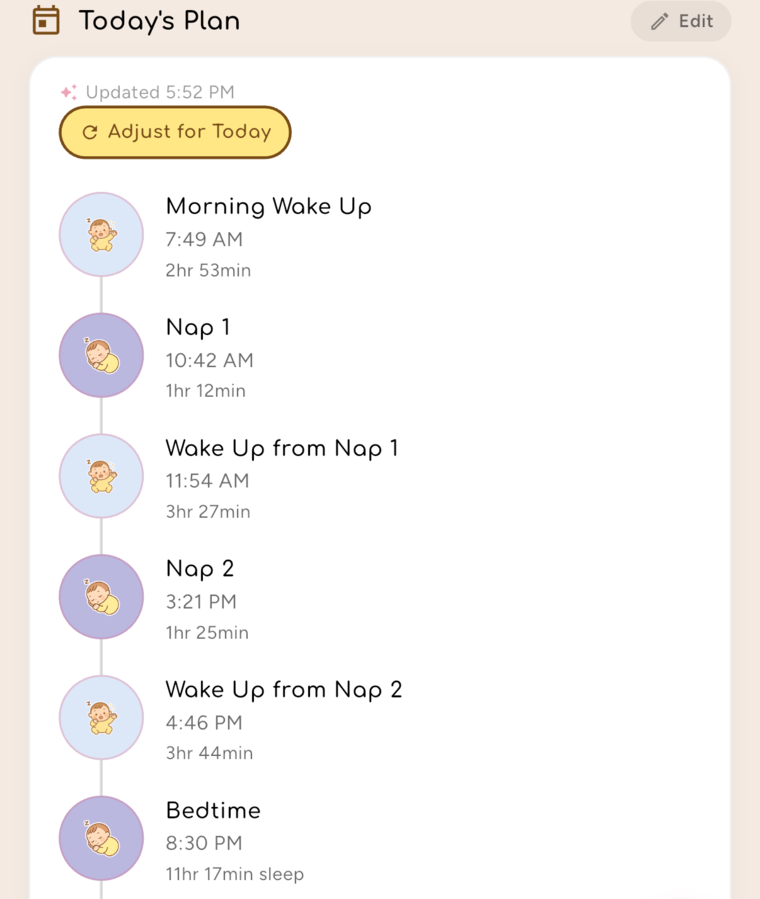
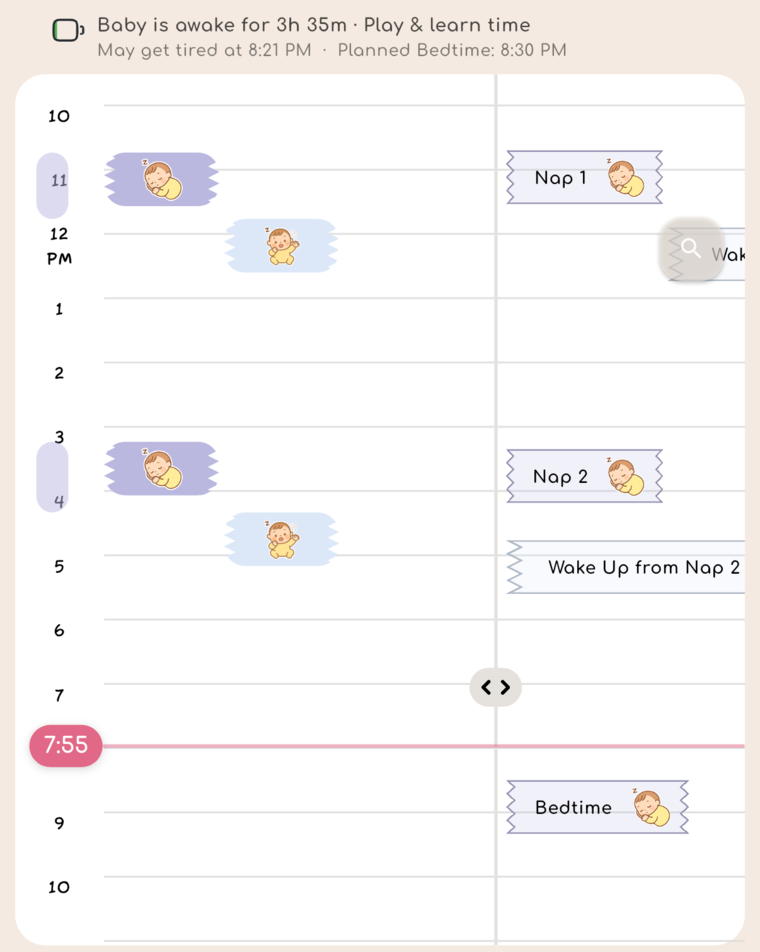
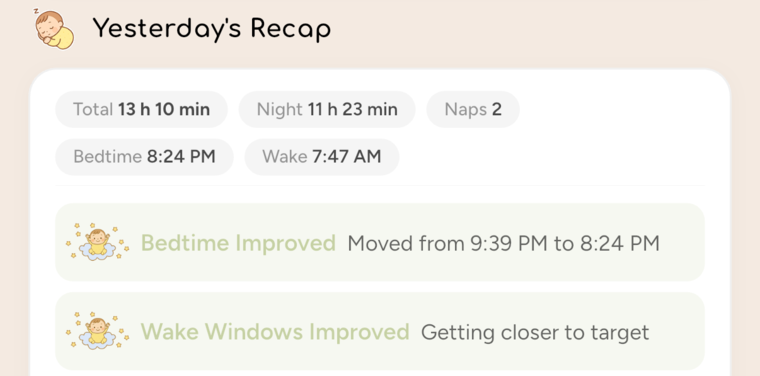
Screenshots: her real logs and the schedules the app gave her, replayed in a test account so her name stays private.
- The logs caught the mistake. Because she logged every sleep, I saw the November 11 night the next morning and we fixed it the same day.
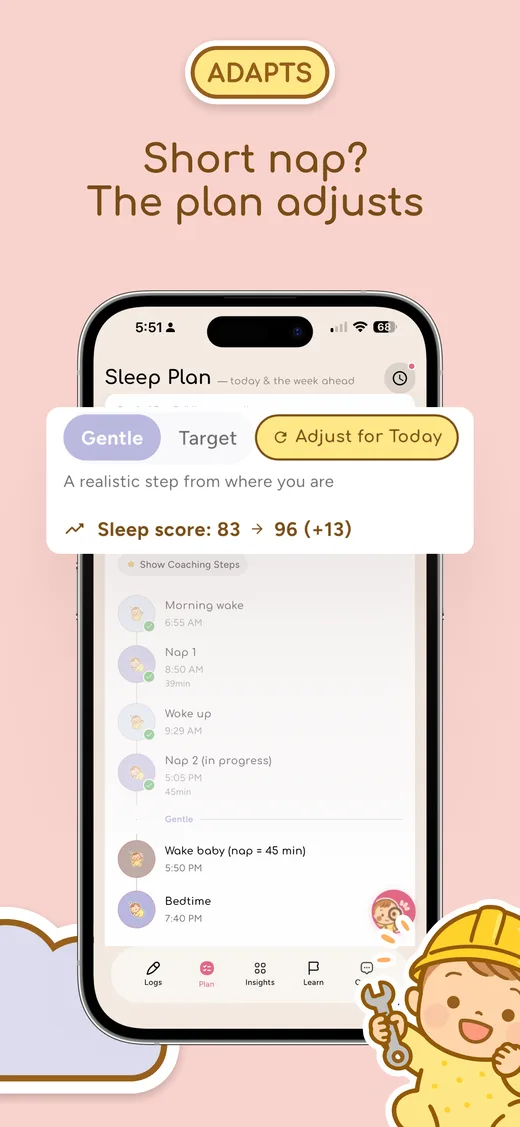
- Messy days had an answer. After a day out, Adjust Rest Of Today gave the same 8:30 bedtime I'd worked out by hand.
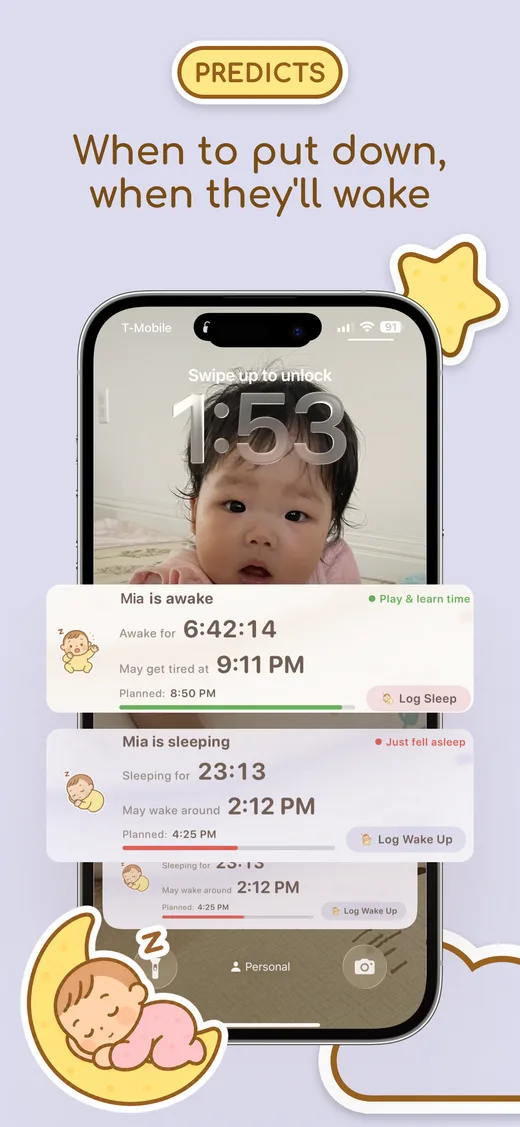
Bedtime keeps sliding back to 10pm?Log her morning wake time and Cocoo works out when she'll be tired for each nap and for bedtime that day.
When should you stop moving the schedule earlier?
Stop when her time in bed matches the sleep she needs. Our first target was a 7:00 wake and 7:30 bedtime. Her logs said no. She sleeps about 11 hours at night plus 2 hours of naps, about 13 hours a day, inside the 12 to 16 hours recommended at 4 to 12 months (Paruthi et al., 2016).
A 7:30pm to 7:00am night would give her 30 minutes more in bed than she sleeps, likely back as a wake-up. At 7:45 and asleep around 8:25 she fills the night, so we stopped there.
When it isn't a schedule problem
If she wakes crying rather than playful, start with our guide to false starts. See your pediatrician if she snores, pauses in breathing or seems in pain at night.
Related questions
How long does it take to move a baby's bedtime earlier?
In this case, 10 nights, from settling around 10pm to asleep at 8:24pm with no wake-ups, in 15-minute steps. That's one baby. A bigger shift takes longer, and if a step goes badly, stay on it an extra day or two.
Why does my baby wake up happy 30 minutes after bedtime?
A baby who wakes calm, chatty or playful soon after bedtime is often not tired enough yet. Her body clock isn't ready for night, so the first sleep is only a nap. An overtired baby tends to wake crying instead. If the wake is playful, move the whole day earlier rather than putting her down even sooner.
Should I wake my baby in the morning to fix a late bedtime?
Yes, while you're shifting. A later or earlier bedtime barely moves the next morning (Adams et al., 2020), but a set wake time with daylight pulls the evening along with it. Once bedtime lands where you want it, you can let her wake on her own.
Keep reading
Sources
Adams EL, Savage JS, Master L, Buxton OM. Time for bed! Earlier sleep onset is associated with longer nighttime sleep duration during infancy. Sleep Medicine. 2020;73:238–245. PubMed
Gradisar M, Jackson K, Spurrier NJ, et al. Behavioral interventions for infant sleep problems: a randomized controlled trial. Pediatrics. 2016;137(6):e20151486. PubMed
LeBourgeois MK, Carskadon MA, Akacem LD, et al. Circadian phase and its relationship to nighttime sleep in toddlers. Journal of Biological Rhythms. 2013;28(5):322–331. PubMed
Paruthi S, Brooks LJ, D'Ambrosio C, et al. Recommended amount of sleep for pediatric populations: a consensus statement of the American Academy of Sleep Medicine. Journal of Clinical Sleep Medicine. 2016;12(6):785–786. PubMed
Case data: one 8-month-old's sleep logs and daily schedules in our app, October 30 to November 18, 2026, London time, shared with her parent's permission. Names left out for privacy.
Bedtime stuck at 10pm? Start with tomorrow morning
Log her wake time and sleeps. Cocoo moves the naps and bedtime with her, day by day.