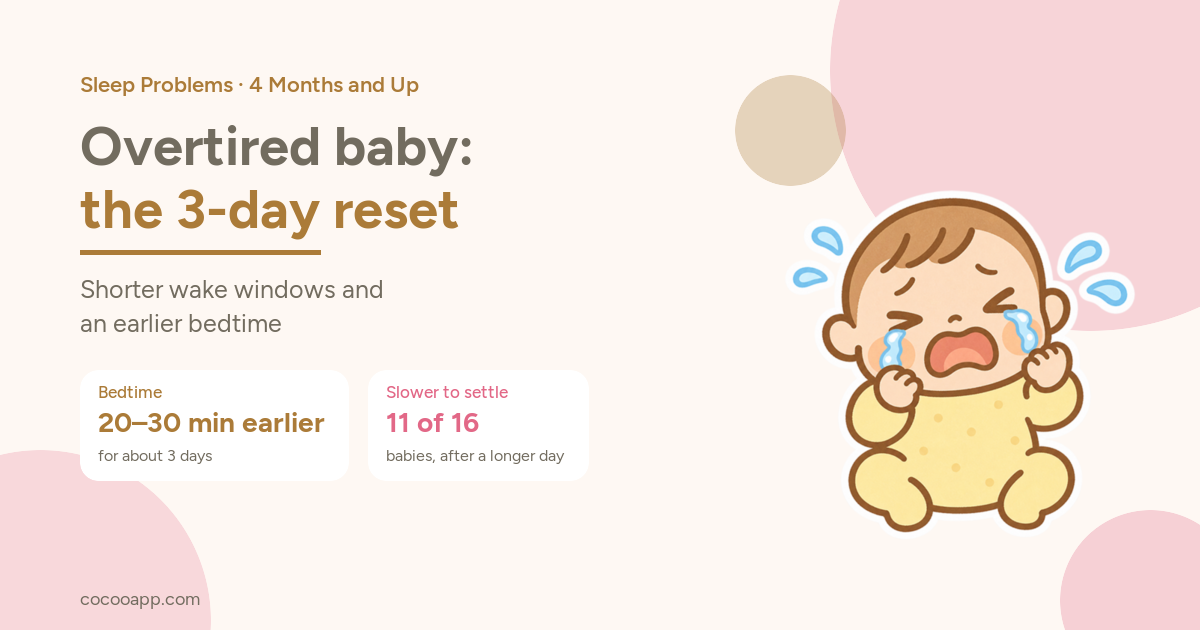
An overtired baby has been awake longer than she can comfortably handle, so she fights sleep instead of crashing. The fix is to make her wake windows 15 to 30 minutes shorter and move bedtime 20 to 30 minutes earlier for about 3 days.
It feels backwards, because she looks too tired to need help sleeping. In our logs, 11 of 16 babies took longer to fall asleep on nights after a longer-than-usual last stretch awake. Below: how to tell overtired from undertired, what to do tonight and the 3-day reset.
If it's 2am and your overtired baby won't settle
- →Lights off, white noise on, phone face down. Less to look at helps more than a new trick.
- →Pick one way to settle her (feeding, rocking, holding still) and stay with it for 10 minutes.
- →Help her to sleep however works. Tonight isn't the night to practice anything.
- →Don't keep her up to tire her out. Plan an earlier bedtime for tomorrow.
What are the signs of an overtired baby?
The clearest sign of an overtired baby is crying that builds the more you try to settle her, often after a burst of energy parents call the second wind. An undertired baby looks different: content in the crib, just not sleeping.
| What you see | Most likely | What I'd try |
|---|---|---|
| Yawning and rubbing eyes, then suddenly bright and giggly | Overtired. This is the second wind. | Start the wind-down now. Don't wait for the sleepy look to come back. |
| Crying gets louder the more you rock or shush | Overtired | Less input: dark room, white noise, hold still. Stop switching tricks. |
| Arching and pushing away from you | Overtired, or gas or reflux if it happens after feeds | Hold her upright for a few minutes, then try again in the dark. |
| Happy in the crib: rolling, chatting, no tears | Undertired | Give her 15 to 30 more minutes awake tomorrow, not an earlier bedtime. |
| Short naps all day, then a hard bedtime | Overtired by evening | Bring bedtime forward 30 to 45 minutes tonight. |
| Fine at bedtime, wakes 30 minutes later | A false start. Could be either. | See the false start test linked below before changing anything. |
If you're seeing a crash a few minutes after she falls asleep, read our false start guide first. In those, overtired and undertired babies both wake early in the night, and the fixes point opposite ways.
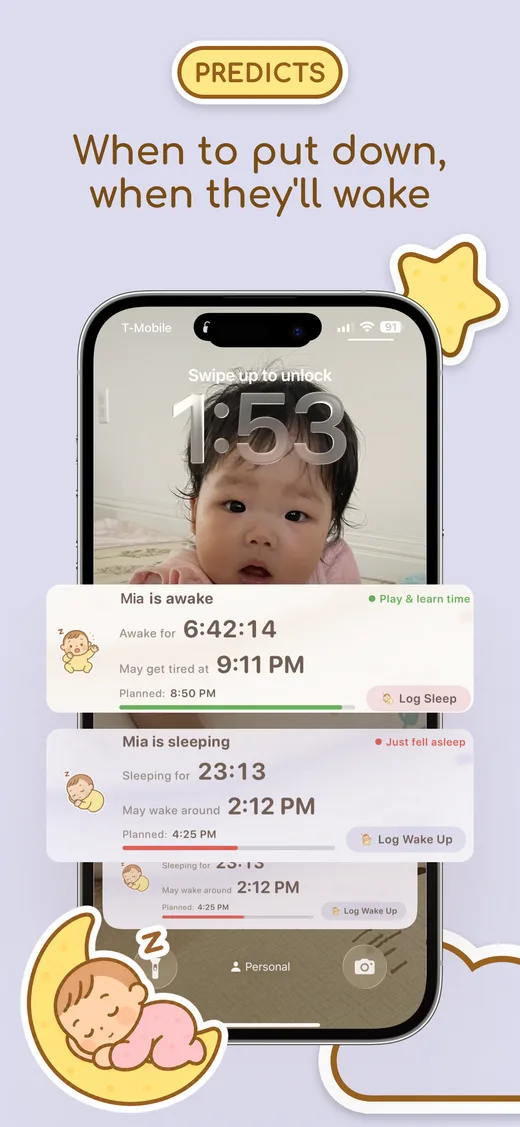
Not sure which row is your baby?Cocoo times each wake window and tells you when the next sleep is due, before the second wind starts.
Why does an overtired baby fight sleep?
An overtired baby fights sleep because a late bedtime makes falling asleep slower, and that part is well documented. In a national survey of 1,473 parents of children from newborn to 10 years, a bedtime after 9pm went with taking longer to fall asleep and getting less sleep in total (Mindell et al., 2009). That's a survey, so it shows the two go together, not which one causes the other.
The usual explanation is cortisol, a stress hormone, kicking in to keep her going. You'll read it everywhere. The research in babies is thinner than that makes it sound. One small study of 27 toddlers aged 12 to 36 months found that the ones with more broken-up sleep had higher cortisol when they woke up (Scher et al., 2010). Another, in daycare, found nap length had nothing to do with cortisol rising during the day (Watamura et al., 2002). Nobody has measured cortisol in a baby during a second wind.
So I hold the hormone story loosely. But the pattern parents describe is real, and it shows up in our own logs.
Does a longer day make bedtime harder?
For most babies in our logs, a longer-than-usual stretch before bed meant a slower bedtime. We compared each baby only with herself, so a naturally slow sleeper doesn't skew it.
11 of 16
babies were slower to fall asleep after a longer last wake window. 3 were faster.
51% vs 34%
of nights had 2+ wakings when falling asleep took 30+ minutes vs under 15
The typical baby took 16 minutes to fall asleep after her longer days and 14 after her shorter ones. Small, but it leaned the same way for most of them.
Night wakings didn't follow so neatly. Across all babies, slow bedtimes came with more wakings. But when each baby was compared with herself, a longer last stretch didn't reliably mean a worse night: 5 woke more and 7 woke less. So an earlier bedtime is a good bet for the fight at bedtime. I wouldn't promise it fixes 2am.
Our log data, pulled November 24, 2026. Within-baby comparison: 16 babies aged 4 to 18 months with at least 3 complete days above and 3 below their own median last wake window (215 days). Wakings by time to fall asleep: complete days, ages 4 to 24 months, 351 days from 77 babies. Aggregate, anonymized data only.
How do you reset an overtired baby?
To reset an overtired baby, catch every sleep a little earlier for 3 days. This is the plan I'd follow. No study has timed it, so treat the numbers as a starting point.
- 1
Day 1: find her real window
Look up the range for her age in our wake windows chart, then use the low end. At 6 to 8 months that's 2.5 hours, not 3. If she was already at the low end, take off another 15 minutes.
- 2
Day 1 evening: bedtime 20 to 30 minutes earlier
If naps were short, go up to 45 minutes earlier. A 6:15pm bedtime for a day or two is fine.
- 3
Days 2 and 3: same windows, every nap
Short naps are what usually tip the evening over. If a nap ends after 30 minutes, the next window starts then, so the next nap comes sooner. Our short naps post has more on that.
- 4
Day 4: ease back
Once she's falling asleep in about 15 minutes again, add 10 to 15 minutes to the last window every couple of days until bedtime is where you want it.
How long does it take to fix an overtired baby?
One overtired day usually settles after a night or two of earlier sleep. A week of late nights can take the full 3 days, and sometimes 5.
And if bedtime is still a fight after a week of shorter windows, I'd stop blaming tiredness. Look at whether she's undertired instead, or whether something else is going on: a new skill like crawling, teething, or a sleep regression. None of that is bad parenting. It just needs a different fix.
How can you tell the reset is working?
The reset is working when the minutes it takes her to fall asleep come down over 3 nights. Write the number down each night, because after a hard evening your memory will tell you nothing changed.
That number is what our app tracks for you. It records how long each settle takes, so you can see the trend across nights instead of judging by the last one. A climb over several days is often the first sign her windows have grown too long again.
Related questions
Do overtired babies wake up early?
Sometimes, and it's a common reason for a 5am start. In our logs, mornings that began before the expected wake time followed 9% of nights when the baby took 30+ minutes to fall asleep, against 5% when they fell asleep in under 15. That's only about six early mornings in the slow group, so treat it as a hint. If early waking is your main problem, there are other causes worth checking first, like a bedtime that's too early or light in the room.
Should I sleep train an overtired baby?
I'd fix the overtiredness first and start sleep training a few days later. A baby who's already wound up at bedtime will cry longer with any method, and that makes the method look like it's failing. Give her three days of shorter wake windows and an earlier bedtime. Once she's falling asleep in a reasonable time again, night 1 of the plan starts from a calmer place.
Keep reading
Sources
Mindell JA, Meltzer LJ, Carskadon MA, Chervin RD. Developmental aspects of sleep hygiene: findings from the 2004 National Sleep Foundation Sleep in America Poll. Sleep Medicine. 2009;10(7):771–779. PubMed
Scher A, Hall WA, Zaidman-Zait A, Weinberg J. Sleep quality, cortisol levels, and behavioral regulation in toddlers. Developmental Psychobiology. 2010;52(1):44–53. PubMed
Watamura SE, Sebanc AM, Gunnar MR. Rising cortisol at childcare: relations with nap, rest, and temperament. Developmental Psychobiology. 2002;40(1):33–42. PubMed
Cocoo log data, pulled November 24, 2026. Complete logged days with a bedtime settle time recorded (0 to 120 minutes). Within-baby wake window comparison: 16 babies, 4 to 18 months, 215 days. Wakings and early mornings by settle time: 4 to 24 months, 351 days, 77 babies. Aggregate, anonymized data only.
Catch the window before the second wind
Log her sleep and the app predicts when she'll get tired next, so the wind-down starts before the second wind.