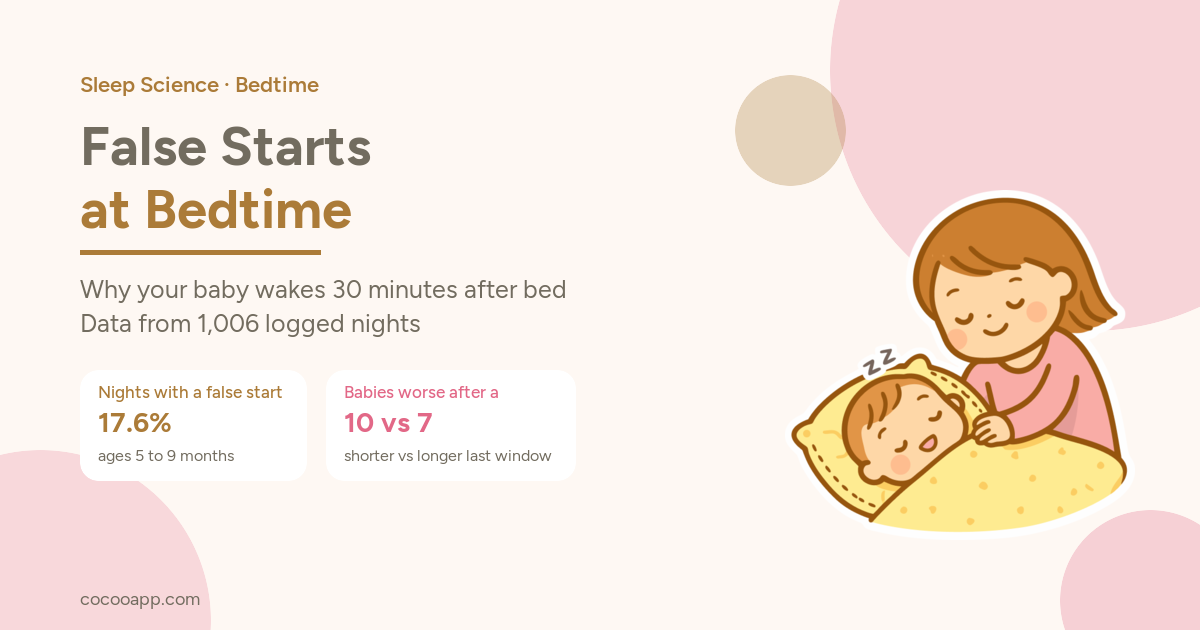
A false start is when your baby falls asleep at bedtime and wakes 10 to 60 minutes later. In 1,006 nights that parents logged for 74 babies aged 5 to 9 months, 17.6% began with one: about one night in six. Overtired and undertired babies both do it, and the fixes point in opposite directions, so the first job is working out which one you have.
You know the scene. Bottle, sleep sack, down by 8:30, quiet. You sit down, and 30 minutes later she's crying. Most advice online says she's overtired and bedtime should be earlier. For plenty of babies that's right. For a big minority it makes things worse.
This guide covers how to tell the two apart from what you can already see at bedtime, what to do with a day of short naps, and a 3-night test that settles the question for your baby.
How common are false starts? What 1,006 nights show
False starts at 5 to 9 months happen on roughly one night in six, and they get rarer as babies approach 9 months. We counted a false start when the first sleep of the night lasted 10 to 60 minutes and the baby was back asleep within 3 hours.
17.6%
of nights began with a false start (n=1,006 nights, 74 babies)
10 vs 7
babies worse after a shorter vs a longer last wake window (n=24)
| Age | Nights with a false start | Nights (babies) |
|---|---|---|
| 5 months | 19.0% | 284 (33) |
| 6 months | 21.3% | 301 (28) |
| 7 months | 16.0% | 225 (20) |
| 8 months | 14.9% | 101 (13) |
| 9 months | 8.4% | 95 (15) |
The second number is the one that changed how we write about this. We took the 24 babies with enough nights to compare against themselves and split each baby's nights into a longer and a shorter last wake window. Ten had more false starts after the shorter window, which points to too little sleep pressure. Seven had more after the longer one, which points to too much. Seven showed no difference either way, which points somewhere else entirely.
That's a small group, so read it as a direction, not a rate. But it's enough to say that "she's overtired, move bedtime earlier" is the right call for some babies and the wrong one for others.
Methodology: complete tracked days logged in Cocoo, ages 5 to 9 months, bedtime between 5:30pm and 11:30pm, pulled November 2, 2026. False start = first sleep starting within 90 minutes of the logged bedtime, lasting 10 to 60 minutes, followed by a new sleep within 3 hours. Within-baby comparison: babies with at least 3 nights above and 3 below their own median last wake window and at least one false start. Aggregate, anonymized data only.
What is a false start, and how is it different from a night waking?
A false start is a wake in the first hour after your baby falls asleep for the night. It's different from the 2am waking because of when it lands: your baby has only just gone down, so the wake tells you about bedtime itself (how tired she was and how she fell asleep), not about hunger or the middle of the night.
Waking briefly during the night is normal at every age. A review of 34 observational studies found infants wake anywhere from 0 to about 3 times a night (Galland et al., 2012). What develops over the first year is self-regulated sleep: longer stretches without needing a parent to get back down (Henderson et al., 2010). A false start is that skill being tested at the very first stretch of the night.
Is my baby overtired or undertired? The signs at bedtime
You can usually tell an overtired false start from an undertired one by two things you already see: how fast your baby fell asleep, and what she's like when she wakes.
| What you see | Points to overtired | Points to undertired |
|---|---|---|
| Falling asleep at bedtime | Out in under 5 minutes, sometimes mid-bottle | Takes 20+ minutes, rolls, chats, sits up |
| How she seems on the wake | Crying hard right away, hard to calm | Calm, babbling or wide awake and playful |
| Naps that day | Short naps, under about 2 hours in total | A long nap, or one that ended late |
| Last stretch before bed | Longer than her other wake windows | Shorter than usual, or under 2.5 hours at 7 months |
| After the false start | Goes back down fast once settled | Up for a while before she's sleepy again |
Mixed signals are common. If she fell asleep at a normal pace (10 to 20 minutes) and the wake looks the same most nights regardless of the day she had, look at the third cause below before you touch the schedule.
The third cause: how she fell asleep. A baby who was fed, rocked or patted all the way to sleep at bedtime can surface at that first light stretch and find the bottle gone or your hand missing. She's asking for the same help she fell asleep with. Behavioral approaches to bedtime settling have strong evidence: 94% of the 52 treatment studies in one review reported they worked (Mindell et al., 2006). You don't need full sleep training to test this. Ending the bottle a few minutes before she's fully asleep is a start.
The short-nap day: how to read it
Short naps are common at this age: 633 of the 1,006 days in our data (63%) had under 2 hours of naps in total. A short-nap day on its own doesn't predict a false start, though. Nights after under 2 hours of naps had a false start 16.3% of the time, about the same as every night. What matters is how the day ends. Here's an illustrative day (not a real baby's log) where it ends badly.
Example day, 7 months
- Wake7:00am
- Nap 19:30 to 10:10 (40 min)
- Nap 212:40 to 1:20 (40 min)
- Nap 33:50 to 4:20 (30 min)
- Bedtime8:00pm
- Total naps1 hr 50 min
- Last wake window3 hr 40 min
Every daytime wake window is a reasonable 2.5 hours. The problem is the end of the day: after under 2 hours of naps, the last stretch runs more than an hour longer than the others. On a day like this, an overtired false start is the likely story, and the fix is bedtime, not the naps: aim for her to be asleep around 7:15 to 7:30 so the last window is closer to 3 hours.
Parents in this spot often ask the opposite question: should I let the third nap run long to make up for the others? Usually no. A third nap that runs to 5:30 pushes bedtime late and can tip her into the undertired pattern instead. Keep it to 30 to 45 minutes and let bedtime absorb a bad nap day.
How long should the third nap be, and when should it end?
The third nap at 6 to 8 months should be short (30 to 45 minutes) and end 2.5 to 3 hours before you want her asleep for the night. Work backward from bedtime. For a 7:30pm bedtime, that means waking her between 4:30 and 5:00.
If she won't take a third nap at all, or fights it for 30 minutes most days, she may be getting ready for two naps. Most babies make that switch between 6 and 9 months. On the days she skips it, bring bedtime earlier rather than stretching her to the usual time. Our wake windows by age guide has the ranges for each month.
How to fix false starts: a 3-night bedtime test
The fastest way to fix false starts is to change one thing about bedtime, hold it for 3 nights, and watch what the false start does. There's no study on how many nights a bedtime test needs. We use 3 because a single night is too noisy to read.
- 1
Pick a direction from the signs
Crashes fast and wakes crying: you're testing overtired. Lies awake at bedtime and wakes happy: you're testing undertired. Can't tell: start with overtired, since an earlier bedtime is the easier change to undo.
- 2
Overtired test: move bedtime 20 to 30 minutes earlier
Start the whole routine earlier, not just lights out. If the bottle starts 30 minutes before bed, start it 30 minutes before the new time.
- 3
Undertired test: stretch the last wake window by 15 to 20 minutes
Either end the last nap earlier or push bedtime later. Keep the morning wake time the same.
- 4
Keep everything else the same for 3 nights
Same routine, same room, same response to the false start. A bedtime routine done the same way every night improves how fast babies fall asleep and how often they wake (Mindell et al., 2009), so changing it mid-test muddies the result.
- 5
Read the result
False start gone or shorter: you found the direction, keep it. Worse, or bedtime takes much longer: try the other direction. No change either way: the schedule probably isn't the cause, so look at how she falls asleep.
During the false start itself, tonight:
- →Keep the room dark and go in with the least help that works.
- →Don't restart the whole routine. A fresh bath and story tell her the night is starting over.
- →Respond the same way each night of the test, so the only thing changing is the one you picked.
- →Note how she seemed (crying or alert) and how long she was up. That's your data for step 5.
How Cocoo works out which kind of false start your baby has
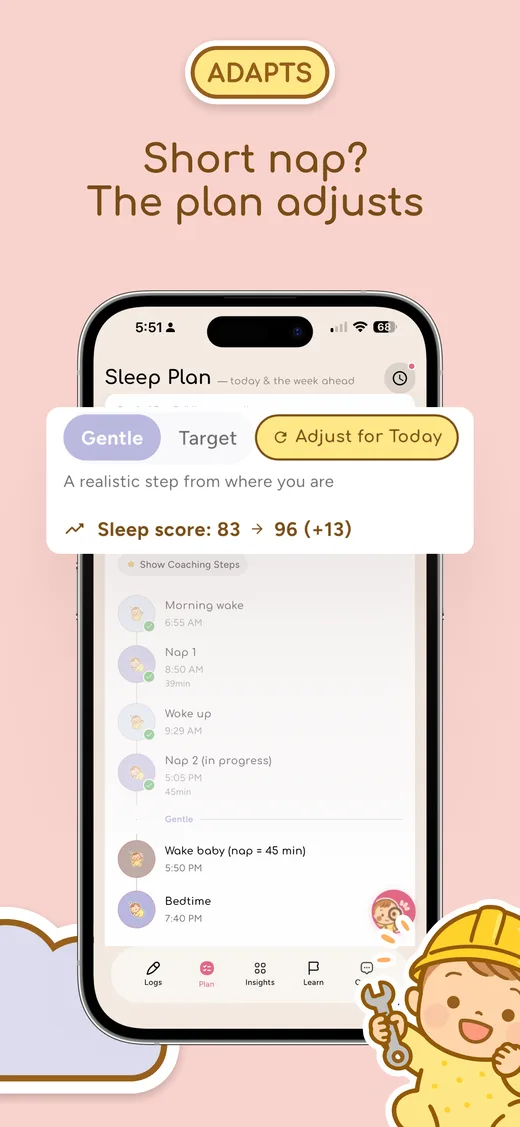
The app runs the same reasoning as this guide on your baby's own logs. You log the bedtime sleep and the wake as they happen, then open "Why won't my baby sleep?" in the chat and pick False Starts.
- →It asks the two bedtime questions from the table above: how fast she fell asleep, and how she seemed when she woke.
- →It compares her last wake window and nap total with her own recent days, not only with an age chart. That's how it tells "long for her" from "long for a 7-month-old".
- →It asks how she falls asleep and what you do on the wake, to rule a sleep association in or out.
- →It ranks the likely causes and suggests one change to hold for a few days, then tracks whether the false starts shrink.
It needs 2 to 3 days of logs to see a pattern, and it can't know about teething or a cold unless you tell it. Logging is free; the full diagnosis is part of Pro after your first 2 days.
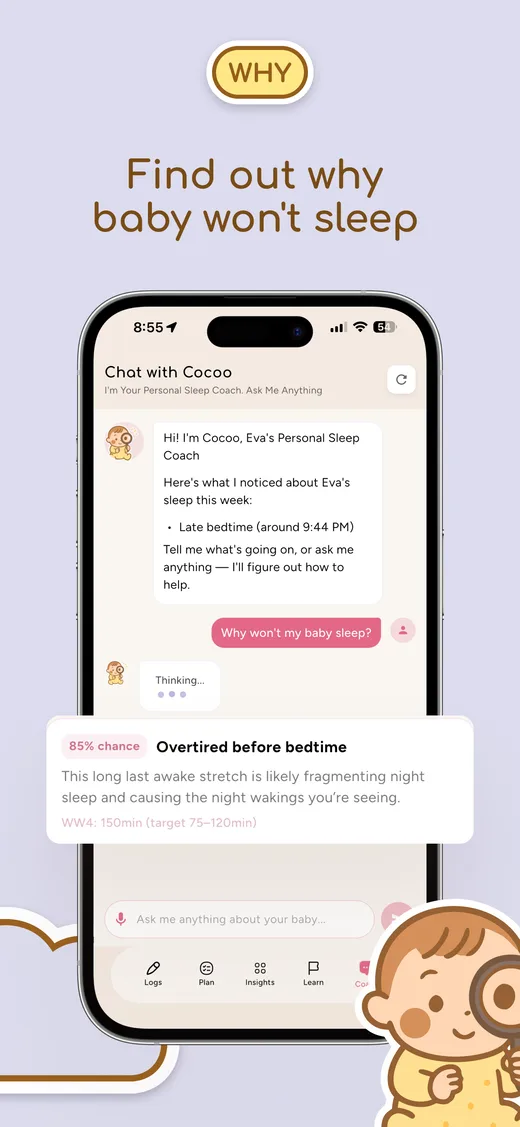
Logging tonight's false start?Cocoo's coach compares her last wake window and nap total with her own recent days and ranks the likely causes of the early wake.
When a false start isn't a schedule problem
Call your pediatrician if the wakes come with snoring, pauses in breathing, fever, pulling at ears, or crying that nothing settles. Pain and illness cause early-night wakes too, and no bedtime change fixes those. This guide is general information, not medical advice.
Related questions
What causes false starts at bedtime?
Three things cause most false starts. An overtired baby goes down with too much sleep pressure, often after short naps and a long last wake window, and wakes upset. An undertired baby goes down without enough sleep pressure and wakes alert. And a baby who was fed, rocked or patted to sleep can wake at the first light stretch of sleep and need the same help to settle again.
Keep reading
Sources
Galland BC, Taylor BJ, Elder DE, Herbison P. Normal sleep patterns in infants and children: a systematic review of observational studies. Sleep Medicine Reviews. 2012;16(3):213–222. PubMed
Henderson JMT, France KG, Owens JL, Blampied NM. Sleeping through the night: the consolidation of self-regulated sleep across the first year of life. Pediatrics. 2010;126(5):e1081–e1087. PubMed
Mindell JA, Kuhn B, Lewin DS, Meltzer LJ, Sadeh A. Behavioral treatment of bedtime problems and night wakings in infants and young children. Sleep. 2006;29(10):1263–1276. PubMed
Mindell JA, Telofski LS, Wiegand B, Kurtz ES. A nightly bedtime routine: impact on sleep in young children and maternal mood. Sleep. 2009;32(5):599–606. PubMed
Aggregate sleep data: complete tracked days, ages 5 to 9 months, n=1,006 nights from 74 babies; within-baby comparison n=24 babies, 731 nights. Pulled November 2, 2026.
Find out which kind of false start your baby has
Log tonight's bedtime and the wake. After 2 to 3 days, Cocoo compares them with her own pattern and tells you which change to test first.