
When a baby fights sleep despite being clearly tired, it almost always means they've passed their ideal sleep window and become overtired. The body responds by releasing cortisol — a stress hormone — to sustain alertness. This creates a vicious cycle: the more exhausted they are, the harder it is to fall asleep.
This is counterintuitive. It means keeping them up longer makes things worse. And it means the fix — catching the sleep window earlier — feels wrong until you understand why it works. Here's the science, real data from babies tracked in Cocoo, and exactly what to do right now.
Why overtired babies fight sleep harder
Sleep pressure — the biological drive to sleep — is governed by adenosine, a chemical that builds up while we're awake (Borbély, 1982). In young babies, this pressure builds faster than in adults. When a baby is tired, adenosine is high, and drowsy cues appear: slow blinks, yawns, quieting movements.
But the body has a failsafe. If it detects that sleep isn't coming — if the baby remains upright, stimulated, or distressed — the adrenal glands release cortisol to override the adenosine signal and maintain wakefulness. This is the biological purpose of a “second wind.”
Cortisol doesn't just make a baby look alert. It raises heart rate, increases muscle tension, lowers the crying threshold, and can take 30–60 minutes to clear the system even after a baby finally falls asleep — shortening that first sleep cycle and increasing the chance of an early waking.
The counterintuitive truth
A baby who fights sleep is not undertired. They are overtired. Keeping them up longer — hoping they'll “tire out more” — adds more cortisol and makes sleep harder. The solution is always to catch them earlier next time.
What we found: data from 751 babies
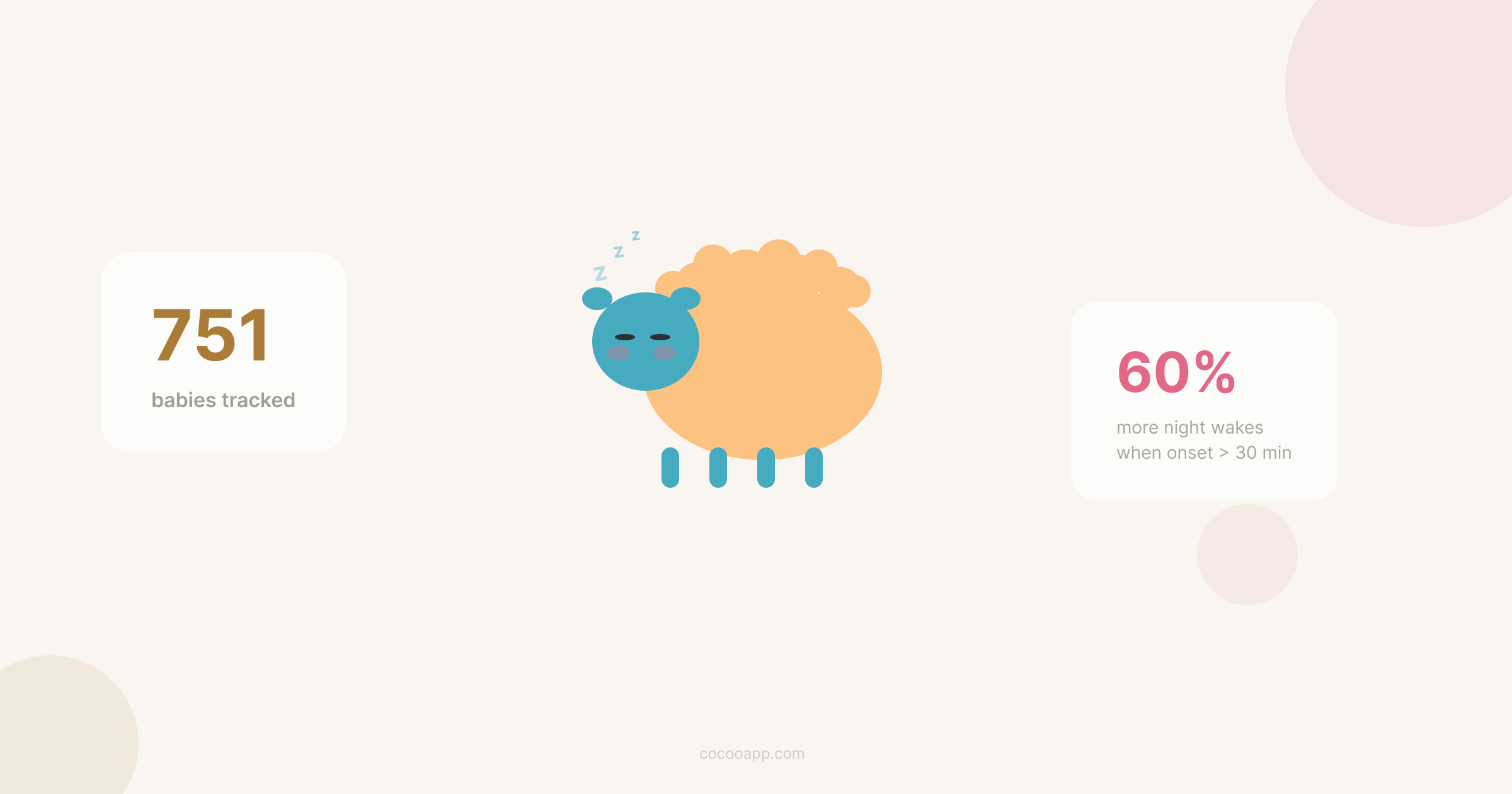
Cocoo tracks sleep onset latency — how long it takes a baby to fall asleep after being put down. We analyzed complete logged days from 751 baby profiles to understand how sleep onset time relates to night sleep quality.
Methodology: Analysis used complete tracked days (is_complete_day = true) with recorded bedtime onset latency. Outliers above 120 minutes were excluded. Sample sizes by age band ranged from n=16 to n=27 days.
Finding 1: Slow sleep onset predicts more night wakings
Nights when babies took more than 30 minutes to fall asleep were associated with 60% more night wake events compared to nights when they fell asleep in under 10 minutes.
| Sleep onset time | Avg night wakes | Avg night sleep |
|---|---|---|
| Fast (≤10 min) | 1.1 | 11.1 hrs |
| Normal (11–20 min) | 1.0 | 11.2 hrs |
| Slow (21–30 min) | 1.0 | 10.7 hrs |
| Very slow (>30 min) | 1.7 | 10.8 hrs |
Source: Cocoo aggregate data, 108 complete logged days. Individual data is never used or shared.
Finding 2: Sleep onset latency drops sharply with age
Young babies take much longer to fall asleep than older babies — and at nap time, even longer than at bedtime. By 9–10 months, the median bedtime onset latency is under 7–10 minutes. This matters because parents often assume a 20-minute bedtime fight is normal for a newborn, when it's actually a signal worth tracking.
| Age | Median bedtime latency | Avg nap latency | Avg night wakes |
|---|---|---|---|
| 2 months | 14.6 min | 31.8 min | 1.9 |
| 3 months | 13.5 min | 20.1 min | 1.8 |
| 4 months | 13.7 min | 14.0 min | 0.8 |
| 9 months | 6.7 min | 5.8 min | 1.3 |
| 10 months | 10.0 min | 5.2 min | 0.4 |
Source: Cocoo aggregate data. Age bands with n < 15 complete days excluded.
These patterns align with published research. Galland et al. (2012) found that sleep consolidation — and therefore faster sleep onset — increases substantially across the first year. The nap latency gap between 2 months and 10 months in our data (31.8 vs 5.2 minutes) reflects that same developmental arc.
Overtired vs. just tired: how to tell the difference
Tired cues come before the overtired window. Overtired cues come after. The goal is to catch the first set.
Tired (catch this window)
- Slowing movement or activity
- Longer blinks, eyes getting heavy
- Decreased interest in toys or faces
- First yawn or two
- Quieter, less vocal
- Rubbing eyes gently
Overtired (window has passed)
- Arching back, hard to hold
- Crying that escalates then stops then restarts
- Glazed stare or frantic eye movements
- Refuses breast or bottle then demands it
- Gets a “second wind” — suddenly seems alert again
- Screams when put down, screams when held
The second-wind look is particularly misleading. A baby who goes suddenly quiet and alert after 20 minutes of crying isn't “over it” — their cortisol has peaked and they're now in a hypervigilant state. If you put them down now, they may seem fine for 5–10 minutes before the full overtired crash hits.
Wake windows: what “earlier” actually means by age
A wake window is the amount of time a baby can comfortably stay awake between sleep periods. When you exceed it, cortisol kicks in. The research — and tracking data — suggests these windows are narrower than most parents expect, especially early on.
| Age | Wake window | Typical naps/day |
|---|---|---|
| 0–6 weeks | 45–60 min | 5–6 |
| 2–3 months | 60–90 min | 4–5 |
| 3–4 months | 75–105 min | 4 |
| 5–6 months | 1.5–2.5 hrs | 3 |
| 7–9 months | 2.5–3.5 hrs | 2–3 |
| 10–12 months | 3–4 hrs | 2 |
| 13–18 months | 4–5 hrs | 1–2 |
These are general starting points based on published literature including Galland et al. (2012) and the Sleep Foundation. Your baby may need 15–20% variation either way — track to find their specific window.
The last wake window of the day — before bedtime — is the most critical. Paruthi et al. (2016) found that irregular or extended evening awake periods were associated with shorter total sleep in the AASM Pediatric Sleep Recommendations. Most parents lengthen the pre-bedtime wake window trying to tire the baby out — this reliably backfires.
How Cocoo uses this
Cocoo's schedule suggestions are built around your baby's tracked wake windows — not a generic chart. After a few days of logged data, it can detect whether your specific baby runs short or long on their windows, and flag when they're consistently ending up in the overtired zone.
What to do right now if your baby is fighting sleep
Two situations: they're overtired right now, or you want to prevent it happening tomorrow.
Right now: they're already in an overtired state
- 1
Stop trying to put them down immediately.
You cannot force sleep over cortisol. Trying harder — more bouncing, more shushing, more putting down — escalates the stress response.
- 2
Reduce all stimulation.
Dim or dark room, continuous low white noise, stop eye contact. You want the environment to signal safety and calm.
- 3
Hold them still and firmly.
Vigorous rocking can over-stimulate an overtired nervous system. A slow sway or firm still hold with white noise often works better.
- 4
Offer a feed if you haven't recently.
Sucking is neurologically calming regardless of hunger. Breastfeeding in particular releases cholecystokinin, which has a sedating effect.
- 5
Wait for a drowsy window, then try again.
After 10–20 minutes of calm holding, watch for the drowsy cues returning. That's your moment. Put them down drowsy, not asleep.
Tomorrow: prevent it from happening again
- 1
Move the next nap or bedtime 15 minutes earlier.
Just 15 minutes. Don't jump an hour — you'll undershoot sleep pressure. A small, consistent adjustment is more effective.
- 2
Start the wind-down before they show tired cues.
If their wake window is 90 minutes, start your routine at 75. Dimming lights, quieting activity, and changing into a sleep sack are all environmental sleep cues that lower cortisol before the window closes.
- 3
Track the actual time from wake to sleep.
Sleep feels random until you see the data. Most parents are surprised by how short the window actually is. Log a few days — even approximate times on your phone — and patterns usually appear within a week.
When it's not overtiredness
Overtiredness is the most common cause of a baby fighting sleep, but not the only one. If you've been consistently catching early tired cues and your baby still fights sleep every time, consider:
Sleep association dependency
If your baby only falls asleep nursing, rocking, or being held, they may be protesting the absence of that condition — not overtiredness. They might be the right level of tired but unable to initiate sleep without the association. See our guide on how to address this.
How to Stop Holding Baby to Sleep →Undertiredness (not enough sleep pressure)
A baby who napped too long in the day or was put down too early at night may fight sleep because they're not tired enough yet. If the cues are missing entirely — no yawns, no eye rubbing, happy and engaged — they may need more wake time, not less.
Physical discomfort
Gas, reflux, teething, or illness can cause sleep resistance that looks like overtiredness. If your baby is inconsolable, arching, and not calmed by holding, rule out physical causes. The AAP has useful guidance on infant discomfort at healthychildren.org.
Developmental leap or regression
New motor skills (rolling, crawling, pulling to stand) and cognitive leaps can temporarily disrupt sleep. This looks like sudden onset of fighting sleep in a baby who had been settling well. It usually resolves within 1–2 weeks.
The one thing that consistently helps
If there's a single evidence-backed intervention for reducing sleep resistance, it's a consistent bedtime routine. Mindell et al. (2009) found that a nightly routine with consistent sequence and timing significantly reduced night wakings and shortened sleep onset in infants across multiple countries.
The mechanism isn't just habit — it's anticipatory cortisol regulation. The familiar sequence (bath, feed, dim lights, song, sleep sack) becomes a physiological signal to begin downregulating. The brain starts preparing for sleep before the baby is even in the crib. The American Academy of Pediatrics recommends it as a first-line sleep intervention.
The routine doesn't need to be long. 15–20 minutes is enough. What matters is repetition — the same steps, in the same order, starting at roughly the same time relative to the last nap.
Frequently asked questions
Why does my baby fight sleep when they're clearly tired?
Babies who fight sleep despite showing tired cues have almost always passed their sleep window. The body responds to missed sleep by releasing cortisol, which creates a second wind — they look wired, cry harder, and fight sleep more as exhaustion increases. The fix is catching them 15–20 minutes earlier, before cortisol kicks in.
What does an overtired baby look like?
An overtired baby often looks paradoxically alert: glazed stare, back-arching, crying that stops and restarts unpredictably, or suddenly seeming calm and content again (the cortisol plateau). True tired cues — yawning, slowing movements, heavy eyelids — happen before overtiredness. The goal is to catch those earlier signs.
Should I keep my baby up longer if they're fighting sleep?
No. This is one of the most common mistakes. If your baby is fighting sleep, keeping them up longer adds more cortisol and makes sleep harder. The solution is the opposite: move the next sleep attempt earlier. If they're overtired right now, focus on calming first, then watch for the next drowsy window.
How do I calm an overtired baby who won't stop crying?
Reduce stimulation first — dim lights, white noise, stop eye contact. Hold still and firmly rather than rocking vigorously. Offer a feed if you haven't recently. Most overtired babies need 10–20 minutes of calming before they can accept sleep. Don't rush the crib — getting them to drowsy in arms is step one.
What are the wake windows by age?
Approximate ranges: newborn 45–60 min; 2–3 months 60–90 min; 3–4 months 75–105 min; 5–6 months 1.5–2.5 hrs; 7–9 months 2.5–3.5 hrs; 10–12 months 3–4 hrs. These are starting points — your baby may run 10–20% shorter or longer. Track a few days to find their actual window.
Want to understand the full sleep science behind Cocoo's approach? Read how Cocoo uses sleep research to build better schedules.
More from the Cocoo blog
Stop guessing your baby's sleep window
Cocoo tracks your baby's actual wake windows from real logged data — so you can see the pattern before the overtired meltdown starts.
Download Cocoo — free to startAvailable on iOS and Android
Sources
- 1.Borbély, A. A. (1982). A two process model of sleep regulation. Human Neurobiology, 1(3), 195–204.
- 2.Galland, B. C., Taylor, B. J., Elder, D. E., & Herbison, P. (2012). Normal sleep patterns in infants and children: A systematic review of observational studies. Sleep Medicine Reviews, 16(3), 213–222.
- 3.Mindell, J. A., Telofski, L. S., Wiegand, B., & Kurtz, E. S. (2009). A nightly bedtime routine: Impact on sleep in young children and maternal mood. Sleep, 32(5), 599–606.
- 4.Paruthi, S., et al. (2016). Recommended amount of sleep for pediatric populations. Journal of Clinical Sleep Medicine, 12(6), 785–786.
- 5.Jenni, O. G., Borbély, A. A., & Achermann, P. (2005). Development of the nocturnal sleep electroencephalogram in human infants. American Journal of Physiology, 286(3), R528–R538.
- 6.Henderson, J. M. T., France, K. G., Owens, J. L., & Blampied, N. M. (2010). Sleeping through the night: The consolidation of self-regulated sleep across the first year of life. Pediatrics, 126(5), e1081–e1087.
- 7.American Academy of Pediatrics. (2022). Safe sleep recommendations. Pediatrics, 150(1), e2022057990.
- 8.Cocoo internal aggregate data. (2026). Sleep onset latency and night wake analysis across 751 tracked baby profiles. Anonymized and aggregated. cocooapp.com.