Self-soothing is when a baby wakes at night and falls back asleep without a parent's help. Babies learn it gradually over the first year, mostly through practice, and Burnham et al. (2002) found that babies put into the crib awake at bedtime were more likely to learn it. It has nothing to do with emotional maturity or personality. And you can watch it form in your baby's sleep data.
The phrase gets argued about online because two different things share the name. The emotional-regulation sense (a toddler managing frustration) is years away, and nobody is asking a 5-month-old to do it. The sleep sense is modest and well documented. Everything below is about the sleep sense: what it looks like, how babies learn it, and how to tell it's happening.
What this guide covers
- 1Signalers and self-soothers: the research definition
- 2Why every baby wakes at night, and why that's not the problem
- 3The three ingredients babies need to learn it
- 4What it looks like in the data, in the order it appears
- 5What self-soothing is not
- 6Where sleep training fits (and when you don't need it)
What does self-soothing mean in sleep research?
In sleep research, a self-soother is a baby who wakes at night and resettles alone, and a signaler is a baby who cries or calls out for a parent. The terms come from infant sleep studies that filmed babies overnight. Anders and colleagues (1992) watched what happened after a night waking and sorted babies into two groups: signalers, who cried or called out until a parent came, and self-soothers, who stirred, maybe fussed briefly, and went back to sleep on their own. Both groups woke about as often. They differed in what they did after waking.
Burnham et al. (2002) followed babies from 1 to 12 months with the same video method. The share who self-soothed after a waking climbed steadily across the year. Two things predicted it: being put into the crib awake at bedtime, and spending less time out of the crib during night wakings. Both mean more chances to do the falling-asleep part alone.
Do babies who self-soothe still wake at night?
Babies who self-soothe still wake at night, because sleep runs in cycles and everyone surfaces briefly between them. Adults roll over and forget it. Babies have shorter cycles, so they surface more often. "Sleeping through the night" never meant zero wakings: Henderson et al. (2010) defined it as the baby resettling between midnight and 5am without a parent, and found most infants manage that by around five months.
So the goal is for wakings to stop needing you. Keep that in mind when you look at your data. Night-wake count is the last number to improve, and wakings get shorter before they get rarer.
How do babies learn to self-soothe?
Babies learn to self-soothe when three things are in place: a chance to fall asleep in the crib, a predictable response to wakings, and a steady body clock.
Opportunity. Falling asleep has to happen in the crib, not in your arms, or the baby never gets to practise the last step. That's why drowsy-but-awake at bedtime matters so much. A baby who falls asleep being rocked and wakes in a crib has, from their point of view, woken somewhere new.
Consistency. The response to a waking has to be predictable. If crying sometimes brings a feed, sometimes a pat, sometimes nothing, the baby keeps testing to find out which tonight is. The same short response every time ends the testing.
A steady body clock. A bedtime and wake time that don't swing by more than about half an hour. The circadian rhythm that supports longer stretches matures around 4 to 6 months, and it only consolidates if the schedule gives it something regular to lock onto.
The list doesn't include a particular method, amount of crying or temperament. Sleep methods differ only in how much structure they add to the first two ingredients.
What are the signs a baby is learning to self-soothe?
The signs of self-soothing show up in a baby's sleep log in a fixed order: crying falls first, then time to fall asleep, then the length and number of night wakings. You'll see it if you log bedtimes, wakings and crying for a week or two. Knowing the order stops you from reading night 3 as a failure.
Crying per night falls
Usually within the first three nights of consistent put-downs. Your baby still protests, but for less time, because protesting no longer brings anything new.
Time to fall asleep drops
Under about 15 minutes is the target for most babies. This is the clearest sign the skill is forming, because your baby is doing the falling-asleep part alone.
Night wakings get shorter, then fewer
This changes last and is the strongest evidence. A baby who resettles a 2am waking in four minutes without you is self-soothing by any definition.
Bedtime barely moves
A steady bedtime is what makes the other three possible. A bedtime that swings by an hour keeps resetting the body clock the skill depends on.
Cocoo's Coaching tab draws this chart: crying, time to fall asleep and night wakings plotted night by night, with plan nights marked, so you can see which line is moving. Whatever you use, read three nights at a time. One bad night inside a falling line is noise. Three rising nights in a row are a signal.
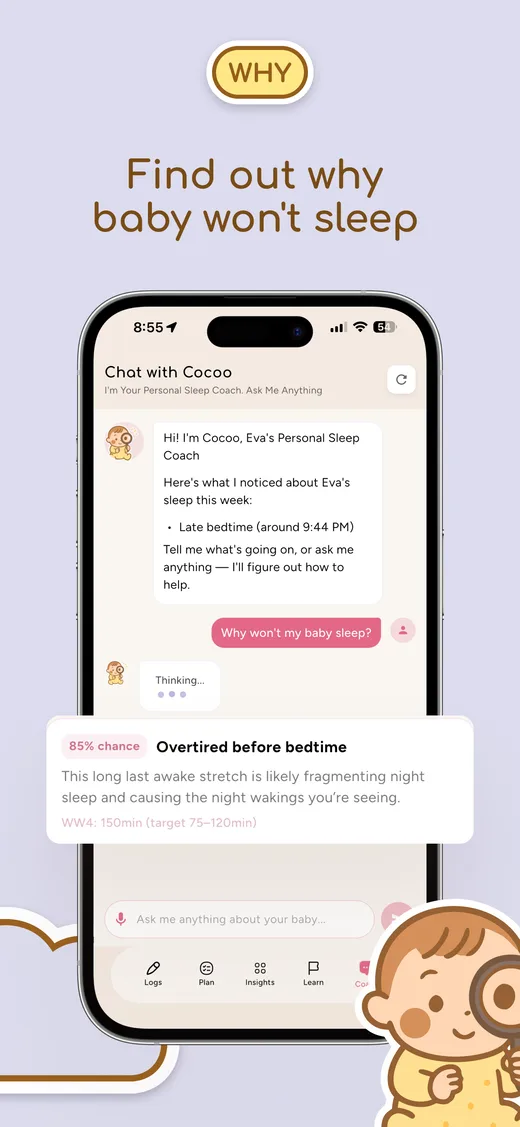
Can't tell which line is moving?Log bedtimes, night wakings and crying in Cocoo, and the Coaching tab plots each one night by night so you can read three nights at a time.
What self-soothing is not
Self-soothing is a narrow sleep skill, and four common beliefs about it don't hold up.
- Not independence. A 6-month-old who resettles at 2am still needs you for everything else, and wants you the moment they're awake for real.
- Not 'learned helplessness'. Trials that followed sleep-trained babies for a year (Gradisar et al., 2016) and five years (Price et al., 2012) found no differences from controls in attachment, stress hormones, behavior or the parent–child relationship.
- Not something you either have or don't. Temperament changes how long it takes and how loud the protest is, not whether it's learnable.
- Not permanent. Illness, travel and developmental leaps bring signaling back for a few nights. The skill returns with the same consistent response, usually within two or three nights.
Does a baby need sleep training to learn self-soothing?
A baby doesn't need sleep training to learn self-soothing, but sleep training is a structured way to supply opportunity and consistency for a baby who isn't getting enough of either. Behavioral methods like these have a solid evidence base for bedtime problems and night wakings (Mindell et al., 2006). Some babies never need it: consistent drowsy-but-awake put-downs from a few months old give them all the practice they need. Others, especially those who learned to fall asleep being fed or rocked, need the structure of a plan because the habit is already strong.
If you go that route, the method matters less than people think and the consistency matters more. See the methods compared, the Ferber chart with what to do at each check, and why night 4 gets worse before you start, so the push-back night doesn't surprise you.
Related questions
At what age can babies self-soothe?
Self-soothing develops across the first year. In Burnham et al. (2002), the share of babies who self-soothed after a night waking rose from 1 to 12 months of age. Most sleep researchers put the window where babies can reliably learn it at around 4 to 6 months, once the circadian rhythm has matured enough to support longer night stretches.
Is self-soothing the same as sleep training?
No. Self-soothing is the skill of falling back asleep without help, and sleep training is one structured way to give a baby practice at it. Some babies learn it with no formal training, through consistent drowsy-but-awake put-downs. Others, especially babies used to being fed or rocked to sleep, need the structure of a plan to get enough practice.
Keep reading
Sources
Anders, T. F., Halpern, L. F., & Hua, J. (1992). Sleeping through the night: A developmental perspective. Pediatrics, 90(4), 554–560.
Burnham, M. M., Goodlin-Jones, B. L., Gaylor, E. E., & Anders, T. F. (2002). Nighttime sleep-wake patterns and self-soothing from birth to one year of age: A longitudinal intervention study. Journal of Child Psychology and Psychiatry, 43(6), 713–725.
Henderson, J. M. T., France, K. G., Owens, J. L., & Blampied, N. M. (2010). Sleeping through the night: The consolidation of self-regulated sleep across the first year of life. Pediatrics, 126(5), e1081–e1087.
Gradisar, M., et al. (2016). Behavioral interventions for infant sleep problems: A randomized controlled trial. Pediatrics, 137(6), e20151486. publications.aap.org
Price, A. M. H., Wake, M., Ukoumunne, O. C., & Hiscock, H. (2012). Five-year follow-up of harms and benefits of behavioral infant sleep intervention. Pediatrics, 130(4), 643–651.
Mindell, J. A., Kuhn, B., Lewin, D. S., Meltzer, L. J., & Sadeh, A. (2006). Behavioral treatment of bedtime problems and night wakings in infants and young children. Sleep, 29(10), 1263–1276.
Want to see the skill forming in your own baby's nights?
Log a few nights in Cocoo and the Coaching tab plots crying, time to fall asleep and night wakings so you can watch the lines move in order. If you decide on a plan, it runs the check-ins and keeps the response the same at every waking.