
Yes, the 10-month sleep regression is real. At around 10 months, most babies hit a cluster of developmental changes at the same time — new motor skills, a leap in cognitive development, and the early pressure of an approaching nap transition. The result is a baby who was sleeping fine at 9 months and suddenly isn't.
What surprises most parents: the disruption usually shows up as nap problems and a harder bedtime, not primarily as more night waking. If you're expecting your baby to start waking every two hours again the way they did at 4 months, that's often not what happens here. The pattern is different — and so is the fix.
Here are the 3 root causes behind the 10-month disruption, how to tell which one is yours, and what to actually do about it.
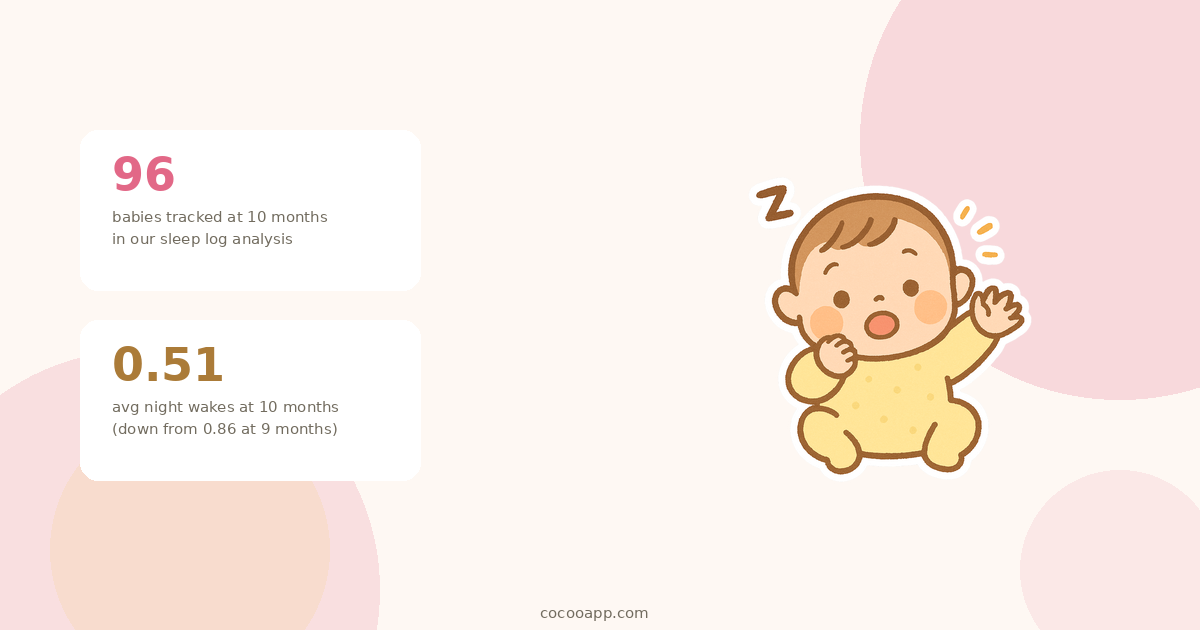
What we found in 96 babies' sleep logs at 10 months
Cocoo analyzed complete tracked days from 96 babies at 10 months of age, alongside surrounding months for comparison. The pattern was clear — and counterintuitive.
0.51
avg night wakes at 10 months
38
short nap flags at 9–11 months vs 10 night wake flags
| Age | Avg night wakes | Bedtime latency | Avg naps/day |
|---|---|---|---|
| 9 months | 0.86 | 9.1 min | 1.87 (n=93) |
| 10 months← regression window | 0.51 | 12.3 min | 1.80 (n=96) |
| 11 months | 0.41 | 20.3 min | 1.70 (n=37) |
Night wakes at 10 months are actually lower than at 9 months (0.51 vs. 0.86). But bedtime onset latency — how long it takes a baby to fall asleep — increases. The 11-month trend continues in the same direction, though with a smaller sample (n=37 vs. 96) so treat those numbers as directional. And the most commonly flagged issue at 9–11 months isn't night waking at all: it's short naps, flagged nearly 4× more often.
The 10-month disruption isn't a night problem. It's a daytime problem that makes evenings harder.
Methodology: complete tracked days (is_complete_day = true), ages 9–11 months. Sample sizes: 9mo n=93, 10mo n=96, 11mo n=37. Bedtime latency = bedtime_onset_latency_avg_minutes. Source: Cocoo aggregate data, anonymized. Individual data is never used or shared.
Nap transition pressure — the approaching 2-to-1 switch
Most babies drop from 2 naps to 1 somewhere between 13 and 18 months. But the pressure starts building earlier. By 10 months, many babies can technically stay awake long enough that the second nap of the day is eating into overnight sleep — but they're not quite ready to drop it entirely.
This creates a bind: two naps is too much daytime sleep, but one nap leaves a dangerously long afternoon stretch. The result is a baby who fights the second nap for 45 minutes, finally falls asleep at 4:30pm, and then can't settle at bedtime until 9pm.
In Cocoo data, nap count at 10 months averages 1.80 — down from 1.87 at 9 months — with the trend continuing to 1.70 at 11 months. The transition is already underway, even if the baby still technically takes two naps most days.
Signs this is your cause:
- →Second nap is a 40-minute fight before a 20-minute sleep
- →Bedtime is pushing later and later
- →Baby wakes early in the morning even though bedtime was late
- →On days where the second nap is skipped, nights are better
What to try: Cap the second nap at 30–45 minutes and keep it before 3:30pm. Or try a “bridge nap” — a short 20-minute second nap in the car to take the edge off without affecting bedtime. Don't rush the full 2-to-1 transition yet; at 10 months most babies aren't quite ready. Just adjust timing and caps.
Tracking helps here because the nap-to-bedtime relationship is hard to see without data. Cocoo automatically detects when your baby is oscillating between nap counts and shows both schedule options side by side, so you can compare how each affects overnight sleep.
Motor development leap — the pulling-to-stand phase
Between 9 and 11 months, most babies master pulling to stand. Some start cruising. A few begin standing unsupported. These are neurologically expensive skills — the brain is building and pruning motor pathways rapidly, and this process doesn't stop when the lights go out.
Mindell et al. (2006) described how periods of rapid motor acquisition reliably coincide with sleep disruption in infants. The current understanding is that motor memory consolidation — the process by which a new physical skill becomes automatic — happens primarily during sleep, particularly during REM and slow-wave sleep. During the height of a motor leap, babies spend more time in light sleep stages, which means more partial arousals.
The giveaway is physical: you put your baby down in their crib and they immediately pull to standing. They haven't figured out how to get back down easily yet, so they cry for you — not from hunger, not from a sleep association, but because they're stuck. This can happen multiple times in one night.
Signs this is your cause:
- →Baby learned to pull to stand in the last 2–3 weeks
- →You find them standing in the crib when they wake
- →Night wakes are brief — they just need help settling, not feeding
- →Daytime naps are fine but bedtime is harder
What to try: Practice standing and sitting down during the day — actively drill the “bend at the knees to lower” motion. The faster your baby masters lowering themselves from standing, the faster this resolves. At night, a brief reassurance without a full pickup (hand on back, verbal comfort) is usually enough once they're not physically stuck. This phase typically resolves in 1–3 weeks once the skill is consolidated.
Contrary to popular advice, this isn't a regression you can “wait out” without any intervention. Practicing the skill during waking hours actively shortens the duration of the sleep disruption.
Sleep association exposure — the unmasking effect
This is the one parents most often mistake for a regression. At 10 months, babies sleep in longer, more consolidated chunks than they did at 4 or 6 months. They cycle between light and deep sleep more efficiently. And when they surface into a lighter stage at 2am, they're more fully aware of their environment — and more aware that whatever helped them fall asleep at 7pm isn't there now.
A sleep association that was tolerable at 6 months (nursing to sleep, held to sleep, pacifier replacement) can become the primary cause of wake-ups at 10 months. Not because anything changed about the association — but because the baby's sleep architecture matured to the point where the absence of it fully wakes them.
Gradisar et al. (2016) found that the number of parental interventions during the night correlates strongly with the presence of sleep-onset associations. The causal arrow runs from association → night wake, not the other way around. Waiting out this kind of disruption without addressing the association typically doesn't work — the association doesn't fade on its own.
Signs this is your cause:
- →Night wakes are at regular, predictable intervals (every 2–3 hours)
- →Baby is immediately calmed by whatever you used at bedtime (nursing, rocking)
- →Baby falls asleep with help in minutes, but can't stay asleep independently
- →This pattern has been building since 8–9 months, not suddenly appearing
What to try: This is where the root cause matters most. Tracking across multiple nights helps identify whether the wake pattern is consistent (association) or variable (developmental). If the pattern is consistent, this is the thing worth addressing. A sleep consultant would look at this same data and ask: is the wake window too long, or is there a sleep association at play? Cocoo's sleep debugger does exactly this, using your logged data to distinguish between these two causes automatically.
You don't have to use cry-it-out to address a sleep association at 10 months. Gentle methods like chair fading and gradual withdrawal work well at this age — and at 10 months, babies respond faster than at 6 months because they understand more about cause and effect.
Which root cause is yours? Quick diagnostic
Bedtime is dragging, naps are short, second nap is a fight
→ Likely: Nap transition pressure
Cap second nap at 30–45 min, keep it before 3:30pm
Baby learned to stand in the last 3 weeks, finds them standing in crib
→ Likely: Motor development leap
Practice sit-to-stand during the day, brief reassurance at night
Waking at regular intervals, immediately soothed by nursing/rocking
→ Likely: Sleep association exposure
Address the association gradually — it won't fade on its own
Fussier than usual during the day, drooling, gum rubbing
→ Likely: Possibly teething — rule it out first
Check with pediatrician; teething can layer on top of a regression
Many babies show more than one of these at once. Start with the one that matches most strongly and give it a week before changing anything else.
How long does it last?
The honest answer: it depends on the cause.
A motor leap regression typically resolves in 1–3 weeks, once the skill consolidates. You don't need to do anything special — just survive it and practice the skill during the day.
Nap transition pressure can drag on for 6–8 weeks if you don't adjust the schedule. The adjustment is small (cap that second nap, adjust timing) but without it, you're working against your baby's biology every day.
A sleep association problem doesn't resolve on its own — it gets worse as babies get more cognitively aware. At 10 months, the window for addressing this gently is still open; at 15 months, it's harder. If this is your cause, sooner is better.
The regression that comes from multiple causes at once is the toughest. A baby who's both learning to stand AND has a nursing association AND whose nap schedule is off is going to have a harder month than a baby dealing with just one of those. Tracking across a few nights makes it easier to separate the causes, even when they're layered.
Find out which cause is actually yours
The 3 causes above behave differently in the data. A sleep association shows a consistent wake every 2–3 hours. Nap transition pressure shows up as a bedtime that keeps drifting later. A motor leap shows variable timing and brief wakes that resolve quickly with minimal intervention.
Track for 4–5 days and the pattern tells you which one it is. Cocoo's sleep debugger analyzes wake timing, nap quality, and onset latency together — and flags which cause best matches your baby's specific pattern. Instead of guessing which fix to try first, you'll have a data-backed diagnosis.
Track free — diagnose your baby's regressioniOS and Android
Frequently asked questions
Is there really a 10-month sleep regression?
Yes, though it's less universally discussed than the 4-month regression. At 10 months, babies are developing new motor skills (pulling to stand, cruising), experiencing a developmental leap in object permanence, and often approaching a nap transition. Together these create a real, temporary disruption in sleep. Most babies move through it in 2–6 weeks.
How long does the 10-month sleep regression last?
Most 10-month sleep regressions last 2–6 weeks. The duration depends heavily on the cause: if it's a developmental leap, sleep usually improves once the skill is mastered. If it's nap transition pressure building, it may persist until you actually adjust the nap schedule. Sleep associations that were manageable before 10 months often need to be addressed during this period rather than waited out.
Is it the 10-month sleep regression or teething?
Both can happen at the same time. Teething signs include drooling, gum rubbing, low-grade fever, and fussiness that starts during the day. Regression signs include trouble settling at bedtime, more frequent night wakings without obvious discomfort, and short naps. If fussiness started during the day before bedtime trouble began, rule out teething first. If bedtime resistance and nap problems came first, it's more likely the regression.
What are the signs of the 10-month sleep regression?
The most common signs are: naps suddenly becoming short or refused, bedtime taking longer than usual, a baby who was sleeping well suddenly waking once or twice per night, increased separation anxiety at bedtime, and difficulty settling independently. At 10 months, short naps are actually more common than increased night waking — which is the opposite of what most parents expect.
What should I do about the 10-month sleep regression?
First, identify the root cause — developmental leap, nap transition pressure, or sleep association. For a developmental leap: maintain your schedule, offer extra comfort, give time. For nap transition pressure: extend wake windows by 15–20 minutes and check whether the 2-to-1 transition is approaching. For sleep associations: this is often when associations that felt manageable become the primary cause of wake-ups — and worth addressing with a gentle method.
Wondering how Cocoo uses your baby's tracked data to build a diagnosis? See the sleep science behind Cocoo's personalized approach.
More from the Cocoo blog
Sources
- 1.Gradisar, M., Jackson, K., Spurrier, N. J., Gibson, J., Whitham, J., Williams, A. S., ... & Kennaway, D. J. (2016). Behavioral interventions for infant sleep problems: a randomized controlled trial. Pediatrics, 137(6), e20151486.
- 2.Mindell, J. A., Kuhn, B., Lewin, D. S., Meltzer, L. J., & Sadeh, A. (2006). Behavioral treatment of bedtime problems and night wakings in infants and young children. Sleep, 29(10), 1263–1276.
- 3.Henderson, J. M. T., France, K. G., Owens, J. L., & Blampied, N. M. (2010). Sleeping through the night: The consolidation of self-regulated sleep across the first year of life. Pediatrics, 126(5), e1081–e1087.
- 4.Galland, B. C., Taylor, B. J., Elder, D. E., & Herbison, P. (2012). Normal sleep patterns in infants and children: A systematic review of observational studies. Sleep Medicine Reviews, 16(3), 213–222.
- 5.Jenni, O. G., & Carskadon, M. A. (2007). Sleep behavior and sleep regulation from infancy through adolescence: normative aspects. Sleep Medicine Clinics, 2(3), 321–329.
- 6.Paruthi, S., et al. (2016). Recommended amount of sleep for pediatric populations: a consensus statement of the American Academy of Sleep Medicine. Journal of Clinical Sleep Medicine, 12(6), 785–786.
- 7.American Academy of Pediatrics. Healthy Children: Safe sleep. healthychildren.org.
- 8.Cocoo internal aggregate data. (2026). Night wake count, bedtime onset latency, and nap count by age, 9–11 months, complete tracked days. n=93 (9mo), n=96 (10mo), n=37 (11mo). Anonymized and aggregated. cocooapp.com.