
The 4-month sleep regression is a permanent change in how your baby's brain cycles through sleep. Around 3–4 months, their brain shifts from newborn-style sleep to adult-like sleep architecture — and that's why they're suddenly waking every hour.
It's not a phase they'll “grow out of.” But with a few specific changes, sleep can get significantly better. Here's what's actually happening and what you can do about it — tonight.
Why this is happening
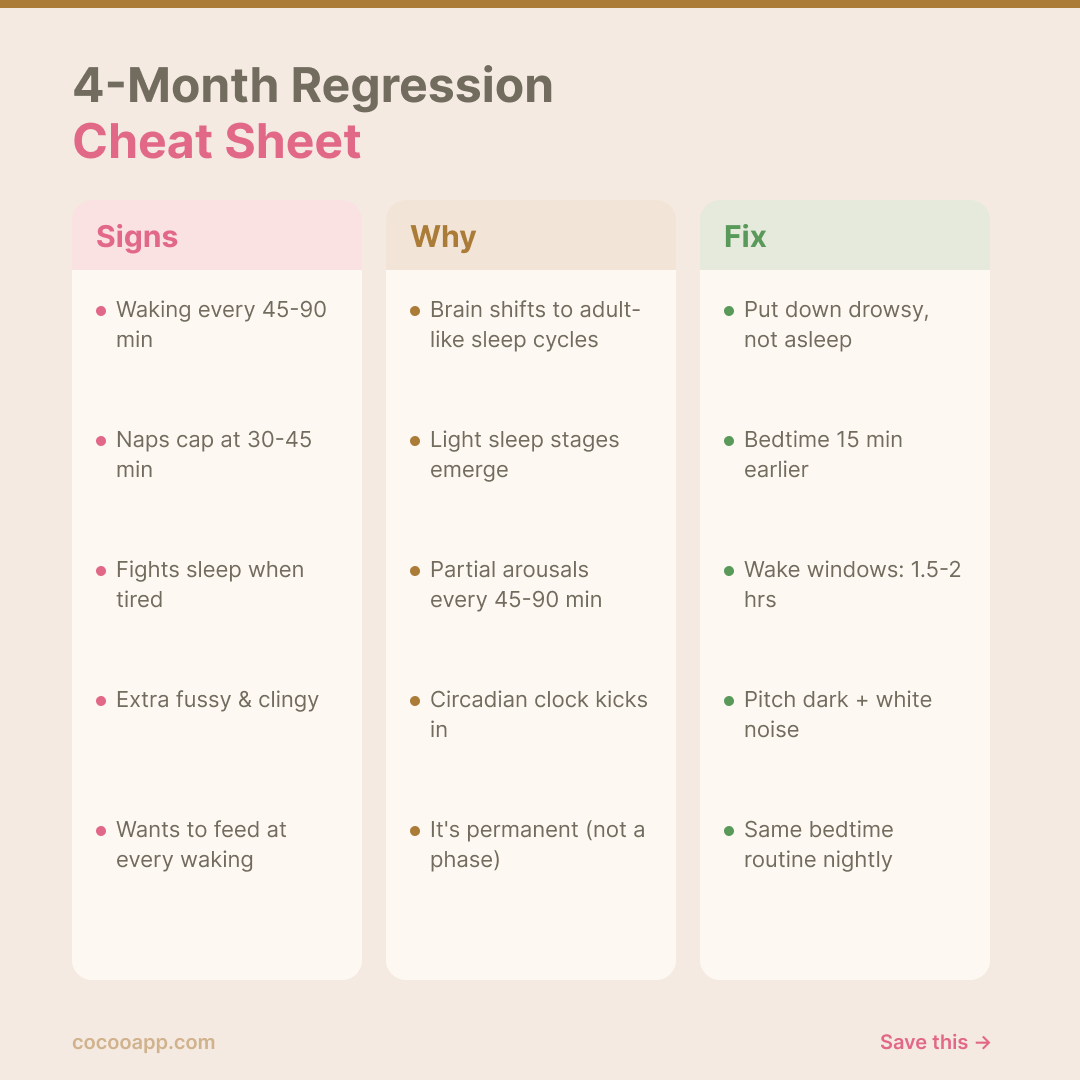
Newborns spend most of their sleep in deep sleep and can tumble back into it easily between cycles. Around 3–4 months, the brain matures to cycle through light and deep stages like adults do (Jenni et al., 2005).
Now your baby partially wakes between every cycle (every 45–90 min). If the conditions from when they fell asleep are gone — no more breast, no more rocking — they fully wake and cry for those conditions back.
This is also when the circadian clock kicks in (Borbély's Two-Process Model), which means timing of sleep starts to matter much more than “watch for tired cues.”
Signs you're in it
- Suddenly waking every 45–90 minutes (was doing 3–5 hour stretches before)
- Naps capping at 30–45 minutes (one sleep cycle)
- Fighting sleep even when clearly exhausted
- More fussy and clingy during the day
- Wanting to feed at every single waking
Growth spurt or regression?
Growth spurts = extra hunger for 2–4 days. The regression = changed sleep patterns for 2–6 weeks, mainly more frequent wakings and short naps. They can overlap.
5 things to try tonight
These are the highest-impact changes based on what the research actually supports.
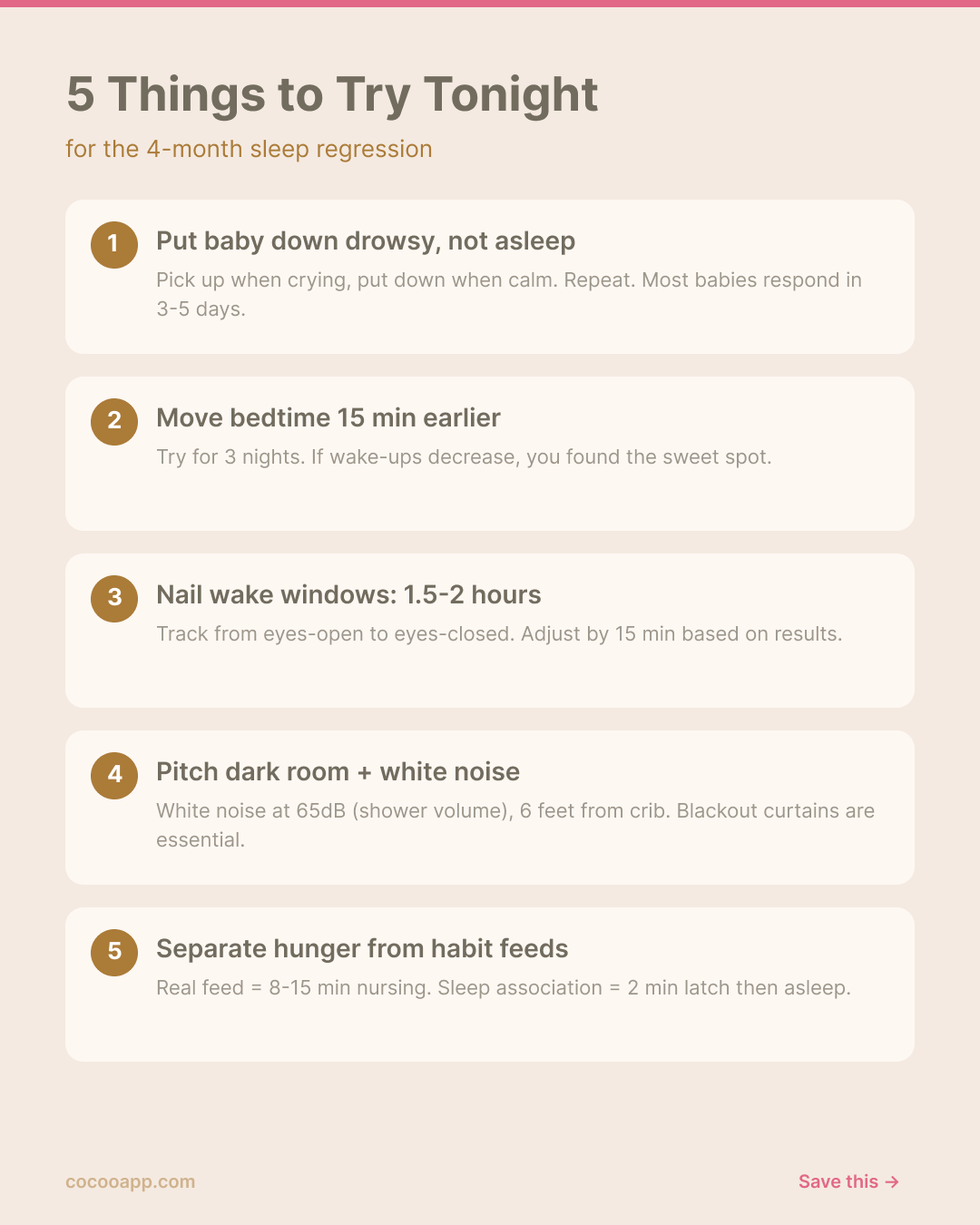
1. Put baby down drowsy, not asleep
This is the single highest-leverage change. If your baby falls asleep at the breast or while being rocked, they'll need that same condition back at every partial arousal overnight.
Try this: Do your normal routine (feed, rock, cuddle) but put baby down when their eyes are heavy and body is relaxed — before fully asleep. Pat the mattress and shush.
If they cry: Pick up until calm, put back down. Repeat. This is the “pick-up-put-down” method. Most babies respond within 3–5 days.
2. Move bedtime 15 minutes earlier
Overtired babies sleep worse, not better. Cortisol rises as an alertness buffer when they're past their window, making it harder to fall and stay asleep.
Try this: Move bedtime 15 min earlier for 3 nights. If night wakings decrease, you've found the sweet spot. If not, try another 15 min. Most 4-month-olds do best with bedtime between 6:30–7:30pm.
3. Nail the wake windows: 1.5–2 hours
Now that the circadian clock is active, timing matters more than tired cues. Too early = not enough sleep pressure. Too late = overtired cortisol spike.
Try this: Track wake windows from eyes-open to eyes-closed. Start with 1.75 hours and adjust by 15 min based on how easily baby falls asleep.
Pro tip: Tools like Cocoo detect your baby's actual optimal wake window from their sleep data — more accurate than generic charts during a regression when everything is shifting.
4. Make the room pitch dark + white noise
At 4 months, your baby is suddenly more sensitive to light and sound during those new light-sleep stages.
Blackout test: If you can see your hand in front of your face, it's not dark enough. Blackout curtains or even garbage bags taped over windows work.
White noise: Set at about 65dB (shower volume). Place the machine across the room (~6 feet from crib), not right next to baby's head. Keep it running all night, not on a timer.
5. Separate real hunger feeds from sleep-association feeds
Not every night waking is hunger. Pennestri et al. (2018) found that frequent night waking is developmentally normal and doesn't indicate a feeding problem.
Try this: Keep 1–2 real feeds (baby nurses for several minutes, seems satisfied). For other wakings, try resettling with patting and shushing first — wait 2–3 minutes before offering the breast.
How to tell: If baby latches for 2 minutes then falls asleep, that's a sleep association, not hunger. A real feed is 8–15 minutes of active nursing.
Start a bedtime routine (it really works)
Mindell et al. (2009) found that a consistent bedtime routine significantly reduced night wakings in infants. The AAP recommends it as one of the most evidence-based sleep strategies.
Keep it simple and repeat it in the same order every night:
- 1Bath (even a quick warm washcloth wipe-down counts)
- 2Fresh diaper + sleep sack
- 3Feed (but not to sleep — stop when drowsy)
- 4One short book or song
- 5Lights off, white noise on, into crib drowsy
Total time: 15–20 minutes. The routine itself becomes a sleep cue as your baby's circadian system learns to associate it with sleep.
When does it get better?
- Week 1–2The hardest stretch. This is the peak of the disruption.
- Week 2–4If you've started on sleep associations and wake windows, you should see early improvement.
- Week 4–6Most parents see meaningful improvement. Baby may start linking sleep cycles overnight.
- Beyond 6 weeksIf still rough, a sleep association is likely still being reinforced at every waking. Time to get more intentional.
Frequently asked questions
How long does the 4-month sleep regression last?
The worst of it is 2–6 weeks. The brain change is permanent, but the disruption ends when your baby develops the skills to handle the new sleep architecture — mainly falling asleep more independently.
Is the 4-month sleep regression real?
Yes. Documented by Jenni et al. (2005) in the journal Sleep. It's a real neurological milestone where infant sleep architecture shifts to adult-like cycling. Not a parenting myth.
Can I sleep train during the regression?
Yes — 4 months is actually a good time to start. A 2016 RCT by Gradisar et al. in Pediatrics showed it was effective with no measurable harm. Sleep training doesn't have to mean cry-it-out — gradual fading methods work too.
My baby was sleeping great — why is this so bad?
Early "good sleepers" often relied on sleep associations (nursing, rocking) that worked fine when they could tumble back into deep sleep. At 4 months, partial arousals become fuller. If the conditions changed, they fully wake. The stronger the association, the harder the regression hits.
Want to understand the full science behind how Cocoo works? Learn about the research behind Cocoo's approach.
More from the Cocoo blog
Track your baby's sleep through the regression
Cocoo detects your baby's real wake windows from their data — so you're not guessing from a generic chart during the hardest weeks.
Download Cocoo — free to startAvailable on iOS and Android
Sources
- 1.Jenni, O. G., Borbély, A. A., & Achermann, P. (2005). Development of the nocturnal sleep electroencephalogram in human infants. American Journal of Physiology, 286(3), R528–R538.
- 2.Gradisar, M., Jackson, K., Spurrier, N. J., et al. (2016). Behavioral interventions for infant sleep problems: A randomized controlled trial. Pediatrics, 137(6), e20151486.
- 3.Henderson, J. M. T., et al. (2010). Sleeping through the night: The consolidation of self-regulated sleep across the first year of life. Pediatrics, 126(5), e1081–e1087.
- 4.Mindell, J. A., et al. (2009). A nightly bedtime routine: Impact on sleep in young children and maternal mood. Sleep, 32(5), 599–606.
- 5.Pennestri, M. H., et al. (2018). Uninterrupted infant sleep, development, and maternal mood. Pediatrics, 142(6), e20174330.
- 6.Galland, B. C., et al. (2012). Normal sleep patterns in infants and children: A systematic review. Sleep Medicine Reviews, 16(3), 213–222.
- 7.American Academy of Pediatrics. (2022). Safe sleep recommendations. Pediatrics, 150(1), e2022057990.
- 8.Borbély, A. A. (1982). A two process model of sleep regulation. Human Neurobiology, 1(3), 195–204.