Cocoo uses AI in two places: the coach chat, and the words that explain your baby's numbers. The numbers themselves don't come from AI. Nap times, bedtime, the sleep score, the issues on the Plan tab and Ferber check-in waits are worked out from your baby's logs by an optimization model, a prediction model and algorithms, so the same logs always give the same answer.
There's one place in between. When you ask why your baby keeps waking, an algorithm finds the evidence and AI helps put the likely causes in order. I'll explain exactly how that works below, because most parents assume Cocoo is “an AI app” and I'd rather you knew which parts are which.
If you're using Cocoo tonight
- A time on the Plan tab or a check-in wait on the timer came from our models, not AI. Follow it.
- A sentence in the chat came from AI. If a number in it doesn't match your log, trust the log.
- Fever, breathing changes, refusing feeds, or a cry that sounds different: call your pediatrician, not an app.
- Want a person? Tap “Talk to Sue, the Founder” in the chat. That's me.
Which parts of Cocoo use AI?
Here is every feature that touches your baby's sleep, and who decides the answer. An optimization model, a prediction model and an algorithm all mean the same thing here: math that runs on your baby's logs the same way every time, built on sleep research and published charts. None of them is a language model like ChatGPT.
| Feature | Decided by | What AI does |
|---|---|---|
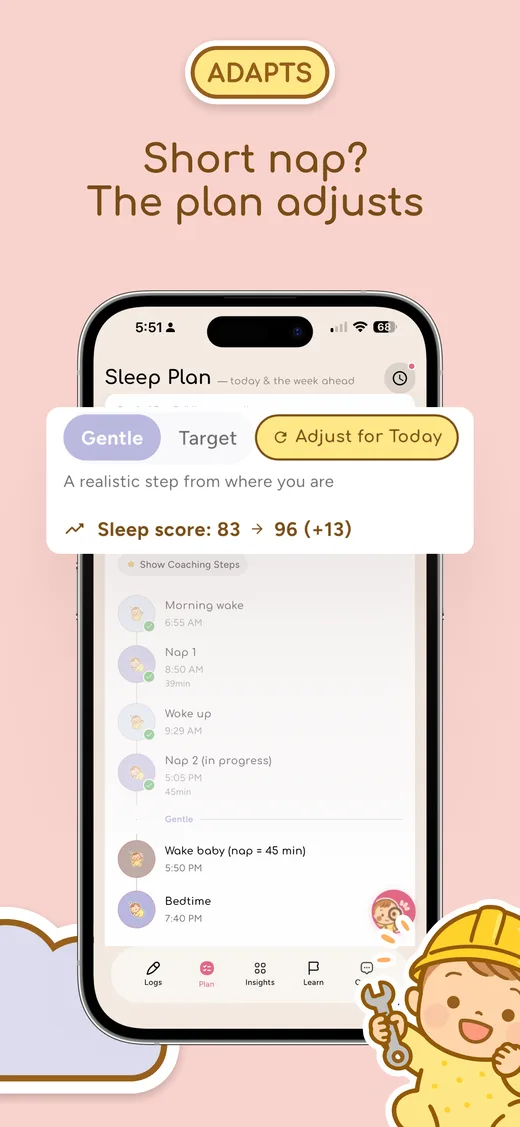
| Today's naps, wake windows and bedtime | Optimization model | None. It builds candidate schedules from your baby's last few days of logs and picks the best fit. |
| Adjust for Today and replanning | Optimization model | None. If you ask the coach to move bedtime, it passes your request to the same model. |
| Next nap, bedtime and the energy level | Prediction model | None. It predicts from your baby's own recent wake windows, with the outliers trimmed. |
| Sleep score, charts and statistics | Algorithm | Writes the sentence under a chart. The number itself is math. |
| Issues detected on the Plan tab | Algorithm | Writes one note per issue the algorithm found, using the exact values. It can't add or drop an issue. |
| Ferber check-in waits | Algorithm | Writes the coaching text. Code checks every wait against Ferber's published chart and rewrites any that differ. |
| Soothing sounds | Algorithm | None. The sounds are generated on your phone. |
| Why your baby woke (the diagnosis) | Algorithm, then AI | An algorithm flags the out-of-range numbers and scores possible causes. AI weighs them with your answers and orders up to 3 likely causes. |
| Coach chat | AI | Understands what you type, looks up your logs and the computed numbers, and explains them. |
Why doesn't Cocoo let AI set the schedule?
Because AI makes mistakes in a way that's hard to catch. It doesn't say “I'm not sure.” It gives you a wrong wake window in the same calm voice as a right one.
The research shows the pattern. When pediatricians gave ChatGPT 100 published pediatric cases, 83 of its diagnoses were wrong or too broad to use (Barile et al., 2024). In a test on cancer treatment questions, about a third of answers mixed in advice that didn't match guidelines, and the authors noted the wrong parts sat among correct ones, where even experts had trouble spotting them (Chen et al., 2023). Both studies used an older model. Newer ones are better. But I build these systems for a living, and that failure mode hasn't gone away.
And a baby's schedule is a bad place for it. Behavioral sleep plans work when they're consistent night after night (Mindell et al., 2006). If bedtime moves 40 minutes because the model phrased something differently today, your baby pays for it, and you can't tell why. Our optimization model gives the same plan from the same logs. When they're wrong, they're wrong the same way every time, so we can find the bug and fix it.
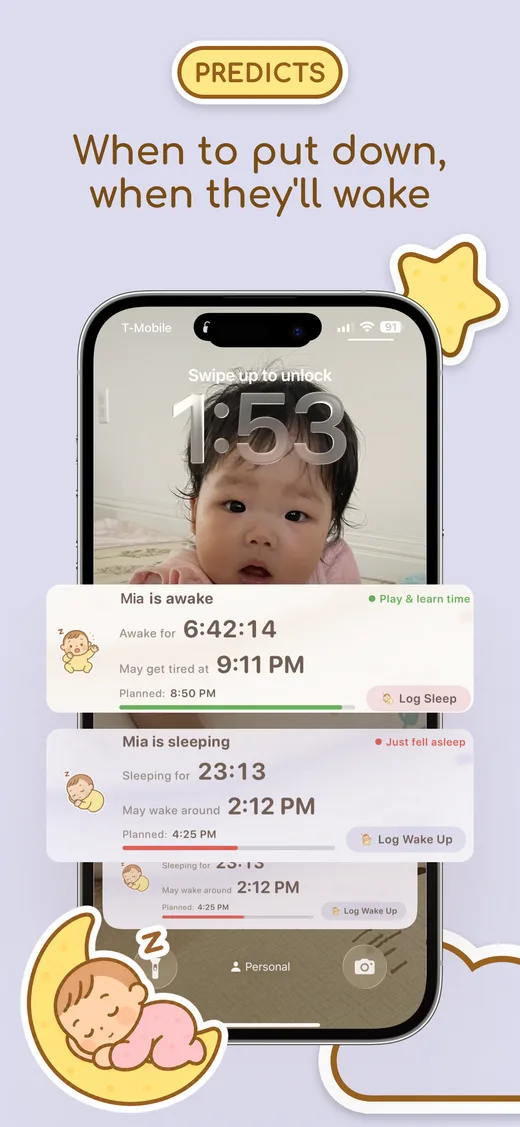
Want nap times you can plan around?Cocoo works out when your baby will be tired next from their own logs, with a prediction model, so the same logs give the same plan.
What does AI do in Cocoo, then?
- It understands you. You type “she napped 40 min at 1” or “can bedtime be earlier?” and the coach turns that into a log entry or a request. A second, smaller AI check runs before anything is written to your log. The new bedtime itself still comes from the optimization model.
- It explains. A schedule is a list of times. Parents need to know why the second nap moved. AI writes that sentence, and it's given the exact numbers to quote. If it changes how serious an issue is, code puts the original back.
- It writes the coaching around the method. For sleep training, AI writes what to say and do at each check-in. Code fills in the clock times, checks every Ferber wait against the published chart, and asks for a rewrite if the text breaks the method you picked.
- It helps rank causes, with the evidence attached. That one needs its own section.
How the “why is my baby waking” diagnosis uses AI
The diagnosis is the one place where AI makes a judgment call. An algorithm does the first steps: it detects the symptom from your logs, choose the follow-up questions, and score each possible cause against your baby's numbers. Then AI reads those scores alongside your answers and puts up to 3 likely causes in order, with a confidence for each.
We let AI do this step because the answers parents give don't fit neatly into an algorithm. “She started crawling Tuesday and her grandma has been doing bedtime” can matter more than a wake window that's 10 minutes long. But every cause it lists has to quote its evidence: a real number from your logs or your own words. A cause with no evidence gets left out.
What we don't have yet is a second algorithm that re-checks the final order after the AI is done. So read the evidence line on each cause. If it doesn't match what you see, go with what you see, and tell me.
Why use AI at all?
Because it's 3am and you have a question. A tired parent shouldn't have to find the right screen and read a chart to learn that the last wake window ran 40 minutes long. The coach can say it in one sentence, using the numbers our models already worked out.
So AI is the layer that ties things together and talks to you. It isn't the part that decides when your baby sleeps. If you're comparing apps on this, our Huckleberry and Napper comparisons list what each app publishes about its own predictions.
Frequently asked questions
Is Cocoo an AI app?
Partly. The numbers you act on (nap times, wake windows, bedtime, the energy level, the sleep score, the issues on the Plan tab and Ferber check-in waits) come from an optimization model, a prediction model and algorithms that run on your baby's logs the same way every time. AI runs the coach chat, writes the explanations around those numbers, and helps order the likely causes when you ask why a night went wrong.
Can AI make a baby sleep schedule?
It can write one, but I wouldn't trust it to. A language model can give two different schedules for the same baby on the same day, and it can state a wrong wake window with full confidence. In Cocoo, the coach is told never to write schedule times itself. When you ask for a new plan, it hands the request to the same optimization model that builds the daily plan.
Is AI baby sleep advice safe?
Treat it as a draft, not a doctor. In one study, ChatGPT got 83 of 100 pediatric case diagnoses wrong or too broad (Barile et al., 2024). Newer models do better, but they still sound sure when they're wrong. For fever, breathing changes, poor feeding or anything that feels medical, call your pediatrician. Cocoo's coach is told to send you there too.
Does the Cocoo coach make up numbers?
It's built not to. Before answering a sleep question, the coach is told to fetch your baby's logs and computed numbers, and to quote only times the planning tools report. Insight text is written from exact values we pass in, and code puts back any severity the AI changes. No setup is perfect, so if a number in the chat looks off, check it against your log.
Can I talk to a person instead of the AI?
Yes. The chat has a Talk to Sue, the Founder option that reaches me, not the AI. I read your baby's logs before I reply. It isn't instant at 3am, which is the main reason the AI coach exists.
Keep reading
Sources
Barile J, Margolis A, Cason G, Kim R, Kalash S, Tchaconas A, Milanaik R. Diagnostic accuracy of a large language model in pediatric case studies. JAMA Pediatrics. 2024;178(3):313–315. doi
Chen S, Kann BH, Foote MB, Aerts HJWL, Savova GK, Mak RH, Bitterman DS. Use of artificial intelligence chatbots for cancer treatment information. JAMA Oncology. 2023;9(10):1459–1462. doi
Mindell JA, Kuhn B, Lewin DS, Meltzer LJ, Sadeh A. Behavioral treatment of bedtime problems and night wakings in infants and young children. Sleep. 2006;29(10):1263–1276. PubMed
How Cocoo works: read from the Cocoo app and server code on November 12, 2026.
A schedule from your baby's logs, not a guess
Log a few days and Cocoo builds tomorrow's naps and bedtime from them, with an optimization model, not a guess.