
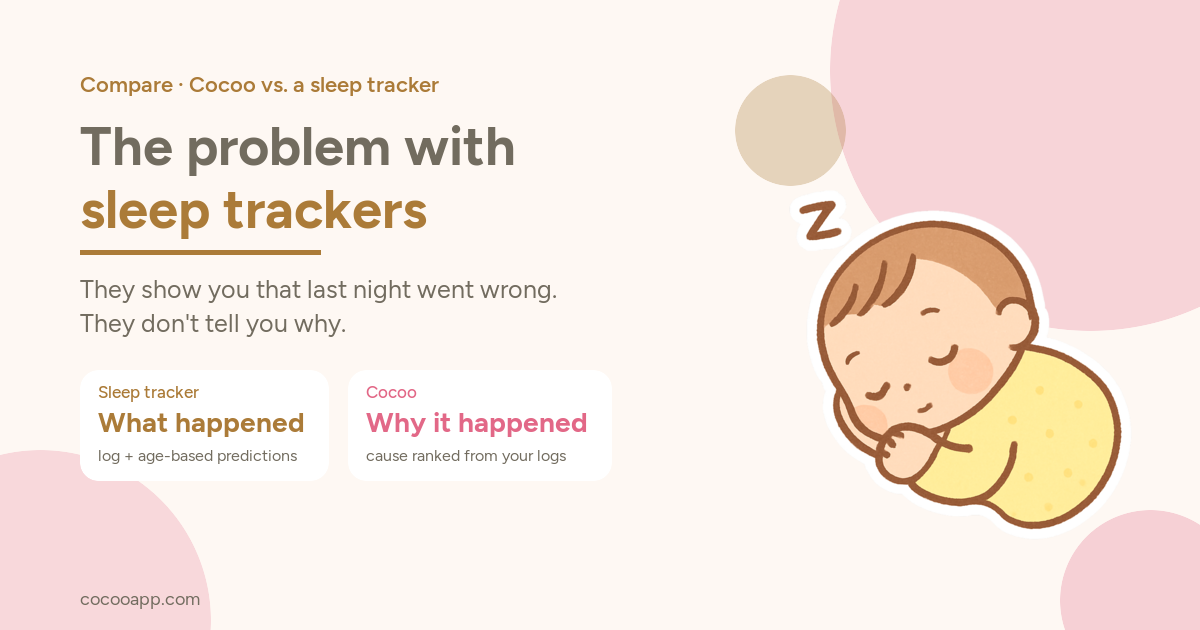
A baby sleep tracker records when your baby slept and predicts the next nap. That's useful, and it's where most parents start. The problem shows up on the bad day.
You open the app and the chart confirms what you already know. Three wakes, a 32-minute nap, bedtime at 8:40. It doesn't say which of those caused the others, or what to change tonight. Tomorrow's predicted nap comes from a wake-window table for your baby's age, which is a decent average and a poor fit for a baby who just had a 32-minute nap.
We make Cocoo. It tracks the same things, then does the part trackers skip: it ranks the likely cause and changes tomorrow's plan. So I'm not neutral here. Every number below has its sample size next to it, and further down I answer the pushback I'd expect from anyone who loves their tracker.
The case for a diagnosis over a chart, in numbers
6
different leading causes behind the same complaint, night waking
30%
of night-waking cases were a sleep association
24% / 21%
were overtired at bedtime / undertired at bedtime, which need opposite fixes
49%
of daily plans asked for a change from the baby's current timing
31%
of "why is this happening" sessions start between 10pm and 5am
0
studies showing that tracking alone improves a baby's sleep
Cocoo log analysis, pulled October 30, 2026. Night-waking causes: 532 diagnosed cases from 230 babies, top-ranked cause in each. Plans: 9,838 daily plans for 945 babies since March 2026. Help sessions: 3,965, local time.
The same chart has six different explanations. Night waking is the most common reason parents open Cocoo's “why is this happening” flow. Across 532 night-waking cases from 230 babies, the top-ranked cause was a sleep association 30.3% of the time, overtiredness at bedtime 24.2%, undertiredness at bedtime 21.1%, schedule drift 10.2%, hunger 6% and a developmental leap 3.8%. On a tracker, all six look like the same row of wake-ups. But overtired and undertired need opposite changes to bedtime. Guess wrong and you've made the week worse.
Age-based predictions are a starting point, and babies leave it fast. Across 9,838 daily plans in Cocoo for 945 babies, 48.9% asked for at least one change to a wake window, nap length or bedtime relative to what the baby had been doing, worked out from the last few days of logs. Most of those changes were 5 to 20 minutes. That's the distance between the chart for a 7-month-old and your 7-month-old. A prediction that only knows the age can't close it. And when the day breaks mid-afternoon, one tap on “Adjust for Today” re-times every nap left and bedtime from what already happened, instead of you redoing the wake-window math.
Parents want the answer at night, not the chart in the morning. Of 3,965 diagnosis sessions in Cocoo, 31.2% started between 10pm and 5am and 71.1% outside 9 to 5. A chart you read over coffee describes a night that's already over. The decision that matters is what to do at the next wake, and you make it during the wake.
The evidence is for plans, not for logging. Behavioral sleep plans are well studied. A review of 52 studies found they improved bedtime problems and night wakings in the large majority (Mindell et al., 2006). A plan delivered by software was tested in a randomized trial of 264 families and cut night wakings by about half within three weeks (Mindell et al., 2011). In every one of those studies, the logs fed a plan. Nobody got better by logging and looking. We know of no study showing that a tracker on its own changes how a baby sleeps. The software evidence has its own limit: two studies of one tool, both industry funded (Mindell et al., 2011; Leichman et al., 2020).
The price is in the same range. Trackers run from free to about $120 a year on their paid tiers (published prices, October 2026). Cocoo is $59.99 a year. Tracking, the summary charts, the sleep training guides, the soothing sounds and 5 coach messages a day are free. The daily plan and sleep training nights after night 1 are paid.
If you love your tracker, you're probably thinking…
Four fair pushbacks. One of them is a good reason to keep the tracker.
“I can already see the pattern in my tracker. Isn't that enough?”
You can see the pattern. Whether you can see the cause is the question. In our 532 night-waking cases, “overtired at bedtime” and “undertired at bedtime” together explained 45% of them, and on a chart they look identical: wakes bunched in the first half of the night. One wants an earlier bedtime, the other a later one. Cocoo tells them apart by checking the last wake window against your baby's own recent range. Eyeballing a bar won't get you there.
Our own analysis of 1,816 sleep logs makes the same point from the other side. At 6 months, only 23.6% of nights were wake-free. Knowing you're normal is a comfort. It still doesn't tell you which fix is yours.
“The age-based nap predictions have been fine for us.”
They're a fine starting point, and Cocoo uses the same age ranges on day 1. By day 4 it has your baby's own numbers, and 48.9% of daily plans moved off the current timing by a few minutes somewhere in the day. A prediction that stays on the age chart can't do that. If your baby happens to be the average baby, the chart is enough. Most babies aren't, in one direction or the other.
“My tracker is free. Why would I pay?”
Cocoo's tracking is free too, with no cap on logs. So is most of what a tracker charges for on its paid tier: the summary tab with sleep score and trend charts, the milestone tracker, the sleep training guides, and white noise, rain and deep-hum sounds with a sleep timer. Free also gets you 5 coach messages a day, the most important point of each day's sleep and feeding insight, and night 1 of any sleep training plan.
The $59.99 a year pays for the rest: today's plan with naps, wake windows and bedtime timed from your logs, one-tap re-planning of the rest of the day after a short nap, the full diagnosis with the fix to try tonight, and nights 2 onward of sleep training. If all you want is a log, Cocoo's free tier does that. If you want a nap prediction and nothing else, a free tracker gives you one and we charge for ours. I'd rather tell you that than have you pay for something you won't open.
“The big trackers have years of reviews. Cocoo is new.”
Right. Cocoo launched in January 2026 and is rated 4.9 on the US App Store from 48 ratings as of 2026-11-27. That's a small number. If a long review history matters to you, a tracker has it and we don't. What we can show you instead is the research the plans are built on, at cocooapp.com/science, and the log numbers on this page.
So, a tracker or Cocoo?
Keep your tracker if what you want is a tidy record and a nap prediction, and your baby's sleep is mostly fine. That's a real use, and a free app covers it.
Switch when the chart stops helping. Trackers stop at what happened, and the same what-happened has six different whys. Cocoo takes the same logs, ranks the cause, moves tomorrow's schedule by the minutes that matter, and runs the night if you decide to sleep train. $59.99 a year.
Find out why, not just what
Log a few days in Cocoo, or import your routine. It ranks the likely cause of the bad nights and short naps, adjusts tomorrow's schedule, and guides the nights if you decide to sleep train.
Download Cocoo — it's free to startFree to start on iOS and Android. Night 1 of any sleep training plan is free.
Sources
Cocoo log analysis, production database, pulled October 30, 2026. Night-waking causes are the top-ranked cause in each diagnosis session. Daily plan changes are adjustments the plan asked for relative to the baby's recent schedule. Sessions are counted in the parent's local time zone.
Mindell, J. A., Kuhn, B., Lewin, D. S., Meltzer, L. J., & Sadeh, A. (2006). Behavioral treatment of bedtime problems and night wakings in infants and young children. Sleep, 29(10), 1263–1276.
Mindell, J. A., Du Mond, C. E., Sadeh, A., Telofski, L. S., Kulkarni, N., & Gunn, E. (2011). Efficacy of an internet-based intervention for infant and toddler sleep disturbances. Sleep, 34(4), 451–458. doi.org/10.1093/sleep/34.4.451
Leichman, E. S., Gould, R. A., Williamson, A. A., Walters, R. M., & Mindell, J. A. (2020). Effectiveness of an mHealth intervention for infant sleep disturbances. Behavior Therapy, 51(4), 548–558. doi.org/10.1016/j.beth.2019.12.011
Tracker prices: published pricing pages (Huckleberry, Napper), checked October 2026. The full five-way comparison, with monitors, courses and consultants, is in our sleep consultant vs. app guide.