Sleep Training · Extinction Method
The Cry It Out Method: What Happens Night by Night (and When It's Not Working)
By Sue Ye · Updated November 2026 · 8 min read
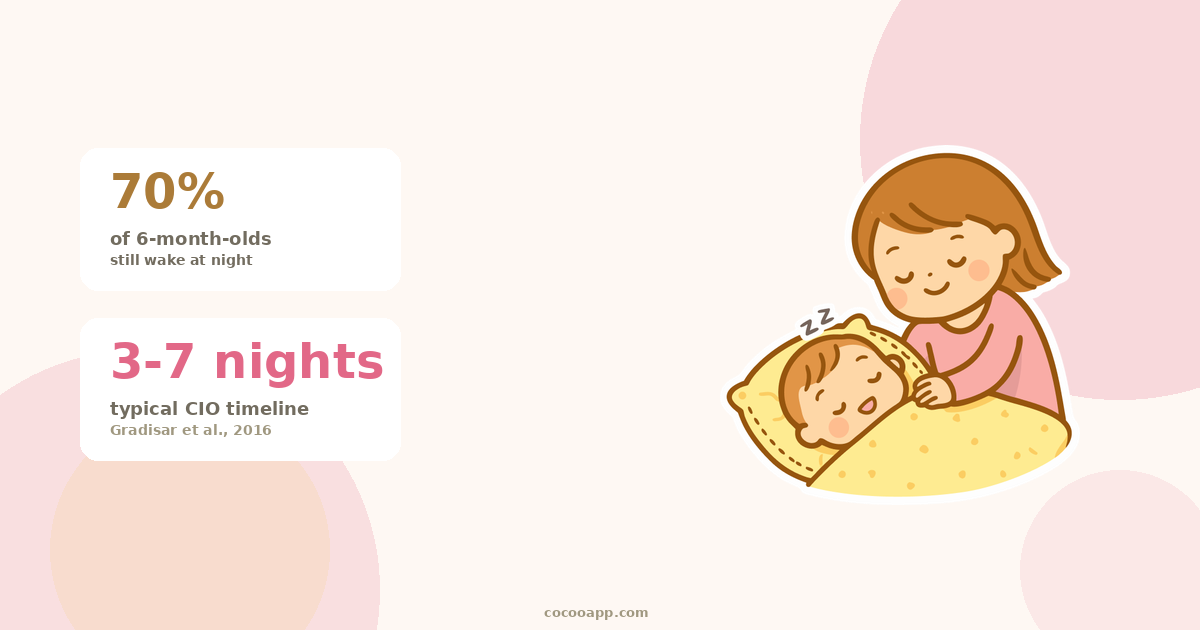
The cry it out method (CIO), formally called extinction sleep training, means putting your baby down drowsy but awake and not returning until morning: no check-ins, no soothing. For most babies 5 months or older, significant improvement happens within 3 to 7 nights (Gradisar et al., 2016).
That's the clinical version. Here's the real version: night 2 is often worse than night 1, and that's normal. The stalling has a specific cause most of the time. "Let them cry" is the least useful advice you can give a parent at 2am. This is what happens, age by age, night by night.
It's 11pm. Your baby went down at 7:30, woke at 9, woke at 11. You just got them back to sleep. You lie down. The monitor lights up at 12:30.
You've been reading about CIO for three weeks. Same tab open every night. And every morning you decide you're not ready. Tonight you're asking the question directly: would this be cruel? Or would it work?
Here's what the research says. And here's what 1,993 complete tracked nights show about how night waking changes across the first year.
What "cry it out" means (and what it doesn't)
CIO is one specific method. Not a category. Not a parenting philosophy.
Formally, it's called extinction: you put your baby down awake at bedtime, leave the room, and don't return until morning or a predetermined wake time. No check-ins, no soothing between put-down and that threshold.
The Ferber method is not CIO. Ferber uses timed check-ins (3 minutes, then 5, then 10). The chair method and fading are also not CIO. Extinction is the most direct version: set it up once, stay out, let the baby learn that sleep comes from within rather than from you.
Why does that distinction matter? Because most of the controversy around CIO is about parental responsiveness during crying, not about whether babies should ever settle without help. Even gentle sleep training involves putting a baby down awake and letting them fuss. Extinction just removes the check-ins that some babies use as a reason to keep escalating.
What the research says (not the angry version, not the dismissive one)
The CIO debate has been polarized for 30 years. Parents who oppose it cite cortisol studies from the 1990s. Parents who promote it act like the science is settled and anyone who hesitates is being precious. Both camps overstate their case.
The 1990s cortisol studies measured stress hormones during crying, when stress is obviously elevated. They measured nothing after. That design can't tell you whether CIO causes long-term harm.
The more informative work: Gradisar et al. (2016) in Pediatrics ran a randomized controlled trial comparing extinction (CIO), graduated extinction (Ferber), and a control group with behavioral advice only. At 12-month follow-up, the researchers found no differences in cortisol levels, attachment security, or behavioral outcomes. Sleep improved in both trained groups. Emotional development was unaffected.
A five-year follow-up by Price et al. (2012) of a comparable behavioral sleep training intervention found the same result: no harm at age 5 in sleep, behavior, attachment, or any measured outcome.
The honest answer, based on the best available data: CIO is not harmful to attachment or emotional development when done at an appropriate age. It works faster than most gentle methods. The risks are starting too early, stopping partway through (which can reinforce the behavior), and applying it when there's an underlying cause like hunger or illness.
CIO is not right for every family. The crying is hard to sit with. Ferber gets you most of the results with less sustained crying. If you're reading this at 2am thinking "I could never", that's a real data point about what you'll follow through on. A method you can sustain beats a faster method you'll abandon on night 3.
What 1,993 tracked nights show about when night waking peaks
Before deciding whether to sleep train, it helps to know what's normal for your baby's age. We analyzed 1,993 complete logged nights of sleep tracking data for babies aged 4–20 months.
70%
of tracked 6-month-olds still wake at night
| Age | Sleep-through rate | Avg wakes / night | Sample (nights) |
|---|---|---|---|
| 5 months | 41.6% | 0.96 | n=366 |
| 6 months | 30.9% | 1.19 | n=393 |
| 7 months | 37.0% | 1.10 | n=297 |
| 8 months | 32.1% | 1.01 | n=160 |
| 9 months | 51.8% | 0.98 | n=114 |
| 10 months | 68.5% | 0.94 | n=95 |
Source: Cocoo aggregate data, 1,993 complete logged nights (is_complete_day = true), babies aged 4–20 months. Sample sizes per age band shown. Individual data is never used or shared.
Two things worth noticing.
The 6-month dip. At 5 months, 41.6% of tracked nights had zero wakes. At 6 months, that dropped to 30.9%. If you expected improvement as your baby got older and instead got more waking, you're not imagining it. The 6-month sleep regression shows up clearly in this data.
And then the 9 to 10 month shift. Something consolidates around 9 months: the sleep-through rate jumps from 32% at 8 months to 51.8% at 9 months and 68.5% by 10 months. For a lot of babies, this happens without any training. If you're at 7 months wondering whether to wait it out, the data says many babies do consolidate on their own. CIO accelerates that timeline. It removes the sleep association that's been interrupting the natural process.
Night by night: what to expect
The hardest part of CIO is sitting in the other room while the crying goes on.
Night 1 is usually the hardest. At the first waking after put-down, most babies cry for 30 to 45 minutes before settling. This is uncomfortable to hear. It's supposed to be.
Night 2 is often longer than night 1. Nobody warns you about this. The baby is testing whether last night's experience was a fluke. Many parents stop here, convinced the method is failing. Keep going.
Nights 3 to 4 usually show real reduction. Most babies who respond to extinction show crying down to 15 to 20 minutes by night 3 (Mindell et al., 2006). Still present. Clearly shrinking.
Nights 5 to 7: for babies who respond, crying typically drops under 10 minutes. Some nights go to 5. Some go silent. By night 7, most responsive babies have stopped waking or are resettling in under 2 minutes.
What causes parents to stop too early
- Night 2 or 3 is longer than night 1 (common, not a sign of failure)
- The baby seems sick: stop, treat the illness, restart when healthy
- One caregiver commits and the other doesn't: inconsistency extends the timeline dramatically
- Protest crying and distress crying sound similar; stay the course unless there are other signs like fever or unusual distress
What age can you start cry it out?
The minimum most pediatricians cite is 4 to 6 months. Before 4 months, the circadian rhythm isn't mature enough for sustained nighttime sleep, and night feeds are still likely legitimate hunger. CIO before 4 months isn't harmful, but it doesn't work consistently.
Six months is the most common and most evidence-backed starting point. By then, most babies can sustain 10 to 11 hours of night sleep without hunger. The 6-month sleep regression makes waiting less appealing for many parents. And the developmental window between 6 and 8 months, before object permanence peaks, is widely cited as a good time to train.
Starting at 7 to 9 months works too. The process is usually faster because older babies have more stable circadian patterns. Separation anxiety begins emerging around 7 to 8 months, though, which can make the first nights harder emotionally.
Starting at 12 months or later is harder. The toddler period brings language development, developmental leaps, and new separation anxiety peaks at 12 to 15 months. CIO works at this age, but expect a longer adjustment and consider whether graduated extinction gives you better odds of following through.
When CIO isn't working: four things to check
On night 5 and still seeing 45 minutes of sustained crying with no downward trend? Something specific is preventing progress. The method itself is probably fine. One of these four things is happening.
1. The bedtime is off. An overtired or undertired baby won't settle quickly regardless of method. If your baby is wired at bedtime, squirming and laughing, the bedtime is probably too late. If they fall asleep within 2 minutes and then wake shortly after, they may be going down undertired. Try shifting bedtime by 15 to 20 minutes in either direction.
2. There's a hunger component. Babies under 8 months often have one genuine hunger wake, usually around 3 to 4am. If the crying is clustered at a consistent early morning time, consider keeping one feed while training the rest. CIO doesn't require eliminating all night feeds.
3. Illness or teething. A baby who was progressing and suddenly regressed almost certainly has something physical going on. Check for fever, ear pulling, drooling, swollen gums. CIO during active illness is not appropriate. Pause, address the illness, restart.
4. Inconsistent application. If one caregiver goes in on hard nights and the other doesn't, the baby is being intermittently reinforced. That extends the timeline significantly and can make crying worse over time. Both caregivers need to be aligned before night 1, not after the third night when it's harder.
If you're not sure which of these is behind a stall, logging the nights helps. A sleep consultant would look at the same data and ask: is the wake clustered at one time (hunger or habit) or scattered across the night (bedtime timing)? Cocoo's sleep debugger does this analysis on your logged data automatically, so you can see the pattern before deciding whether to continue or adjust.
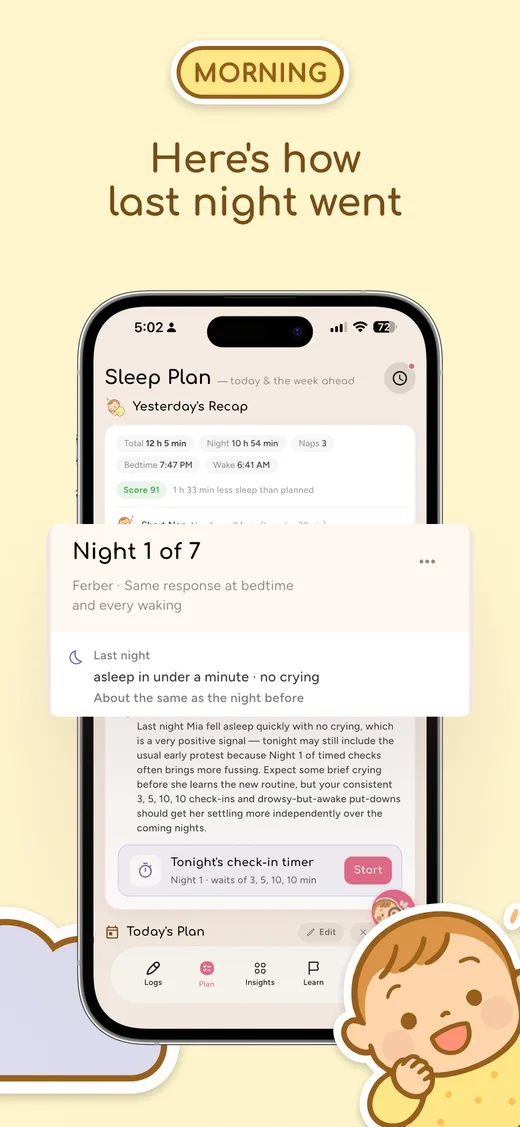
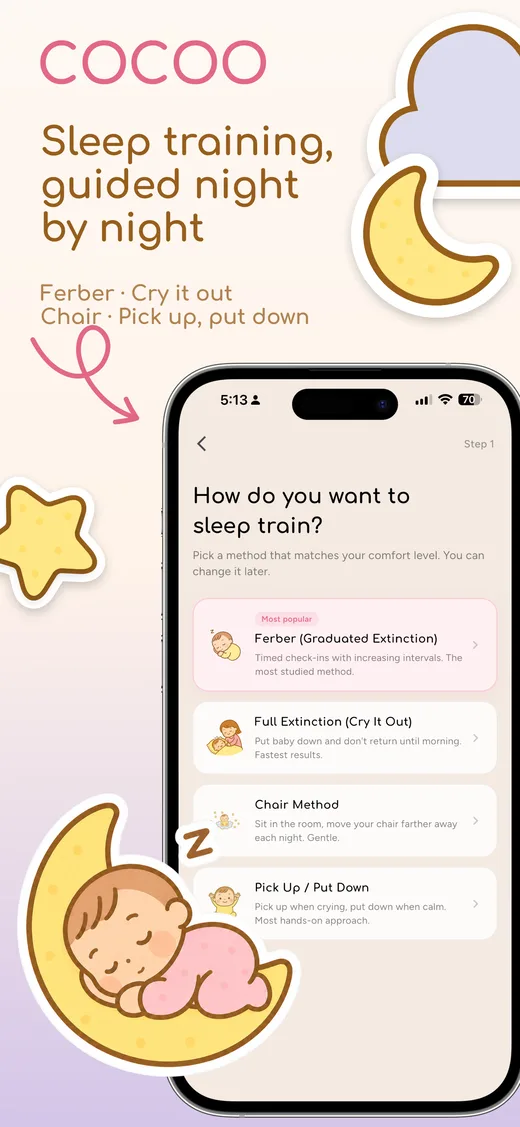
Not sure if it's a stall or progress?Cocoo guides cry it out night by night and gives you a morning recap of how last night went, so you can see whether the crying is shrinking.
Your next step
If your baby is 5 months or older, still waking 2 or more times per night, and you've ruled out illness and growth spurts: CIO is worth seriously considering. The research says it's not harmful. The data says the 6-to-10-month window is when night-waking patterns set, and when intervention has the clearest impact.
Start on a Thursday. The hardest nights are likely nights 1 and 2, and having the weekend to recover helps. Get both caregivers aligned before night 1. And track the first 7 nights: the direction of the trend matters more than any single bad night.
If you're not sure you can sit with no check-ins, start with the Ferber method instead. The check-ins don't speed things up much. But they make the process more sustainable for a lot of parents.
Related questions
How long do you let a baby cry it out?
In the extinction method, you let your baby cry without check-ins until they fall asleep or until morning. Night 1 typically involves 30 to 45 minutes at the first waking. By nights 4 to 7, most responsive babies are crying for under 10 minutes. If crying is still extending past 45 minutes on night 5 with no downward trend, there's usually a specific cause: undertired, overtired, illness, or hunger.
Is the cry it out method safe?
Yes. Gradisar et al. (2016) followed babies for 12 months after CIO sleep training and found no differences in cortisol, attachment, or behavioral outcomes compared to controls. A 5-year follow-up (Price et al., 2012) found the same. The research consensus is that CIO is safe when used at an appropriate age and without underlying illness.
Not sure if it's the right time to sleep train?
Track a few nights first. Find out whether your baby's wakes are hunger, habit, or timing before you decide.


More from the blog
Sources
- Gradisar M, Jackson K, Spurrier NJ, et al. Behavioral interventions for infant sleep problems: A randomized controlled trial. Pediatrics. 2016;137(6):e20151486.
- Mindell JA, Kuhn B, Lewin DS, Meltzer LJ, Sadeh A. Behavioral treatment of bedtime problems and night wakings in infants and young children. Sleep. 2006;29(10):1263–1276.
- Price AMH, Wake M, Ukoumunne OC, Hiscock H. Five-year follow-up of harms and benefits of behavioral infant sleep intervention. Pediatrics. 2012;130(4):643–651.
- Hiscock H, Wake M. Randomised controlled trial of behavioural infant sleep intervention to improve infant sleep and maternal mood. BMJ. 2002;324(7345):1062.
- Paruthi S, Brooks LJ, D'Ambrosio C, et al. Recommended amount of sleep for pediatric populations. J Clin Sleep Med. 2016;12(6):785–786.
- Cocoo aggregate data: 1,993 complete logged nights (is_complete_day=true), babies aged 4–20 months. Sample sizes per age band range from n=95 to n=393. Individual data is never used or shared.