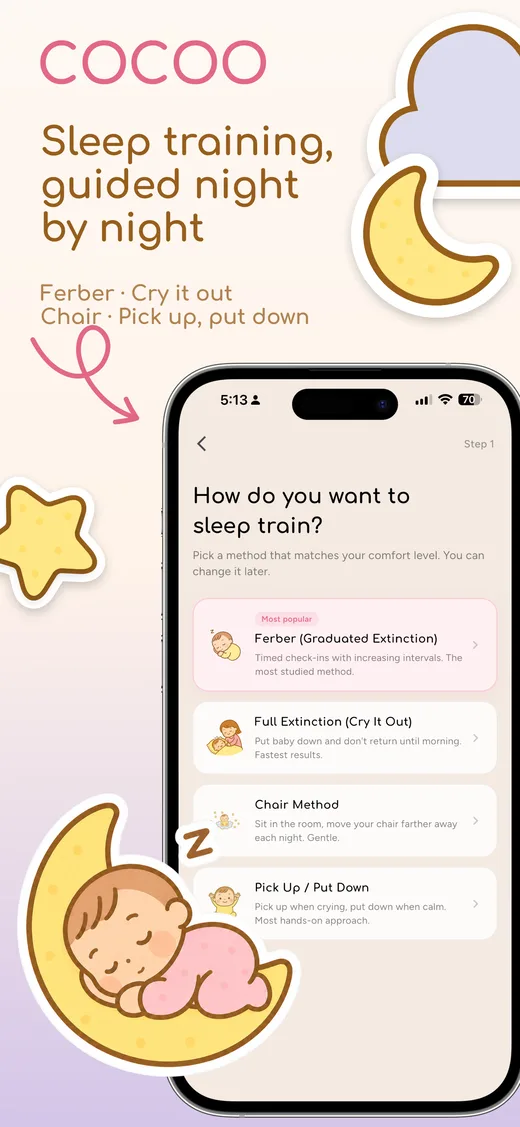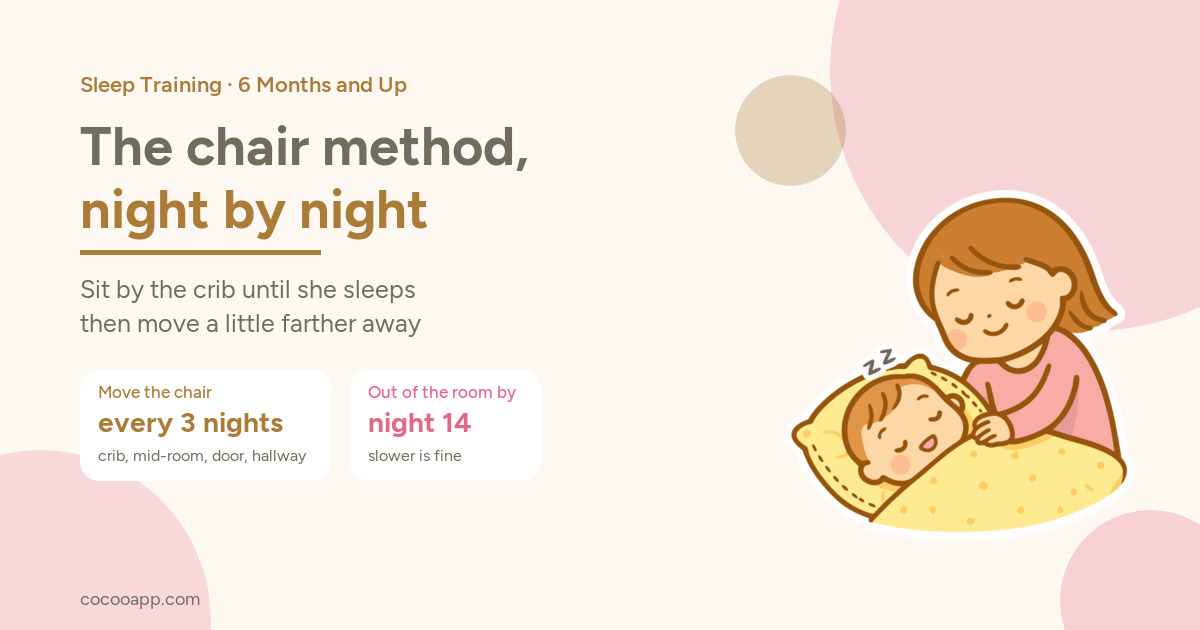
With the chair method, you put your baby in the crib awake and sit in a chair beside her until she's asleep. Every 3 nights you move the chair farther away: the middle of the room, the door, the hallway. By about night 14 she falls asleep with you out of the room.
The schedule fits in a table, and it's the first thing below. What a table can't show you is how night 3 feels from the chair, so after it I've told the two weeks as a story, one night at a time. The baby in it is made up. She's 7 months old and has been rocked to sleep since she was born.
If it's 2am and you're in the middle of the chair method
- →Sit where the chair was at bedtime tonight. Don't go back to the crib side.
- →Do what you did at bedtime: the same shush, the same few words.
- →If a feed is due, feed her and put her back in the crib awake.
- →If she's sick, stop for tonight and comfort her.
Where does the chair go each night?
In the chair method, the chair starts against the crib and moves every 3 nights until it's outside the door. You stay until she's asleep every night.
| Nights | Where the chair is | What you do from it |
|---|---|---|
| 1 to 3 | Touching the crib | Shush, a few pats. No picking up. |
| 4 to 6 | Middle of the room | Your voice only. |
| 7 to 9 | By the door, inside the room | A quiet word now and then. |
| 10 to 14 | Outside the door | She can hear you, then she can't see you. |
This is the 14-night schedule our app's chair plan uses. No study has tested 3 nights per spot against 2 or 4. The one large trial that offered this method gave parents 3 weeks (Hiscock et al., 2007), so slower is fine.
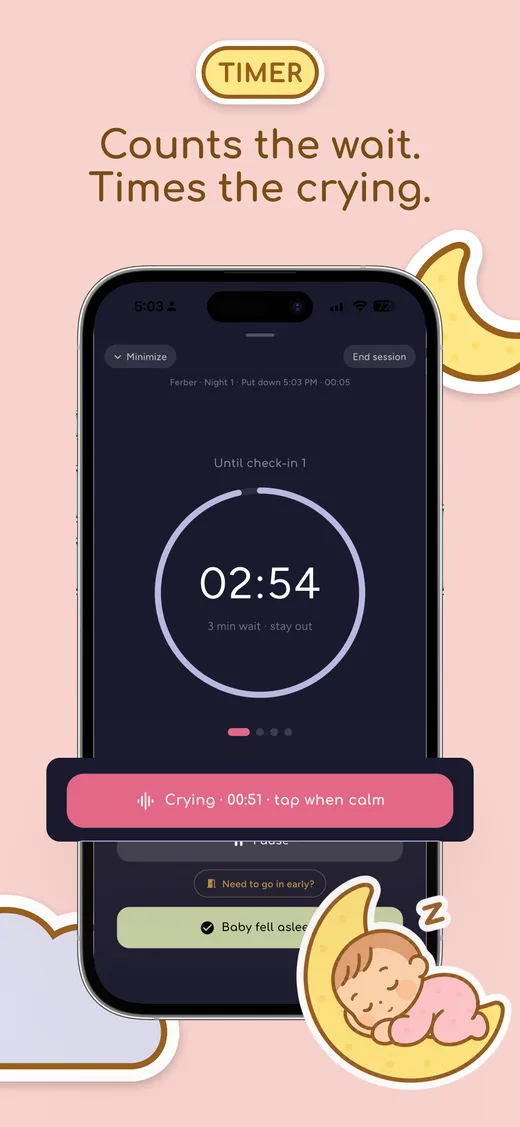
Don't want to count nights in your head?Cocoo's chair plan tells you where the chair goes tonight and times how long she takes to fall asleep.
What do the two weeks feel like?
The first three nights of the chair method are the loudest, and each time the chair moves there's usually a smaller protest. Here is how that plays out. It's a made-up example of a common pattern, not one family's log, so don't hold your baby to its timings.
Night 1 · chair touching the crib
Bath, pajamas, feed, the same book. Then the new part. You lay her down with her eyes open and sit.
She looks at you through the bars and waits to be picked up. You don't pick her up, and she starts to cry. You shush. You put a hand on her back for a few seconds and take it away again. She pulls up on the rail and cries at your face from a foot away.
With timed checks you'd be in the hallway. Here you watch all of it. It takes most of an hour, and you stay until her breathing slows.
Night 3 · same spot
Night 2 was a little shorter, so you expect tonight to be shorter again. It's longer. She's angrier than she was on night 1.
Behavior researchers call this an extinction burst: a short rise in a behavior right after it stops getting the old result. It doesn't happen in every case (Lerman & Iwata, 1995). When it does, it looks like the method failing, and it's the night most parents pick her up. We have a whole post on why night 3 or 4 gets worse.
You do exactly what you did last night. She falls asleep.
Night 4 · middle of the room
You move the chair six feet. It doesn't look like much to you. To her, your hand is gone.
She notices, and she protests the new deal. Your voice still works from here, so you use it and nothing else. And you leave the chair where it is. If crying moves it back to the crib, she learns that crying moves the chair.
Night 7 · by the door
She fusses, rolls over, finds her thumb. She checks you're there twice and is asleep before you've finished the page you were reading.
Then she wakes at 2am. You're tired and the crib side is right there. You sit by the door, where you sat at bedtime.
Night 10 · outside the door
The door is open and you're in the hallway. She can hear you say goodnight but she has to lift her head to see you. There's a short cry about that. You answer once, from where you are.
Night 14 · no chair
Same bath, same book. You lay her down awake, say goodnight and walk out. She talks to the ceiling for a while. Then it's quiet.
For a sense of where “a while” ends up: in our logs, babies aged 4 to 10 months took a median of 12 minutes to fall asleep at bedtime, across 296 logged days from 65 babies. That's all babies, not only sleep-trained ones.
Does the chair method work?
The chair method has less research behind it than timed checks, and what exists is positive. Researchers call it extinction with parental presence. A review for the American Academy of Sleep Medicine found four studies of it, covering 290 children, and all four found it worked. In the five studies that compared sleep training methods head to head, none came out ahead in the long run (Mindell et al., 2006).
The same review notes that some parents find staying in the room easier to accept, and so they're more consistent with it.
The largest trial I know of that offered it was Australian. 328 mothers of 7-month-olds with sleep problems got either usual care or a nurse who taught them timed checks or “camping out”, the local name for the chair method. By 12 months, 39% of the taught group still reported a sleep problem, against 55% of the others (Hiscock et al., 2007). Five years on, the children showed no differences in emotional health, stress or closeness to their parents (Price et al., 2012).
Two cautions about that trial. It didn't report results for each method separately. And in a survey of about 60 of the mothers, 21 had tried camping out and 10 of them called it helpful. For timed checks it was 47 of 56.
When is the chair method the wrong pick?
The chair method is the wrong pick for a baby who gets more worked up with you in the room. For some babies, a parent who is right there and won't pick them up is harder to take than a parent who left. If she's still escalating at you on night 5 or 6 and falling asleep is taking as long as on night 1, I'd switch to timed checks.
It also asks the most of you. Two weeks of sitting in the dark, on top of every night waking. Pick it if you know you couldn't stand in the hallway and listen. Our methods comparison lays out what each one costs.
From November 1 to 23, 2026, 154 babies started a sleep training plan in our app with a named method. 13 chose the chair, 114 chose timed checks and 40 chose pick up, put down (a few tried more than one). Ten of the 13 were 6 to 9 months old. Those plans are three weeks old at most, so I have nothing to say yet about how they went.
Don't run it while she's sick, and check she's ready before night 1. Kim West, the sleep coach who popularized this method, starts at about 6 months.
How do you know the chair method is working?
You know the chair method is working when the time she takes to fall asleep is trending down across several nights, even if one night in the middle is worse. Write down the minutes every night. On night 3 you won't believe your memory of night 1.
In Cocoo, the chair plan shows tonight's spot and runs a stopwatch while she settles, so the minutes log themselves. Night 1 is free. The rest of the plan is part of Pro.
Related questions
Is the chair method the same as the Sleep Lady Shuffle?
They're the same idea under different names. The Sleep Lady Shuffle is sleep coach Kim West's version, which she says works for children from 6 months to 6 years. In Australia it's called camping out, and researchers call it extinction with parental presence or gradual withdrawal. In all of them a parent stays in the room at bedtime and moves away over two to three weeks.
Does the chair method work for toddlers?
It can. Kim West uses her version up to age 6. A toddler in a bed can get out and come to you, so plan for walking her back without a conversation. I can't tell you how it goes from our own logs yet: only one of the 13 babies who have started a chair plan in our app was over 12 months.
Keep reading
Sources
Hiscock H, Bayer J, Gold L, Hampton A, Ukoumunne OC, Wake M. Improving infant sleep and maternal mental health: a cluster randomised trial. Archives of Disease in Childhood. 2007;92(11):952–958. PubMed
Lerman DC, Iwata BA. Prevalence of the extinction burst and its attenuation during treatment. Journal of Applied Behavior Analysis. 1995;28(1):93–94. PubMed
Mindell JA, Kuhn B, Lewin DS, Meltzer LJ, Sadeh A. Behavioral treatment of bedtime problems and night wakings in infants and young children. Sleep. 2006;29(10):1263–1276. PubMed
Price AM, Wake M, Ukoumunne OC, Hiscock H. Five-year follow-up of harms and benefits of behavioral infant sleep intervention: randomized trial. Pediatrics. 2012;130(4):643–651. PubMed
West K. The Sleep Lady Shuffle. sleeplady.com. Source for the 6-month starting age and the 6-months-to-6-years range. A sleep coach's guidance, not a study.
Cocoo log data, pulled November 23, 2026. Time to fall asleep: complete logged days with a bedtime latency recorded, babies 4 to 10 months (296 days, 65 babies). Method choice: sleep training plans started November 1 to 23, 2026 (154 babies). Aggregate, anonymized data only.
Starting the chair method tonight?
Open the chair plan, lay her down and start the stopwatch. Night 1 is free.