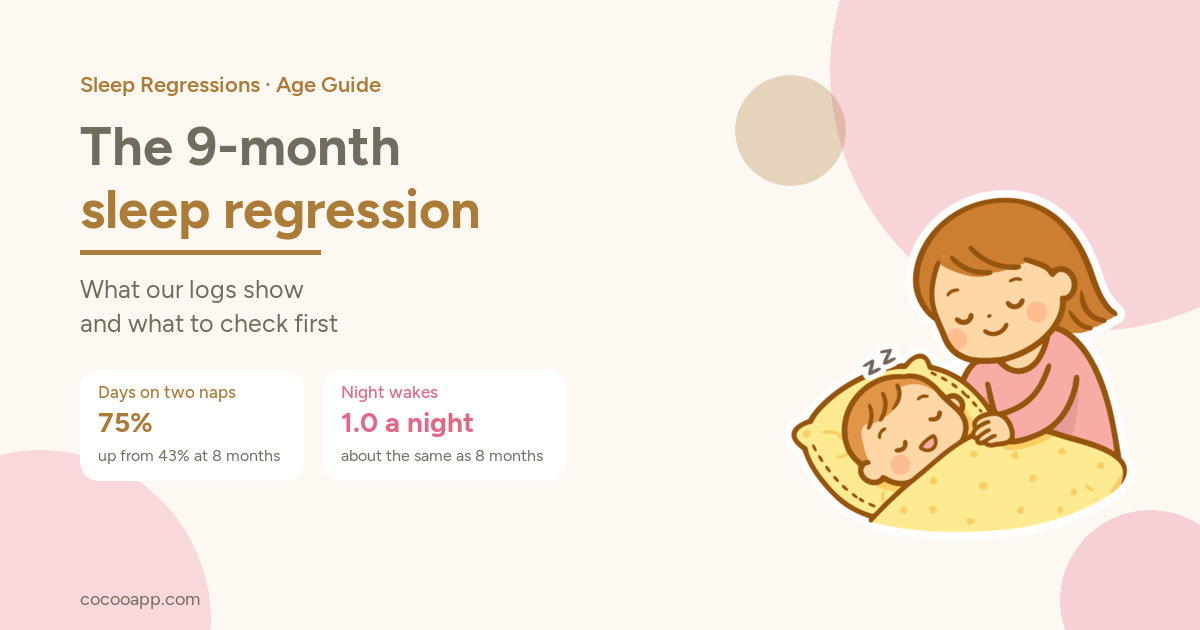
The 9-month sleep regression is mostly the end of the switch from three naps to two. In 130 logged days from 19 babies at 9 months, night wakes averaged 1.01 a night, about the same as at 8 months. Naps are what moved: 75% of days had two naps, up from 43% a month earlier.
An average doesn't help much if your baby was up three times last night. But it tells me where to look first, and at 9 months that's the day. Wake windows that worked on three naps are too short on two.
If it's 2am and she's up again
- →Standing at the rail? Lay her down once, say your goodnight line, leave.
- →Respond the way you do at bedtime. No new method tonight.
- →Hot, pulling at an ear, or a cry that sounds like pain: comfort her and skip the rest.
- →Tomorrow, write down when each nap started and how long she took to fall asleep.
Is there a 9-month sleep regression?
Many 9-month-olds sleep worse for a few weeks, but in our logs the average night at 9 months looks like the average night at 8 months. Here are 7 to 9 months, using only days a parent logged in full.
Swipe the table sideways to see every column →
| Age | Night wakes | Days on 2 naps | Days on 3+ naps | Typical night | Logged |
|---|---|---|---|---|---|
| 7 months | 1.14 | 32% | 61% | 10.6 hours | 329 days, 33 babies |
| 8 months | 0.95 | 43% | 40% | 10.5 hours | 186 days, 24 babies |
| 9 months | 1.01 | 75% | 14% | 10.6 hours | 130 days, 19 babies |
From our app, complete logged days only, pulled November 22, 2026. Night wakes is the average per night. Typical night is the median. Age is the baby's age in whole months on the logged day. Individual data is never shared.
Night wakes and night length barely move across the three rows. The two nap columns do. Three-nap days go from 61% to 14% in two months.
Nineteen babies is a small group, and parents who log every day aren't every parent. So read this as a pattern to check against your own baby. A baby whose nights got worse at 9 months is inside that average too.
What does a 9-month-old's day look like on two naps?
A 9-month-old on two naps is awake about 3 hours before the first nap, a little longer before the second, and about 4 hours before bed. These are the medians from 98 two-nap days logged by 16 babies.
- Morning wake-up to nap 1
- about 3 hours
- Nap 1
- about 65 minutes
- Nap 1 to nap 2
- about 3 hours 20 minutes
- Nap 2
- about 55 minutes
- Nap 2 to bedtime
- about 4 hours (most days 3.5 to 4.5)
- Bedtime
- 7:45pm
- Night
- about 10 hours 50 minutes
Compare the last wake window with a three-nap day. On three naps at 8 months, the stretch before bed was about 2 hours 35 minutes. On two naps it's closer to 4. That's the adjustment most likely to get missed. The full chart is in wake windows by age.
Why is my 9-month-old suddenly waking at night?
A 9-month-old who starts waking at night has usually changed her naps, learned to pull up, or started minding when you leave. Often two of those at once.
The nap change comes first because it's the most common and the easiest to fix. A baby who just dropped the third nap is often put down for the remaining two at the old times. She isn't tired enough, so she takes a long time to fall asleep or wakes after one sleep cycle. Then the day runs short on sleep and bedtime gets loud.
Pulling to stand has the best study behind it. Researchers followed 20 babies from 7 to 12 months, filming their movement and tracking sleep with ankle monitors every 3 weeks. Among the babies who pulled to stand early, by 8 months, the new skill lined up in time with a stretch of disrupted sleep (Atun-Einy and Scher, 2016). Twenty babies is small, and the link showed up in the early standers only.
Separation is the third. Around this age babies work out that you still exist when you're out of sight (Piaget, 1954), so your leaving the room means something it didn't at 6 months. I haven't found a study that measures how much sleep this costs at 9 months, so I'd treat it as the explanation of last resort, after naps and standing.
Which cause is it?
You can usually tell which cause it is from what happens right before the crying starts. Find your row.
Swipe the table sideways to see every column →
| What you see | Most likely | What I'd try |
|---|---|---|
| On two naps, but it takes 20+ minutes to fall asleep, or naps end at 30 to 40 minutes | Wake windows still sized for three naps | Add 15 minutes to each wake window every 3 days until you're near 3, 3.5 and 4 hours. |
| A third nap most days that's a fight, and a bedtime that keeps sliding later | Still in the 3-to-2 nap switch | Drop the third nap and move bedtime 20 to 30 minutes earlier for about a week. |
| Standing at the crib rail crying, asleep within a minute once you lay her down | Pulling to stand | Practice getting down from standing during the day. At night, lay her down once and keep it boring. |
| Cries the moment you leave, at bedtime and after a wake, and calms when you're in the room | Separation | Same short goodbye every time. Don't sneak out. She notices. |
| Fever, pulling at an ear, off her food, or a cry that sounds like pain | Illness | Comfort her and call the pediatrician. Leave the schedule alone until she's well. |
More than one row can be true. If so, start with the naps. The “what I'd try” column is common practice plus the wake windows from our logs. None of it has been tested in a trial at this age.
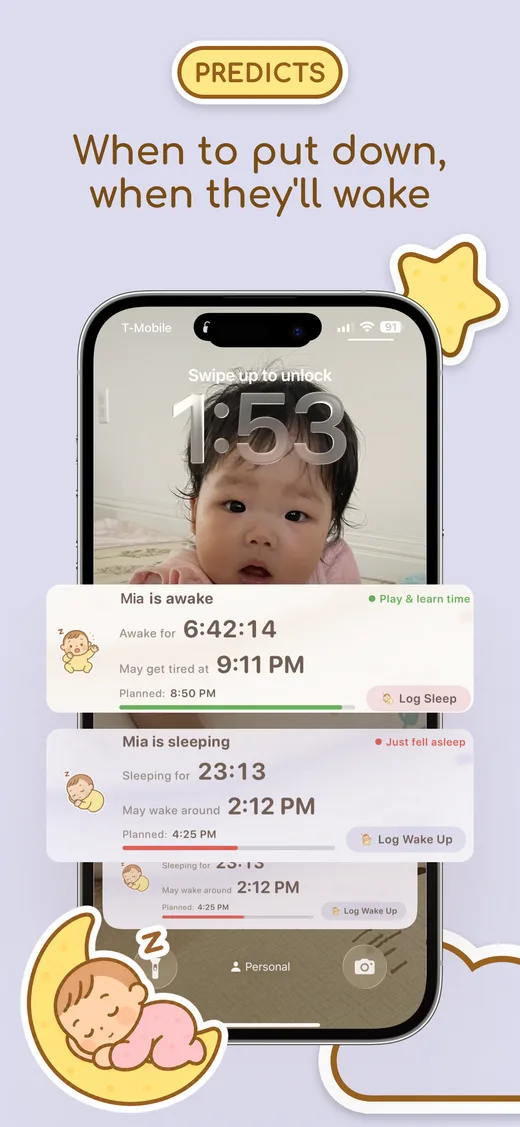
Can't tell which row?Log her naps for three days and compare her wake windows with the ones above.
How long does the 9-month sleep regression last?
Nobody has timed the 9-month sleep regression in a study, so the “2 to 6 weeks” you'll read elsewhere is a guess. The closest evidence is the pulling-to-stand study, where the rough patch sat around the weeks the skill arrived.
The nap part has an end you can see. In our logs, three-nap days were already down to 14% at 9 months. Once she's settled on two naps with windows that fit, that cause is gone. If it's been more than a month and nothing is improving, stop waiting and change the schedule.
What should you do this week?
- Write down three days. Wake-up, each nap's start and end, bedtime, and how long she took to fall asleep each time.
- Check the windows against the list above. If hers are 30 minutes or more shorter, stretch each one by 15 minutes every 3 days. Start with the one before bed.
- Teach the way down. During floor time, help her bend her knees and sit from standing at the couch, over and over.
- Keep the goodbye the same. Same words, same order, every nap and every night.
If the third nap is still hanging on, the 8-month post covers how to drop it. If things get rough again next month, the cause is usually different: see the 10-month regression.
When to call the doctor
Call your pediatrician if she has a fever, is pulling at an ear, snores or pauses in her breathing, is eating much less than usual, or is much sleepier than normal and hard to wake.
Related questions
How much sleep does a 9-month-old need?
The American Academy of Sleep Medicine recommends 12 to 16 hours in 24 for babies 4 to 12 months old, naps included (Paruthi et al., 2016). In our logs the middle 9-month-old day had about 12 hours 40 minutes of sleep: a night of roughly 10.5 hours plus two naps of about an hour each.
Can you sleep train a 9-month-old during a sleep regression?
Yes, if she's well and you can hold one plan for a week. A review of 52 studies found behavioral sleep methods worked in 94% of them (Mindell et al., 2006). None of those studies looked at regressions specifically. I'd fix the nap schedule first, because a baby put down too early or too late cries more with any method.
Keep reading
Sources
Atun-Einy O, Scher A. Sleep disruption and motor development: Does pulling-to-stand impacts sleep-wake regulation? Infant Behavior and Development. 2016;42:36–44. PubMed
Mindell JA, Kuhn B, Lewin DS, Meltzer LJ, Sadeh A. Behavioral treatment of bedtime problems and night wakings in infants and young children. Sleep. 2006;29(10):1263–1276. PubMed
Paruthi S, Brooks LJ, D'Ambrosio C, et al. Consensus statement of the American Academy of Sleep Medicine on the recommended amount of sleep for healthy children: methodology and discussion. Journal of Clinical Sleep Medicine. 2016;12(11):1549–1561. PubMed
Piaget J. The Construction of Reality in the Child. Basic Books; 1954.
Our data: days a parent logged in full, pulled November 22, 2026. At 9 months that is 130 days from 19 babies, of which 98 days from 16 babies had two naps. The three-nap comparison at 8 months is from 59 days and 14 babies.
Not sure her wake windows fit two naps yet?
Log a few days and see each window next to the nap that followed it.