A 1-year-old needs 11–14 hours of total sleep per day, split between 10–12 hours overnight and 1–3 hours of naps (Paruthi et al., 2016). The problem is that most schedules that worked at 9 or 10 months stop working around the first birthday, not because something is wrong, but because your baby is in the middle of one of the most disruptive sleep transitions of the first two years.
In data from babies tracked in Cocoo at exactly 12 months, the average nap count is 1.67. That number tells the whole story: your baby is caught between a 2-nap schedule and a 1-nap schedule, alternating between them day to day. Building a schedule that works means knowing which phase you're in, and what to adjust as it shifts.
It's 7:45pm. Your baby went down fine for 10 months straight. Now she's standing in the crib, babbling at the monitor, clearly tired but not falling asleep. Last Thursday she took two naps like a champ. Today she took one long one and you moved bedtime up. It's been 35 minutes and she's still not out. The schedule that was working two weeks ago isn't working anymore.
This is what the 2-to-1 nap transition looks like in real life. The chaos is predictable, and it ends.
Step 1: Know what normal looks like at 12 months
Before you can fix a schedule, you need to know what you're aiming for. Here's what the research says is typical for a 1-year-old:
| What | Range at 12 months |
|---|---|
| Night sleep | 10–12 hours |
| Daytime naps | 1–2 naps, 1.5–3 hours total |
| Total sleep | 11–14 hours (AAP recommendation) |
| Wake windows | 3.5–4.5 hours between sleeps |
| Bedtime | 6:30–8pm |
Source: Paruthi et al., 2016 (AASM consensus); Galland et al., 2012 (normal sleep patterns review).
Notice the ranges are wide. That's intentional. A 12-month-old on two naps will have different totals than one who already dropped to one, and both are normal. The ranges bracket both situations. What matters is consistency within whatever schedule you're running (Mindell et al., 2006).
One thing that is not on this table: total sleep does not go up as the transition happens. It tends to stay flat or drop slightly, as shorter daytime sleep gets partially offset by slightly longer nights. If your baby's overall hours look fine but she's fighting bedtime, the culprit is almost always schedule timing, not total amount.
Step 2: Figure out which schedule your baby is running right now
This is the question most schedule guides skip. They give you a 2-nap schedule or a 1-nap schedule and say "pick the one for your age." But at 12 months, the answer is usually neither. It's both, alternating.
What the data shows: nap counts from 10 to 15 months
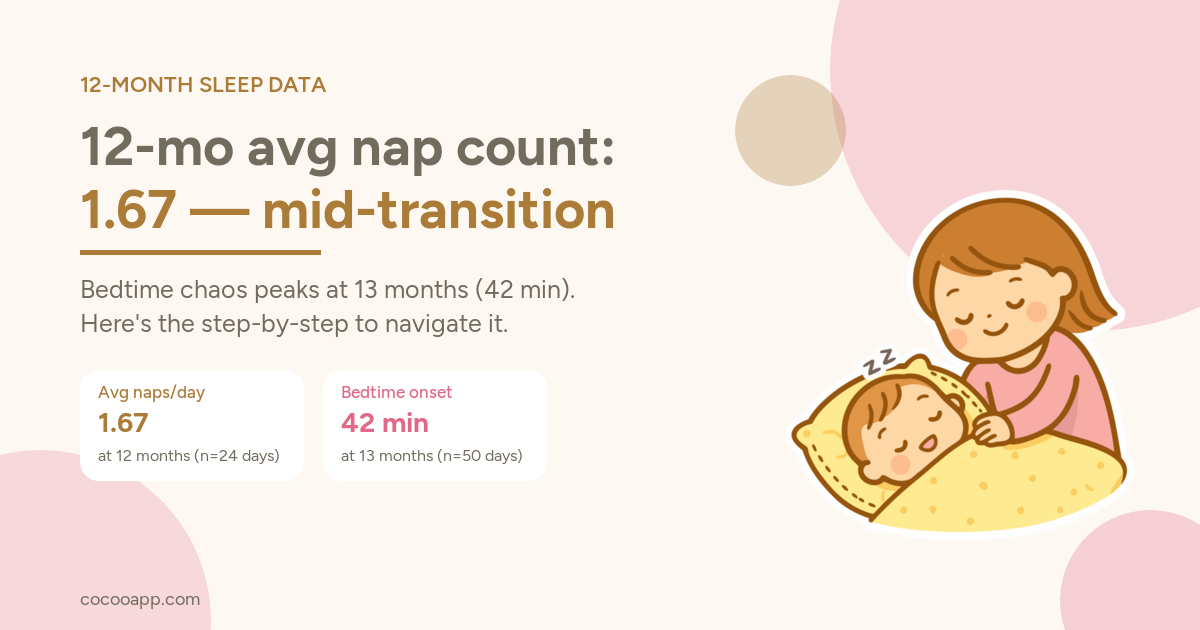
1.67
avg naps/day at 12 months (n=24 days)
42 min
avg time to fall asleep at 13 months (n=50 days)
| Age | Avg naps | Onset latency | Night wakes | n |
|---|---|---|---|---|
| 10 months | 1.96 | 9.7 min | 0.89 | 100 days |
| 11 months | 1.96 | 18.8 min | 0.63 | 27 days |
| 12 months | 1.67 | 19.8 min | 0.21 | 24 days |
| 13 months | 1.38 | 42.1 min | 0.82 | 50 days |
| 14 months | 1.34 | 38.5 min | 1.34 | 41 days |
| 15 months | 1.25 | 15.0 min | 1.70 | 20 days |
Source: Cocoo aggregate data, complete tracked days (is_complete_day = true), babies 10–15 months. Sample sizes by age band ranged from n=20 to n=100 days. Individual data is never used or shared.
Look at that onset latency column. It's 19.8 minutes at 12 months, then it nearly triples to 42.1 minutes at 13 months. This is the moment the nap transition is completing: the median nap count flips from 2 to 1 around 13 months, and the bedtime chaos peaks right then. It settles back down by 15 months once the 1-nap schedule is established.
To figure out which schedule your baby is on right now, track for 5–7 days and count the days with 2 naps versus 1 nap. If you get a 60/40 split or more toward 2 naps, you're still on a 2-nap schedule with occasional skip days. If it's 50/50 or more toward 1, you're in full transition. Pure 1-nap days consistently means the drop has happened.
You're not choosing which schedule to put your baby on. She'll show you. Your job is to build the schedule around the nap count she's actually taking.
Step 3: Set wake windows to match the schedule you're running
Wake windows at 12 months are longer than most parents expect. A baby who was comfortable with 2.5-hour windows at 6 months can usually handle 3.5 to 4.5 hours at 12 months. Getting these right matters more than the nap count. An overtired baby fights sleep regardless of how perfect your schedule looks on paper.
On a 2-nap schedule (still 2 naps consistently)
- Morning wake → Nap 1: ~3.5 hours
- Nap 1 → Nap 2: ~3.5 hours
- Nap 2 → Bedtime: ~3 hours (keep nap 2 ending by 3pm)
- Sample: Wake 7am → Nap 1 at 10:30am → Nap 2 at 2:30pm → Bed at 7pm
On a 1-nap schedule (consistently 1 nap per day)
- Morning wake → Nap: 4–5 hours (aim for a noon-ish nap)
- Nap → Bedtime: 4–5 hours
- Nap should be 1.5–2.5 hours for this to work
- Sample: Wake 7am → Nap at 11:30am → Bed at 7pm
In the oscillation zone (some 2-nap days, some 1-nap days)
Follow the baby, not the clock. On a 2-nap day, use 2-nap wake windows. On a 1-nap day, push the first nap to at least 11am so the afternoon wake window is manageable. The mistake is offering nap 2 when she's mid-transition and not tired enough for it, and she'll refuse, bedtime moves up, and overnight gets fragmented.
The wake windows matter most in the late afternoon. An awake stretch of 5+ hours before bedtime will produce a baby who seems wired but is overtired. 4 to 4.5 hours from last nap end to lights out is the target on a 1-nap day.
Step 4: Adjust bedtime when the nap count changes
This is the step most parents miss, and it's the one that causes the most bedtime drama.
When your baby drops from 2 naps to 1, her total daytime sleep drops by roughly 45–90 minutes. The only way to cover that deficit is a later midday nap (that takes longer) and a slightly earlier bedtime, at least temporarily. If you keep the same 7:30pm bedtime you used on a 2-nap schedule but your baby is now taking one shorter nap, she's been awake for 6+ hours before bed. That's too long.
Bedtime quick guide
| Schedule | Bedtime target |
|---|---|
| 2 naps, both solid | 7–7:30pm |
| Transition zone (mixed days) | 6:30–7pm on 1-nap days, 7–7:30pm on 2-nap days |
| 1 nap, nap ending before 2pm | 6:30–7pm until nap lengthens to 2h+ |
Early bedtime is temporary. Once your baby's single nap consolidates to 1.5–2 hours and lands consistently around noon, you can gradually push bedtime back toward 7–7:30pm. Expect this normalization to take 4–6 weeks from when the transition begins in earnest.
A note on the data: the onset latency spike to 42 minutes at 13 months in the tracked data above is partly explained by parents who kept late bedtimes during the transition. Babies who arrive at bedtime genuinely tired (4–4.5 hours after a completed nap) tend to fall asleep in under 15 minutes. The ones who fight for 40 minutes often have a gap of 5+ hours between nap and bed.
Step 5: Troubleshoot the top 4 problems this age
Bedtime resistance (taking 30–45 minutes to fall asleep)
Usually overtiredness or under-tiredness. Check the last nap end time. If it's more than 5 hours before bed, move bedtime earlier by 30 minutes. If it's under 3 hours, the nap was too late. Shift it forward tomorrow. Separation anxiety also peaks around 12–18 months; a brief check-in every 5 minutes during the first few nights tends to work better than complete extinction at this age (Mindell et al., 2006).
Short naps during the transition
If nap 1 is under 45 minutes and nap 2 never materializes, you're in classic transition chaos. For 2–3 days, try capping nap 1 at 45 minutes (wake her if needed) to build sleep pressure for nap 2. If nap 2 still doesn't happen, offer a rescue nap in the car at 3:30pm and move bedtime to 6:30pm. A short rescue nap beats no nap: it prevents the overtired spiral that makes bedtime worse.
Night wakings coming back after months of sleeping through
Look at the data table above: night wakes go from 0.21 at 12 months back up to 0.82 at 13 months and 1.34 at 14 months. The pattern makes sense: the nap transition creates schedule misalignment, and that misalignment surfaces as night waking. The fix is almost never night-focused. Fix the daytime schedule first (right nap count, right wake windows, right bedtime), and nights usually follow within a week.
If night waking persists after 7–10 days on a stable schedule, that's when tracking patterns becomes useful. Wakes that happen at the same time every night point to a schedule issue. Wakes that are variable usually mean hunger, developmental disruption, or a sleep association your baby still needs to fall back asleep.
The 5am wake (before you're ready)
Early morning waking at 12 months is almost always a bedtime problem in disguise. Too-early bedtime on a 1-nap day, or too-late bedtime creating overtiredness that fragments the last sleep cycle. Experiment in both directions: move bedtime 15 minutes earlier for 3 nights, then 15 minutes later for 3 nights. One direction will usually move the wake-up. See also: why babies wake at 4am for the full breakdown.
How to tell if the nap drop is causing the bedtime chaos
The tricky part of the 2-to-1 transition is that it looks like 4 different problems (short naps, bedtime resistance, early waking, and night waking) that are all the same schedule misalignment. Cocoo automatically detects when your baby is oscillating between nap counts and shows both schedule options side by side so you can compare how each one affects the rest of the day. If you've been adjusting the schedule by feel and not seeing progress, three to four days of complete tracking usually makes the pattern obvious.
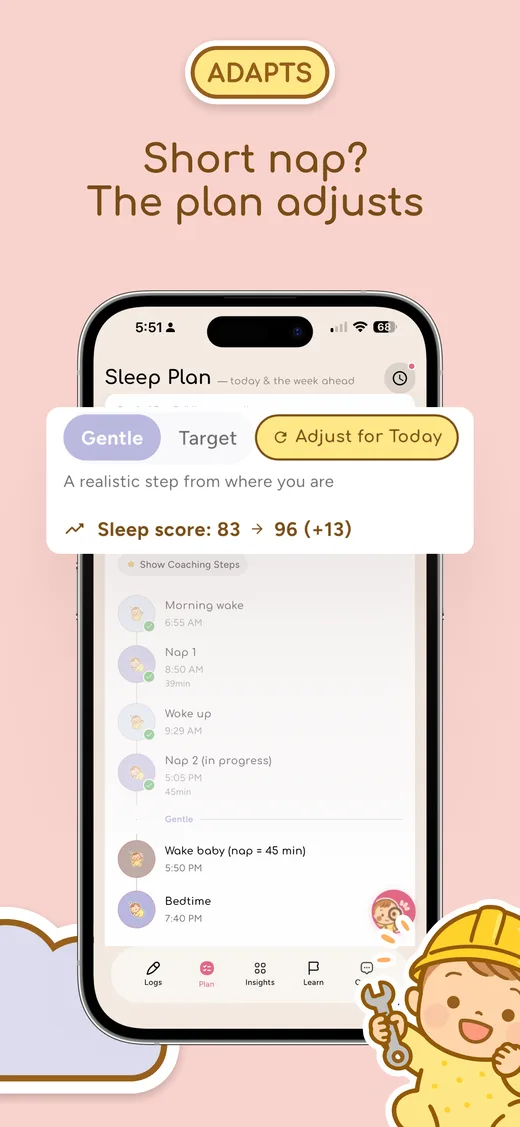
Stuck between one nap and two?Cocoo builds today's naps and bedtime from your baby's logs, and adjusts the rest of the day when a nap runs short.
Quick reference: 1-year-old schedules by nap count
| Schedule | Sample timing | Bedtime |
|---|---|---|
| 2 naps | Wake 7am · Nap 1 at 10:30 (~1h) · Nap 2 at 2:30 (~45min) · Bed | 7–7:30pm |
| Transition | Wake 7am · Push nap 1 to 11am (~1–1.5h) · Skip nap 2 · Bed | 6:30–7pm |
| 1 nap | Wake 7am · Nap at 12pm (~1.5–2h) · Bed | 6:30–7:30pm |
These are starting points, not prescriptions. Adjust based on your baby's actual wake-up time and nap length. The goal is consistent wake windows, not hitting exact clock times.
More from the Cocoo blog
Not sure which schedule your baby is on right now?
Track for 4–5 days and Cocoo shows you whether your baby is oscillating between nap counts, flags the transition window, and builds both schedule options so you can see which one fits your day.


Sources
- Paruthi S, Brooks LJ, D'Ambrosio C, et al. “Recommended Amount of Sleep for Pediatric Populations: A Consensus Statement of the American Academy of Sleep Medicine.” Journal of Clinical Sleep Medicine, 2016. Link
- Galland BC, Taylor BJ, Elder DE, Herbison P. “Normal sleep patterns in infants and children: A systematic review of observational studies.” Sleep Medicine Reviews, 2012. Link
- Mindell JA, Kuhn B, Lewin DS, Meltzer LJ, Sadeh A. “Behavioral treatment of bedtime problems and night wakings in infants and young children.” Sleep, 2006. Link
- Mindell JA, Meltzer LJ, Carskadon MA, Chervin RD. “Developmental aspects of sleep hygiene: Findings from the 2004 National Sleep Foundation Sleep in America Poll.” Sleep Medicine, 2009. Link
- Cocoo aggregate data, complete tracked days (is_complete_day = true), babies 10–15 months. All data is anonymized and aggregated; no individual baby data is used. Sample sizes per age band ranged from n=20 to n=100 tracked days.