Personalized guidance backed by sciencePersonalized guidance backed by science
Sleep Science · Data Study
By Sue Ye · November 2026 · 7 min read
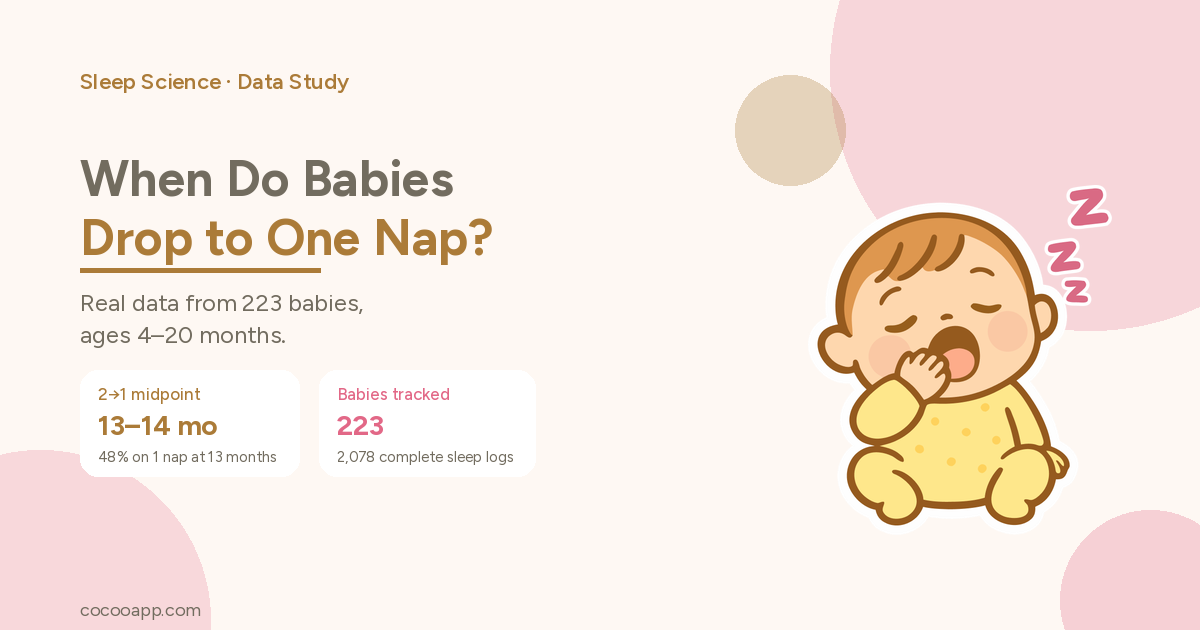
Most babies drop to one nap between 13 and 15 months. The 3-to-2 nap transition happens earlier than most parents realize: by 9 months, 78% of babies in our dataset had moved to 2 naps. These numbers come from 2,078 complete logged days tracked by 223 families in Cocoo across the first two years.
The data reveals the shape of each transition too. Neither drop is a single overnight switch. Both come with a 4-to-8-week oscillation period where your baby alternates between nap counts and nothing about the schedule feels reliable. That alternating pattern is the transition working as expected.
Below: the full breakdown by age, what the oscillation period looks like in the logs, and what changes when it's over.
48%
of 13-month-olds logged at least one 1-nap day in our data
223
babies tracked across 2,078 complete logged days, ages 4–20 months
Most sleep advice treats the 3-to-2 transition as happening at "5 to 8 months." Our data puts it later and faster than that. At 7 months, 61% of babies were still on 3 or more naps. At 8 months, things got genuinely messy: 40% were on 3+ naps, 43% had moved to 2, and 15.5% were already down to 1. By 9 months, 78% were on 2 naps and the transition was essentially over.
The 8-month period is the oscillation zone for this transition. If your 8-month-old is on 2 naps on Tuesday and 3 on Wednesday, that inconsistency is the transition in progress.
| Age | 3+ naps | 2 naps | 1 nap | days (n) |
|---|---|---|---|---|
| 5 months | 76.4% | 20.3% | 2.2% | 369 |
| 6 months | 67.2% | 27.4% | 3.7% | 405 |
| 7 months | 60.8% | 32.4% | 5.5% | 309 |
| 8 months ◀ | 40.2% | 43.1% | 15.5% | 174 |
| 9 months | 10.8% | 77.5% | 11.7% | 120 |
| 10 months | 6.1% | 83.7% | 10.2% | 98 |
◀ oscillation zone. Source: aggregate sleep-log data, complete tracked days only (is_complete_day = true). Sample sizes per age band shown in final column.
This is the transition parents mean when they ask "when does my baby drop to one nap." The standard answer is 12 to 18 months, which is accurate but not very useful. The data gives a clearer picture.
At 12 months, only 12.5% of babies logged 1-nap days. That's genuinely rare at that age. At 13 months, the number jumped to 48%, meaning the transition had started, but half of babies were still split between 1 and 2 naps. By 15 months, 78% were consistently on 1 nap. The median sits around 14 months. Iglowstein et al. (2003) found the same general range in a longitudinal Swiss cohort: most toddlers completed the transition between 13 and 18 months, with significant individual variation.
| Age | 2 naps/day | 1 nap/day | days (n) |
|---|---|---|---|
| 10 months | 83.7% | 10.2% | 98 |
| 11 months | 81.5% | 11.1% | 27 |
| 12 months | 58.3% | 12.5% | 24 |
| 13 months ◀ | 36.0% | 48.0% | 50 |
| 14 months ◀ | 34.1% | 58.5% | 41 |
| 15 months | 16.7% | 77.8% | 18 |
| 17 months | 5.9% | 70.6% | 17 |
◀ oscillation zone. Percentages may not sum to 100% because a small share of days had 0 or 3+ naps logged. Source: aggregate sleep-log data, complete tracked days only.
Look at the 13-month row again: 48% of days had 1 nap, 36% had 2 naps. On roughly every other day, the nap count is different. That daily variation is the transition working. Something went wrong only if the variation continues for 10 or more weeks with no trend.
The reason it oscillates is biological. Sleep pressure (the drive to sleep that builds with time awake) doesn't shift overnight. For a few weeks, some days your baby has enough capacity to consolidate daytime sleep into one block, and some days they don't. What they ate, how active the morning was, whether they slept well the night before: all of it tips the scale.
The standard advice to "offer 1 nap on most days and 2 on days they seem tired" is correct but misses something. The pattern of which days flip first tells you whether the transition is progressing. Three 1-nap days in a row followed by a 2-nap day is very different from every other day alternating. Apps like Cocoo track this automatically and flag when the nap count starts stabilizing, so you can see the transition in progress instead of guessing.
Most parents can expect the oscillation to last 4 to 6 weeks before the new schedule locks in. Some babies sort it out faster; some take 8 weeks. If your baby is still bouncing between 1 and 2 naps at 16 or 17 months, check whether the single nap is long enough. A nap under 60 minutes during the transition often means the wake window to that nap is too short.
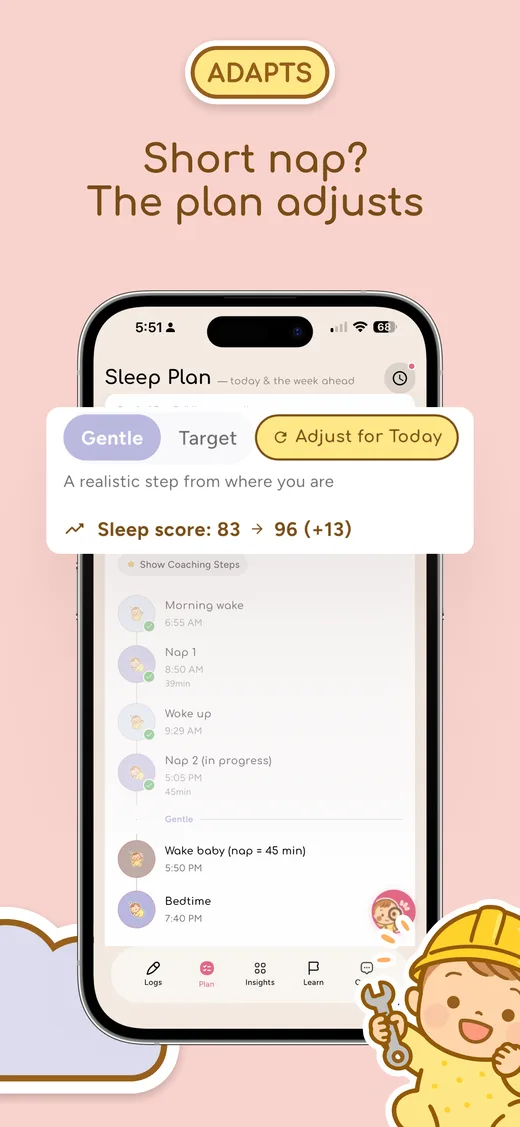
Bouncing between one nap and two?Cocoo builds each day's plan from your baby's logs and adjusts the rest of the day when a nap runs short.
Night sleep stays relatively stable through the 3-to-2 transition. In the data, average night sleep rose slightly from 7 months (11.6 hours) to 8 months (11.9 hours) as babies settled into fewer, longer daytime blocks. The disruption most parents feel at 7 to 8 months usually comes from the developmental changes happening at the same time, not from the nap transition itself.
The 2-to-1 transition is different. Night sleep at 14 months averaged 9.8 hours in our data, about 1 hour less than at 13 months (10.9 hours). The dip reflects the total sleep need shifting downward at this age rather than any fault in the schedule. By 15 months, night sleep had recovered to 10 hours. Galland et al. (2012) found similar patterns in a cohort of New Zealand infants: total sleep decreases gradually across the second year as consolidation improves.
If nights get significantly harder during the 2-to-1 transition (more fragmented, with new wake-ups, not just shorter), look at two things first: whether the nap is too late (pushing bedtime past 7:30pm) and whether the wake window before bed has gotten too long. The wake window before bed on a 1-nap schedule is typically 4.5 to 5.5 hours, longer than many parents expect.
The analysis used 2,078 complete tracked days from 223 babies aged 4 to 20 months. A complete day requires both a full night and full daytime logged (is_complete_day = true), with no gaps. Partial days are excluded.
Age bands with fewer than 10 complete days are not shown in the tables. Some ages between 15 and 20 months have thin sample sizes (n = 17 to 18 days) and should be read as directional rather than definitive. The oscillation zone percentages may not sum to 100% because a small fraction of days had 0 naps logged or 3+ naps after 10 months (both rare).
Data is aggregate and anonymous. No individual baby's records are included or referenced. Sample sizes by age band are shown in the table footnotes.
The numbers above don't tell you exactly when your baby will drop a nap. Individual variation is real: some babies are solidly on 1 nap at 11 months, some are still on 2 at 16 months. What the data gives you is a baseline. If your 10-month-old is suddenly refusing the second nap but it's only happening 1 or 2 days a week, they're probably not ready. If your 13-month-old is refusing 4 or 5 days a week, the transition is likely underway.
The data also makes the limits of "just watch for signs" clear. The signs people describe (refusing the second nap, bedtime fighting) appear during overtiredness and developmental leaps too. What distinguishes a nap transition from a rough week is the pattern across 7 to 10 days, with the nap count trending in one direction.
Cocoo tracks the nap count across days and flags when it starts oscillating consistently, the sign that a transition has begun rather than a bad week. It also shows both the 1-nap and 2-nap schedule side by side so you can see which one fits your baby's current wake windows.
For more on what the full sleep schedule looks like by age from 0 to 24 months, including nap timing and wake windows, see the age-by-age reference guide.
In our data from 223 babies, the 2-to-1 midpoint falls at 13 to 14 months: 48% of 13-month-olds logged 1-nap days, rising to 59% at 14 months and 78% at 15 months. The standard range (12 to 18 months) is accurate, with the median closer to 14 months.
The oscillation period typically lasts 4 to 8 weeks. During that time your baby alternates between 1-nap and 2-nap days. That alternation is normal; it doesn't mean the transition has stalled. Most families settle into a consistent 1-nap schedule by 15 months.
The 3-to-2 transition oscillation happens most at 8 months (40% still on 3+ naps, 43% on 2 naps). By 9 months, 78% of babies in our data had moved to 2 naps. Most babies settle into 2 naps by 9 months, though some stay on 3 until 10 or 11 months.
Dropping to 1 nap before a baby is ready typically causes overtiredness: a first nap that runs very long and pushes bedtime late, more night waking, or early morning wake-ups. Only 10% to 13% of 10- to 12-month-olds in our data were consistently on 1 nap. If your 11-month-old is on 1 nap and nights are getting worse, adding back a second nap is usually worth trying for a week.
Keep reading
Baby Sleep Schedule by Age (0–24 Months)
Total sleep, nap counts, and sample timings at every age.
Baby Wake Windows by Age: The Complete Guide (0–24 Months)
How wake windows change during nap transitions.
The 8-Month Sleep Regression: What Our Logs Show
The 3-to-2 nap transition and what else happens at 8 months.
Why Are Baby Naps So Short? The 4 Root Causes
Short naps during a transition vs. short naps that need fixing.
Not sure which transition your baby is in?
Track a few days and let the nap count pattern tell you. The app flags when the oscillation starts and shows both schedule options side by side — so you're not guessing.