
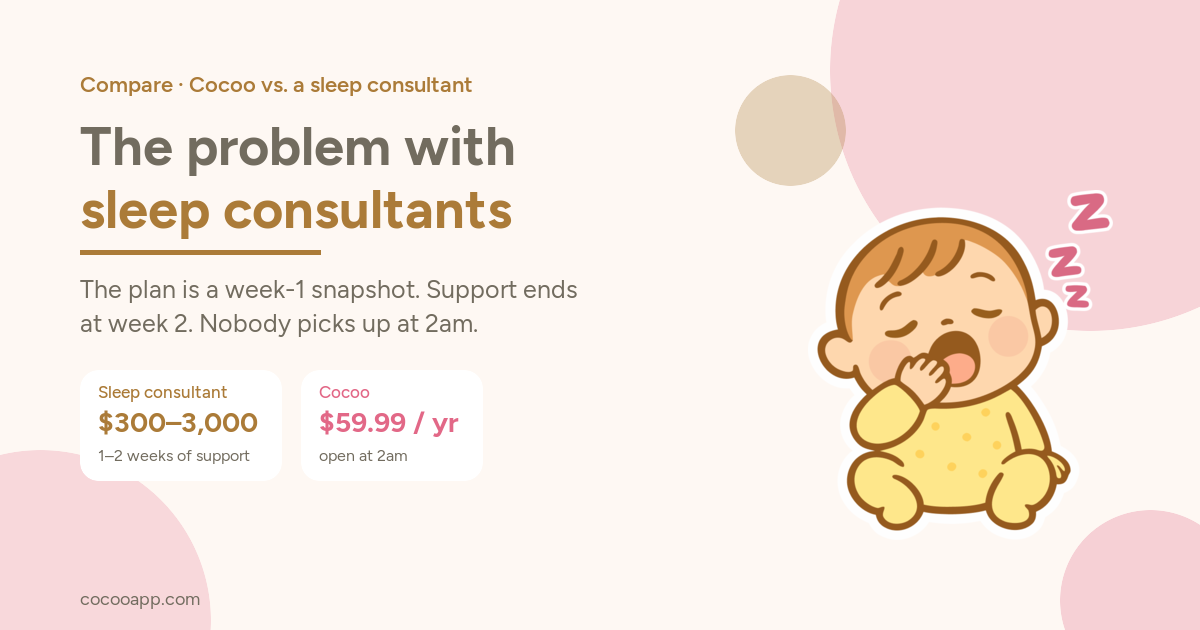
A sleep consultant gives you two things most apps don't: a plan written for your baby, and a person who checks in during the hard week. I'd want both. My problem with the model is when you get them, and for how long.
The plan comes out of one intake call. Support runs for a week or two and then ends, and the calls happen during the day. Your baby doesn't know any of that. The 2am wake still happens at 2am, and the schedule keeps shifting long after the package is over.
I should say up front that we make Cocoo, a $59.99-a-year app that does the diagnosis and the night-by-night guidance from your own logs, so I have a stake in this. I've tried to be fair about it. Every number on this page has its sample size next to it, and further down I answer the pushback I'd expect from anyone leaning toward a consultant, including the two places where I think they're right.
The case against waiting for business hours, in numbers
71%
of parents' "why is my baby waking" sessions in Cocoo start outside 9am to 5pm
31%
start between 10pm and 5am
28%
start on a Saturday or Sunday
6
different leading causes behind the same complaint, night waking
49%
of daily plans asked for a schedule change
65%
of babies tracked 3+ weeks still needed changes after day 14
Cocoo log analysis, pulled October 30, 2026. Help sessions: 3,965 sessions since March 2026, local time. Night-waking causes: 532 diagnosed cases from 230 babies. Plans: 9,838 daily plans for 945 babies; 309 of 479 babies with 21+ days of plans.
Parents look for help when the baby is awake, and that's mostly not office hours. Cocoo has a “why is this happening” flow that parents open when a night or a nap goes wrong. We've had 3,965 of those sessions since March 2026. 71.1% started outside 9am to 5pm in the parent's own time zone. 31.2% started between 10pm and 5am, and 27.6% fell on a weekend. Plain logging looks the same: 55.7% of 35,590 sleep entries from 570 babies were typed in outside 9 to 5. If you text a consultant at 2am, you'll usually hear back in the morning. By then the night is over and you handled it however you handled it.
Night waking has at least six different causes, and they don't get the same fix. It's the most common thing parents bring to Cocoo's diagnosis. In 532 night-waking cases from 230 babies, the top-ranked cause was a sleep association 30.3% of the time. Overtired at bedtime came next at 24.2%, then undertired at bedtime at 21.1%, schedule drift at 10.2%, hunger at 6% and a developmental leap at 3.8%. Look at the second and third. Overtired means bedtime needs to move earlier. Undertired means later. A consultant works that out from an intake form and a call, once. The logs work it out from what your baby did this week, and they keep working it out after the call.
The plan goes stale before the baby does. Most remote packages come with one or two weeks of support. We looked at 479 babies with at least three weeks of daily plans in Cocoo. For 309 of them (64.5%), the plan was still asking for a schedule change after day 14, and on 56.2% of those later days it asked for one. Across all 9,838 daily plans for 945 babies, 48.9% carried at least one adjustment to a wake window, nap length or bedtime, worked out from the previous few days of logs. Most of those are small, 5 to 20 minutes. Small is the whole point. Nobody books a follow-up call to move bedtime by ten minutes, so bedtime doesn't move.
The price. A remote package runs $300 to $1,000 for an intake, a written plan and one to two weeks of text or phone support. In-home and overnight consultants charge $1,500 to $3,000 or more (published package rates, October 2026). Cocoo is $59.99 a year. Tracking, 5 coach messages a day and night 1 of a sleep training plan are free.
The research backs the methods, not the credential. A review of 52 studies found that behavioral methods (graduated extinction, bedtime routines, parent education) improved bedtime problems and night wakings in the large majority of them (Mindell et al., 2006). Software with no human coach has been tested on its own too. In a randomized trial of 264 families, an internet program that tailored its advice to a questionnaire cut the number and length of night wakings by about half within three weeks, and the control group barely moved (Mindell et al., 2011). Sleep consulting isn't a licensed profession and has no outcome studies of its own that we could find. To be fair, the software evidence is thin as well: two studies of one tool, both funded by the company that made it (Mindell et al., 2011; Leichman et al., 2020).
If you're leaning toward a consultant, you're probably thinking…
Four fair pushbacks. Two of them are good reasons to hire the consultant.
“An app can't see my baby. A consultant takes in the whole picture: temperament, feeding, our family, what we've already tried.”
Fair, but ask where that picture comes from. Mostly it's a form you fill out once and a call. Cocoo asks the same questions when you start a diagnosis: how your baby falls asleep, what you do when they wake, teething, feeds, what you've already tried. Then it has something an intake form doesn't, which is every nap and night you've logged since. And it's still reading them in week 3, when the consultant has moved on to the next family.
Where a consultant wins outright: reflux, a medical history, twins, a baby who has already failed two methods. Those need a person who can weigh things a log can't hold. The app says so when it sees them, and I'll say it here.
“I know the method. What I'll need on night 3 is someone to answer to.”
This is the strongest one, and it's half right. Cocoo does have a person: tap “Talk to Sue” in the app's chat and you're messaging me, the founder, not the AI. I read your baby's logs before I reply, and it's free. But it isn't an on-call line, and I won't promise you a reply at 2am.
What you do get at 2am is the thing most parents don't have on night 3. Tonight's check-in waits, set from today's naps. A timer that runs them so you aren't counting in your head. And a warning, given in advance, that night 3 or 4 usually gets worse before it gets better. Parents who know that going in cave less often. If you already know you'll need a human voice to get through it, hire the consultant. Pick the shortest package you can, and keep logging so you know what to change after they're gone.
“A consultant's plan is custom. An app's plan is generic.”
Custom for the week you bought. In our data, 309 of 479 babies tracked for three weeks or more still needed schedule changes after day 14. The plan a consultant writes in week 1 is right for week 1.
Cocoo rereads the last few days every morning. And when a nap goes wrong at 2pm, you tap “Adjust for Today” and it re-times every remaining nap and bedtime on the spot. A skipped nap moves tonight's bedtime earlier. A last wake window that's crept too short gets a few minutes added back. If your baby gets sick mid-training, the plan pauses rather than starting over. None of that needs an appointment.
“Sleep is too important to trust to software.”
The research backs the methods and the consistency, not the credential of the person delivering them. The best evidence for sleep training comes from studies where parents followed a written plan and logged with pen and paper (Mindell et al., 2006). The one randomized trial of a software-delivered plan cut night wakings by about half in three weeks (Mindell et al., 2011). Sleep consulting is unregulated, so a certificate tells you less than you'd hope. Whoever you hire, ask about their training and what happens after week 2.
The limit on our side: the software evidence is two studies of one tool, with industry funding. We publish what Cocoo is built on at cocooapp.com/science. And we're newer than any consultant you'll talk to. Cocoo is rated 4.9 on the US App Store from 48 ratings as of 2026-11-27. That's a small number, and I'd rather you saw it than guessed.
So, a consultant or Cocoo?
Hire a sleep consultant if your baby has a medical complication, has already failed two methods, or you know you need a human to answer to on night 3. That's a real group of families, and a good consultant earns the fee.
If that's not you, the problem with a consultant is timing. The plan is a snapshot from week 1. Support ends in week 2. The phone is off at midnight, which is when 31.2% of parents in our data are looking for an answer. Cocoo reads this week's logs, changes tomorrow's plan, runs tonight's check-ins, and is awake at 2am. And when you want a person, the founder is a message away in the app. $59.99 a year.
See what your baby's logs say before you book anyone
Log a few days in Cocoo. It shows the likely cause of the bad nights, adjusts tomorrow's schedule, and guides the nights if you decide to sleep train.
Download Cocoo — it's free to startFree to start on iOS and Android. Night 1 of any sleep training plan is free.
Sources
Cocoo log analysis, production database, pulled October 30, 2026. Sessions and log entries are counted in the parent's local time zone. Night-waking causes are the top-ranked cause in each diagnosis. Daily plan changes are adjustments the plan asked for relative to the baby's recent schedule.
Mindell, J. A., Kuhn, B., Lewin, D. S., Meltzer, L. J., & Sadeh, A. (2006). Behavioral treatment of bedtime problems and night wakings in infants and young children. Sleep, 29(10), 1263–1276.
Mindell, J. A., Du Mond, C. E., Sadeh, A., Telofski, L. S., Kulkarni, N., & Gunn, E. (2011). Efficacy of an internet-based intervention for infant and toddler sleep disturbances. Sleep, 34(4), 451–458. doi.org/10.1093/sleep/34.4.451
Leichman, E. S., Gould, R. A., Williamson, A. A., Walters, R. M., & Mindell, J. A. (2020). Effectiveness of an mHealth intervention for infant sleep disturbances. Behavior Therapy, 51(4), 548–558. doi.org/10.1016/j.beth.2019.12.011
Consultant prices: published package rates from independent remote and in-home sleep consultants, checked October 2026. The full five-way comparison, with trackers, monitors and courses, is in our sleep consultant vs. app guide.