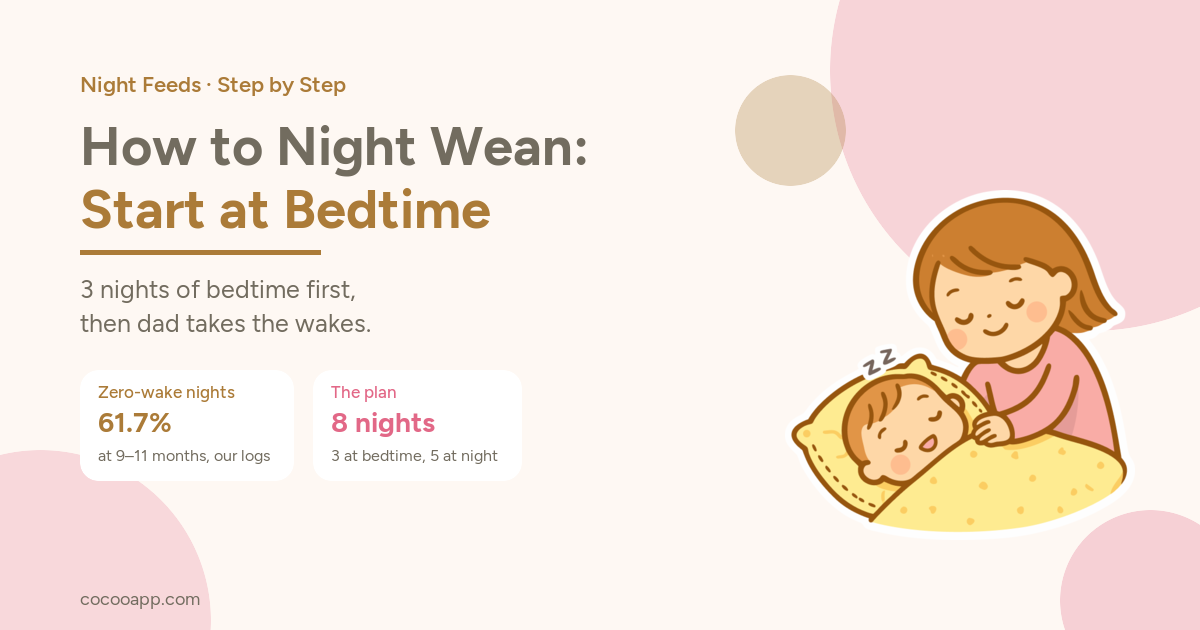
Night weaning works best when it starts at bedtime, not at 2am. For 3 nights, feed her at the start of the bedtime routine and let dad (or another partner) put her down. On night 4 he takes the night wakes, except one planned feed.
A baby goes back to sleep in the night the same way she fell asleep at bedtime. And after 9 months the timing is on your side: in our logs, nights with zero wakes almost double.
If it's 2am right now
- Don't start the plan tonight. Feed her and get some sleep.
- If you know you'll end up feeding, feed in the first few minutes, not after 45 minutes of crying.
- Tomorrow at bedtime, move the feed to the start of the routine. That's night 1.
When can you start night weaning?
Most babies can drop night feeds from about 6 months if they're growing well and your pediatrician agrees. But our logs show the first year has two very different halves. From 4 to 8 months, about a third of nights had no wakes at all. At 9 to 11 months it was 61.7%.
| Age | Zero-wake nights | 2+ wakes | Avg wakes | Sample |
|---|---|---|---|---|
| 4–5 months | 35.6% | 31.2% | 1.16 | 735 nights · 94 babies |
| 6–8 months | 33.5% | 30.4% | 1.11 | 823 nights · 73 babies |
| 9–11 months | 61.7% | 16.7% | 0.67 | 209 nights · 30 babies |
| 12–15 months | 56.4% | 28.6% | 0.98 | 133 nights · 20 babies |
Aggregate sleep logs, complete logged days only, test accounts removed. Each band is a different mix of babies, not the same babies followed over time. The 12–15 month band is small.
So in a rough 6-month stretch I'd wait and try again closer to 9 months. One limit: parents log wakes by hand, and a quick 2-minute feed doesn't always get logged.
Why night weaning with dad fails at 2am
Babies whose parents do more to help them fall asleep (feeding, rocking) wake more often and for longer at night (Sadeh et al., 2010). A survey of 5,006 parents found the same link between what parents do at bedtime and how babies sleep (Sadeh et al., 2009). So if you feed her to sleep at 7pm, at 2am she's looking for you and milk.
Dad walking in at 2am is a brand new way to fall asleep, at the hour she's least tired and most upset. She can smell milk on you too. Breastfed babies recognize their mother's smell from the first days (Porter & Winberg, 1999), so you standing in the doorway is close to offering. Bedtime is the opposite. She's the most tired she'll be all day, which makes it the easiest time to learn something new. Dads being involved also goes with better sleep for both baby and mom, at least in one study of 57 families (Tikotzky et al., 2015). No partner? Same order: move the feed first, then the night.
How to night wean in 8 nights
1. Nights 1–3: bedtime only
Feed her at the very start of the routine, lights on, outside the bedroom if you can. She should finish awake. Then you say goodnight and leave, out of sight and out of earshot.
2. Nights 1–3: dad does the rest
Pajamas, one book, one song, into the crib awake. He can stay and pat or shush. Same words every night. At night wakes you still feed as usual. One change at a time.
3. Night 4: pick one feed before bed
Choose one wake you'll keep, like the first one after 2am. You feed then, in the dark, straight back to the crib. Every other wake is dad, settling her the way he does at bedtime.
4. Nights 4–8: give it 5 nights
Sleep in another room or wear earplugs. If you're uncomfortably full, express just enough to feel ok. Then drop the last feed gradually (see the ounce-by-ounce schedule linked below).
Working looks like this: bedtime with dad is shorter by night 3, then the first stretch of the night gets longer, then the wakes that aren't the planned feed get shorter each night. Behavioral plans like this one work for most babies in studies, though most of those studies cover bedtime and night wakings in general, not night weaning by itself (Mindell et al., 2006).
Is it hunger or habit?
Hunger and habit look different at the wake itself.
| What you see | Most likely | What I'd try |
|---|---|---|
| She eats for 10+ minutes and goes straight back to sleep | Real hunger, at least at this wake | Keep this one as the planned feed for now |
| She nurses 2–4 minutes, falls asleep on you, wakes again in an hour | Feeding is how she falls back asleep | Dad settles this wake from night 4 |
| She screams for dad but settles in seconds for you | Dad is new at night, and you smell like milk | Go back to nights 1–3: dad does bedtime first |
What usually undoes it
- Mom "just helping" from the doorway.
- Dad bringing a bottle of milk. That moves the feed to him, it doesn't drop it.
- Switching who goes in from night to night.
- Going in to feed after 45 minutes of crying, which teaches her that crying longer works. If you're going to feed, feed at minute 5.
None of that is bad parenting. It's why the plan keeps the hard part at 7pm.
To shrink the last feed night by night, use the ounce-by-ounce night weaning schedule. Related: the dream feed, how to stop holding her to sleep, and the science behind our plans.
How Cocoo helps with night weaning
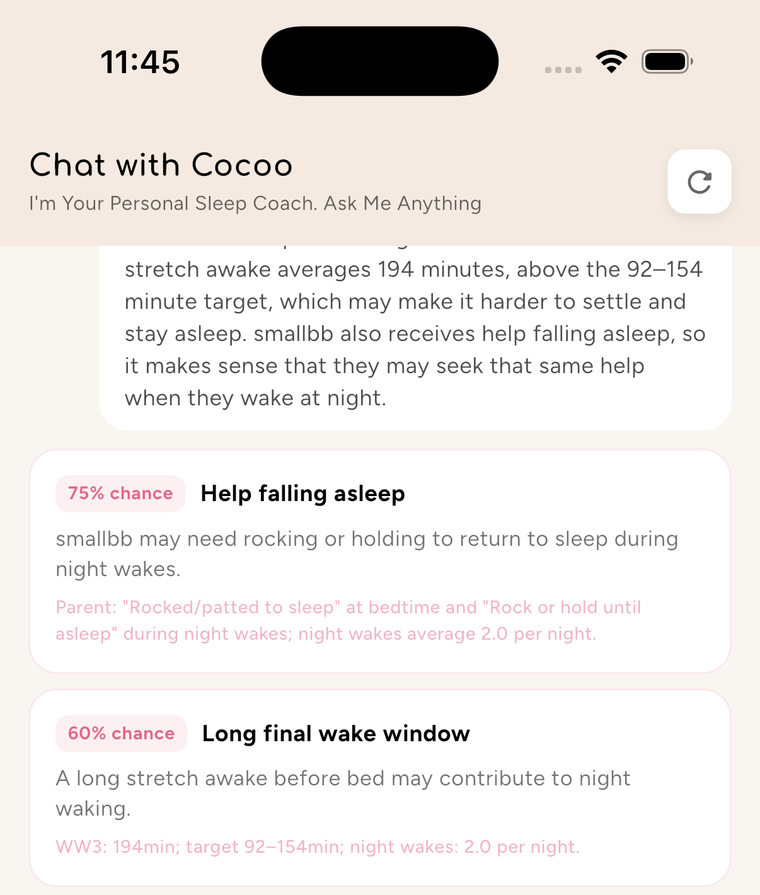
The two questions I couldn't answer at 3am were "is this hunger or habit?" and "how many wakes is normal now?" That's why I built Cocoo. When you log a bedtime or a night wake, you tap how she fell asleep (independently, nursing, bottle, held, co-sleep). After a few nights, the Coach tab lines those up and tells you what's most likely driving the wakes.
The Sleep Plan then puts a Night wake-ups row under bedtime with her usual number, like "0–1 (~10 min awake)". When the plan is aiming lower, it says "aim for 1 or fewer". That's the number to hold the planned feed against on night 4. And the plan rebuilds the next day from what really happened, so a rough night changes tomorrow's nap and bedtime times instead of just going in the log.
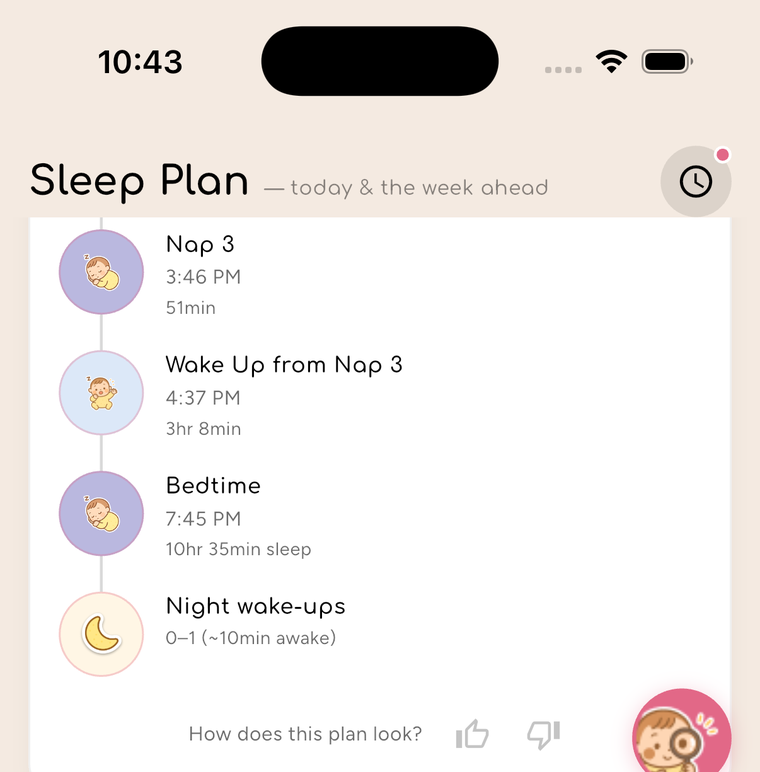
Two limits. There's no special "night weaning mode", just the logs, the Coach and the plan. And there are no separate caregiver accounts yet, so if dad does the wakes, he logs them on the same account.
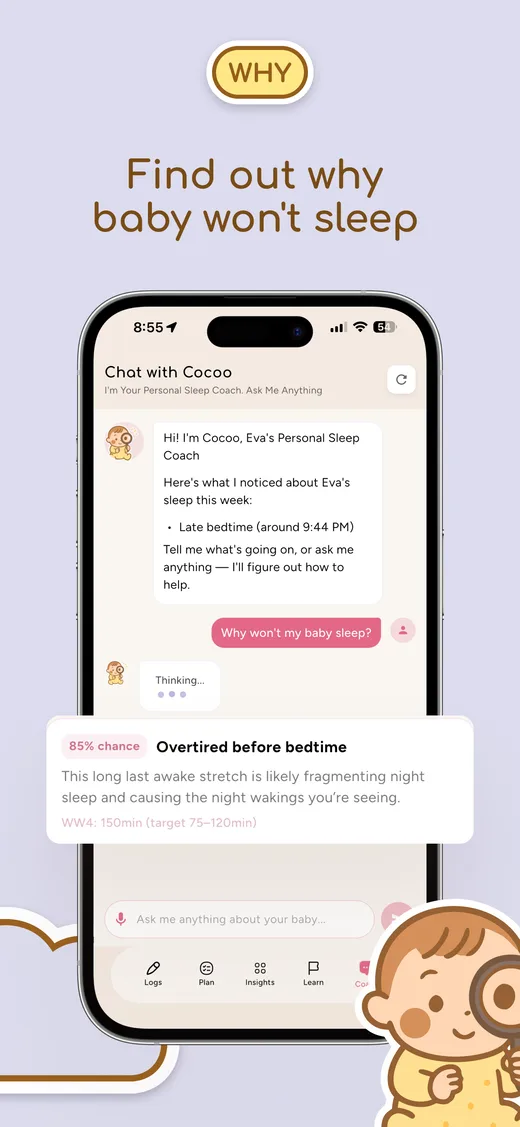
Hunger or habit at 3am?Log how she falls asleep at bedtime and at each wake, and Cocoo's coach ranks what's most likely driving the wakes.