Personalized guidance backed by sciencePersonalized guidance backed by science
Sleep Science · Data Study
By Sue Ye · November 2026 · 8 min read
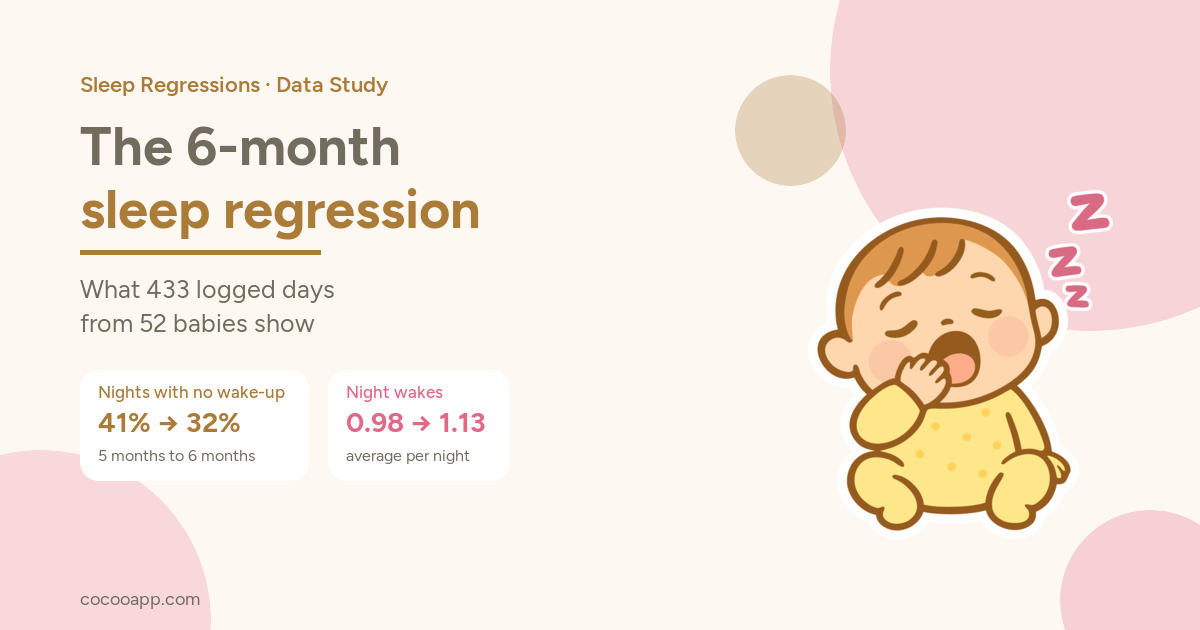
The 6-month sleep regression shows up in our logs, though it's a smaller dip than the one at 4 months. In 433 complete logged days from 52 babies, sleep-through nights dropped from 40.8% at 5 months to 32.3% at 6 months, and average night wakes rose from 0.98 to 1.13. Your baby sleeping beautifully at 5 months and then suddenly waking twice a night is not bad luck.
But it doesn't look like the 4-month regression. That one hits hard and permanently rewires sleep architecture. The 6-month disruption is quieter and sneakier. A lot of parents wonder if they're imagining it. They're not.
Here's what the data shows, three things that drive it, and how to figure out which one is affecting your baby specifically.
The table below shows key sleep metrics across 4 to 9 months, using complete tracked days from the Cocoo sleep tracking dataset. Complete means both a full night and full daytime logged, with no gaps. Partial days are excluded.
| Age | Night sleep | Avg wakes | Sleep-through nights | Total sleep | Days / babies |
|---|---|---|---|---|---|
| 4 months | 10.7h | 1.38 | 29.5% | 14.0h | 434 / 63 |
| 5 months | 10.7h | 0.98 | 40.8% | 13.7h | 397 / 57 |
| 6 months | 10.3h | 1.13 | 32.3% | 13.1h | 433 / 52 |
| 7 months | 10.6h | 1.14 | 36.4% | 12.8h | 329 / 33 |
| 8 months | 10.5h | 0.95 | 35.5% | 12.7h | 186 / 24 |
| 9 months | 10.6h | 1.01 | 45.4% | 12.7h | 130 / 19 |
15%
more night waking at 6 months vs. 5 months
−9 pts
drop in sleep-through nights (41% → 32%)
Source: Aggregate tracked data, 1,909 complete days across 4 to 9 months, pulled November 22, 2026. Night sleep and total sleep are medians. Analysis used is_complete_day = true. Sample sizes reflect complete days per age band. Individual data is never used or shared.
Look at 5 months in the table. Sleep is at its best since the 4-month regression. About 4 in 10 nights are uninterrupted. Total sleep is 13.7 hours. Then 6 months arrives and some of that is given back: fewer sleep-through nights, more waking, and about 36 fewer minutes of total sleep per day. It's still better than 4 months, when the average was 1.38 wakes a night.
The dip partly recovers. By 7 months, sleep-through nights are back to 36%, and by 9 months they're at 45%. Average night wakes don't fall at 7 months, though (1.14), so I'd read this as a dip of a few weeks for some babies. The group also shrinks with age, from 52 babies at 6 months to 19 at 9, so hold the later rows loosely.
Three things drive it. Each one shows a different pattern in the data.
Around 6 months, most babies are learning to sit unsupported, roll both directions, and reach with precision. Motor learning happens largely during sleep. The motor cortex consolidates the day's practice in the overnight hours. In adults this shows up as leg twitching when learning a new skill. In a 6-month-old, it shows up as more frequent partial wake-ups, shorter sleep cycles, and a baby who wakes at 3am and immediately tries to roll or sit.
If motor learning is driving your baby's disruption, the pattern is inconsistent. Three rough nights followed by two decent ones, loosely tracking days with a lot of floor time or new skill attempts. Henderson et al. (2010) found this kind of disruption resolves on its own within 3 to 4 weeks once the motor skill consolidates. Don't change the sleep environment or routine. Give plenty of floor time during the day so the motor system has what it needs.
In the data, average nap count at 6 months is 2.86. That's a mix: some days 3 short naps, some days only 2. Both can leave them overtired or under-tired at bedtime, which directly affects night sleep quality.
An overtired bedtime elevates cortisol, which paradoxically makes it harder to fall and stay asleep. An under-tired bedtime means sleep pressure isn't strong enough to keep them down past the first cycle. Either way, you get night waking. And because the nap count flips day to day, the nights feel completely unpredictable. They are.
Apps like Cocoo flag when a baby is oscillating between nap counts across a week, which tells you whether a 2-nap or 3-nap schedule is working for your specific baby's current pattern. That's more useful than generic age-based guidance, because 6-month babies vary widely.
If nap variability is the main driver, commit to a 2-nap schedule consistently for two weeks. Wake window of 2 to 2.5 hours after morning wake, 2.5 hours between nap 1 and nap 2, and 3 to 3.5 hours before bedtime. The nights stabilize when the days do.
The 4-month regression is when adult-like sleep cycles begin. Before it, babies could fall asleep anywhere and stay asleep through light sleep phases. After it, they surface every 45 to 90 minutes. If something was needed to get them to sleep at the start of the night (a feed, rocking, a pacifier), that same thing is now needed at every partial wake-up.
By 6 months, this association is 2 months old and very entrenched. Galland et al. (2012) found that bedtime associations are the strongest predictor of night waking frequency in infants 6 to 12 months old. A baby who needed a feed to fall asleep at 4 months often wakes 2 to 3 times a night by 6 months, not because they're hungry, but because feeding is the only path back to sleep they know.
The pattern is very consistent: waking at roughly the same times, quickly settled by the same thing, usually within 1 to 2 minutes. The frequency also tends to increase over weeks rather than resolving. That's the opposite of motor-milestone disruption, which diminishes on its own.
Whether to address a sleep association now is a personal call. But it won't resolve without deliberate action. 6 months is one of the most commonly recommended starting points for sleep training, and the regression doesn't make it a worse time. It can make the motivation clearer.
The research on a 6-month regression is thinner than you'd expect. Most large cohort studies treat the first year as a continuum rather than a set of discrete regressions. The 4-month regression has the strongest mechanistic evidence because sleep architecture visibly shifts on EEG at that age. At 6 months, there's no single equivalent biological trigger.
Henderson et al. (2010) found that about 28% of 6-month-olds woke more than once a night. Their data also showed that parental response to night waking was the strongest predictor of whether waking resolved by 12 months, which supports the sleep-association explanation.
Mindell et al. (2010) tracked sleep across 17 countries and found 6-month sleep quality varied far more than 4-month sleep quality, which is consistent with the idea that multiple different causes are at play rather than one universal developmental trigger.
The honest summary: the 6-month disruption is real in the data, the research on its cause is mixed, and figuring out your specific baby's driver matters more than applying generic 6-month advice.
Three questions narrow it down quickly.
Is the waking inconsistent, with good nights mixed in?
Motor milestone disruption. Don't change anything. Give lots of floor time during the day. Wait 3 to 4 weeks and check if it's improving.
Is your baby's nap count varying between 2 and 3 across the week?
Nap transition zone. Commit to a firm 2-nap schedule for two weeks. Keep wake windows consistent (2–2.5 hours after morning wake, 3–3.5 hours before bed). The nights stabilize when the days do.
Is the waking predictable — same approximate times, same quick fix, increasing over weeks?
Sleep association. This one won't resolve on its own. See the guides on when to start sleep training and which method fits your baby.
It's also possible you're dealing with two at once. A baby in a nap transition who also has a strong feed association will have the worst nights. In that case, nail the nap schedule first (two weeks), then address the association.
The fastest way to see the pattern is to track. Three nights of data usually shows whether waking is consistent (association), irregular (motor), or timed with bad nap days (transition). Cocoo's sleep debugger works through these questions alongside your actual logged data, showing you the most likely root cause rather than a generic age-based recommendation.
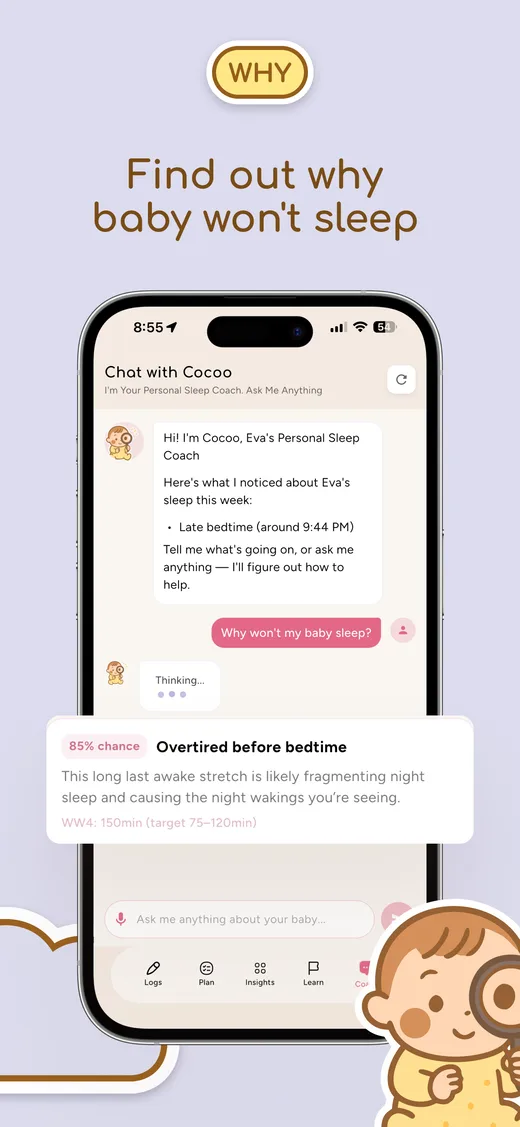
Still not sure which one it is?Cocoo's sleep coach reads your baby's logs and ranks the likely causes, so you know whether to start with the naps or the association.
In the data, the dip eases by 7 months but doesn't vanish. Sleep-through nights go from 32.3% at 6 months back to 36.4% at 7 months, while average wakes stay about the same (1.13 and 1.14). For motor-driven disruption, this happens on its own. For nap-transition disruption, it happens once you commit to a consistent schedule.
The cases that don't resolve are almost always the sleep-association ones. Henderson et al. (2010) showed that parental response to waking was the primary factor separating babies who slept through by 12 months from those who didn't. Looking at the 9-month data, sleep-through nights reach 45.4%, but that number reflects the babies whose sleep situations changed, not a universal improvement.
If you're still dealing with frequent waking at 7 or 8 months with no sign of improvement, a sleep association is almost certainly the reason. That's the most actionable diagnosis, because it's the only cause with a clear path to a fix.
Related reading
Not sure what's driving your baby's waking?
Track 3 nights and let the pattern tell you the cause.


Yes. In 433 complete logged days from 52 babies, sleep-through nights dropped from 40.8% at 5 months to 32.3% at 6 months, and average night wakes rose from 0.98 to 1.13. The disruption is real, though it looks different from the 4-month regression. The most common causes are motor development milestones, a shifting nap count, and sleep associations.
Three things drive most 6-month sleep disruption: motor development milestones (rolling, sitting) activating the motor cortex during sleep; the transition from 3 naps to 2 naps creating erratic daytime sleep and bedtimes; and sleep associations that became entrenched after the 4-month regression.
6 months is one of the most commonly recommended starting points for sleep training, and a regression doesn't make it a bad time. If your baby is waking due to a sleep association, sleep training addresses the root cause directly rather than waiting for it to resolve on its own. Most methods take 1 to 2 weeks.
No. The 4-month regression has a single, permanent biological trigger: sleep architecture shifts to adult-like cycles with light sleep phases. The 6-month disruption is softer, with multiple possible causes and no single brain-structure change behind it. Most babies experience it, but the severity and cause vary much more than at 4 months.