
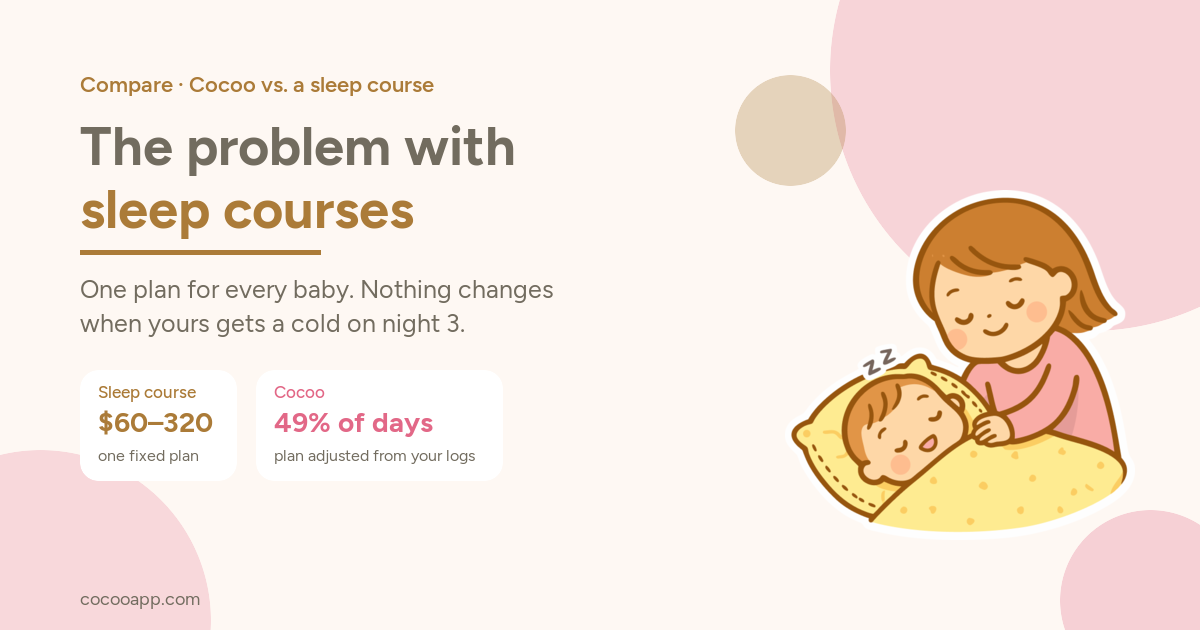
A baby sleep course teaches you one method well, from a voice you trust, for $60 to $320. That part works. The problem is that the plan inside was written before anyone met your baby, and it stays written.
The sample schedule is the schedule for the average 7-month-old. The troubleshooting video covers the three most common problems. So when night 3 goes sideways because of a tooth, or because the last nap ran long, the course gives you the same answer it gave yesterday.
We make Cocoo, an app that guides the same methods courses teach (Ferber, cry it out, chair, pick-up-put-down) but builds tonight's plan from this week's logs. So I'm not neutral. Every number here has its sample size next to it, and further down I answer the pushback I'd expect from anyone who's bought a course.
The case against one plan for every baby, in numbers
49%
of daily plans in Cocoo asked for a change to a wake window, nap or bedtime
65%
of babies tracked 3+ weeks still needed changes after day 14
6
different leading causes behind the same complaint, night waking
24% / 21%
overtired / undertired at bedtime: opposite fixes, same symptom
31%
of "why is this happening" sessions start between 10pm and 5am
$60–320
for a course, once. Cocoo is $59.99 a year, and night 1 is free.
Cocoo log analysis, pulled October 30, 2026. Plans: 9,838 daily plans for 945 babies since March 2026; 309 of 479 babies with 21+ days of plans. Night-waking causes: 532 diagnosed cases from 230 babies. Help sessions: 3,965, local time. Course prices as published, October 2026.
The plan needs to change about every other day. Across 9,838 daily plans in Cocoo for 945 babies, 48.9% asked for at least one change to a wake window, nap length or bedtime relative to what the baby had been doing, worked out from the last few days of logs. Most changes were 5 to 20 minutes. A longer last wake window after a run of slow bedtimes. An earlier bedtime after a skipped nap. A course's sample schedule is printed once and can't move. In Cocoo, even a bad afternoon moves it: tap “Adjust for Today” after a short nap and every remaining nap and bedtime is re-timed in one go.
And it keeps changing after the course is over. Of 479 babies with at least three weeks of daily plans, 309 (64.5%) still had the plan asking for a change after day 14, on 56.2% of those later days. Most courses are built around a two-week sleep training window. The 8-, 10- and 12-month shifts come after it, and there's no new module for them.
The course can't tell you which problem you have. Night waking, the most common reason parents open Cocoo's diagnosis, had six different leading causes across 532 cases from 230 babies: a sleep association (30.3%), overtired at bedtime (24.2%), undertired at bedtime (21.1%), schedule drift (10.2%), hunger (6%), a developmental leap (3.8%). A course's troubleshooting module gives you that list and you pick the one that sounds like you. Overtired and undertired sound exactly alike at 3am, and they need opposite fixes. The logs can tell them apart. A list can't.
The method is proven. The method isn't the hard part. A review of 52 studies found behavioral methods improved bedtime problems and night wakings in the large majority (Mindell et al., 2006), and a randomized trial found graduated extinction and bedtime fading both worked without lasting stress for the baby (Gradisar et al., 2016). Courses teach those methods well. But in the trials, the plans were personalized to the child. In the one randomized trial of a software-delivered plan, the advice was tailored to each family's answers, and night wakings fell by about half in three weeks (Mindell et al., 2011). A recorded course can't personalize anything. It was recorded before you showed up.
Nobody is in the video at 2am. Of 3,965 “why is this happening” sessions in Cocoo, 31.2% started between 10pm and 5am. A course answers the questions you had before you bought it. The one you have on night 3 is “is this normal and what do I do right now”, and it needs an answer that knows what tonight looked like.
If you've got a course in your cart, you're probably thinking…
Three fair pushbacks. One of them is a good reason to buy the course.
“A good course teaches me to read my own baby. I don't need an algorithm, I need understanding.”
Partly right. Knowing why wake windows matter, and why night 3 gets worse, is worth having, and a well-taught course gives you that. Cocoo explains its reasoning for the same reason. You'll hold a plan you understand.
But reading your own baby at 6am, after four wakes, is a different skill from understanding the principle. The arithmetic (how long was the last wake window, what's this baby's own range, did the morning nap run over) is exactly what tired parents get wrong. Cocoo does that part every morning. You still need the understanding. You just don't have to do the math on no sleep.
“The methods are proven. The method is what matters, not the app.”
Agreed on the first half. The methods are what's proven (Mindell et al., 2006; Gradisar et al., 2016), and Cocoo guides the same ones a course teaches. The difference is what goes in. In the trials, plans were personalized to the child's age, sleep onset time and current schedule, then adjusted. In our data, 48.9% of days called for an adjustment. A recorded course delivers the method with one set of inputs, the average baby's. If yours is average, that's enough.
“I pay for a course once. An app bills me every year.”
True, and worth doing the math on. A course is $60 to $320 once. Cocoo is $59.99 a year, or free if you only want tracking, the summary charts and the sleep training guides, and night 1 of any sleep training plan is free. If your baby has one obvious sleep association, you're sure of your method and you'll follow it for two weeks, buy the course. It's the cheaper way to learn one method well. Cocoo is for the family that doesn't know which problem they have, or whose baby keeps changing on them. We're also newer than any course you'll find. Cocoo is rated 4.9 on the US App Store from 48 ratings as of 2026-11-27, and the research behind it is at cocooapp.com/science.
So, a course or Cocoo?
Buy the course if you want to learn one method well, your baby has one clear sleep association, and you'll hold the plan for two weeks. For that family a course is the cheapest good option.
If that's not you, the problem with a course is that the plan was finished before your baby showed up. It can't tell overtired from undertired, it can't move bedtime after a skipped nap, and it has nothing new for month 10. Cocoo guides the same methods from this week's logs, changes the plan on the days it needs changing, and is awake on night 3. $59.99 a year.
Get the method, personalized to your baby
Log a few days in Cocoo. It finds the likely cause of the bad nights, builds tonight's plan from today's naps, and guides Ferber, cry it out, chair or pick-up-put-down with a check-in timer.
Download Cocoo — it's free to startFree to start on iOS and Android. Night 1 of any sleep training plan is free.
Sources
Cocoo log analysis, production database, pulled October 30, 2026. Daily plan changes are adjustments the plan asked for relative to the baby's recent schedule. Night-waking causes are the top-ranked cause in each diagnosis session. Sessions are counted in the parent's local time zone.
Mindell, J. A., Kuhn, B., Lewin, D. S., Meltzer, L. J., & Sadeh, A. (2006). Behavioral treatment of bedtime problems and night wakings in infants and young children. Sleep, 29(10), 1263–1276.
Gradisar, M., et al. (2016). Behavioral interventions for infant sleep problems: A randomized controlled trial. Pediatrics, 137(6), e20151486. publications.aap.org
Mindell, J. A., Du Mond, C. E., Sadeh, A., Telofski, L. S., Kulkarni, N., & Gunn, E. (2011). Efficacy of an internet-based intervention for infant and toddler sleep disturbances. Sleep, 34(4), 451–458. doi.org/10.1093/sleep/34.4.451
Course prices: published pricing pages (Taking Cara Babies, Little Ones), checked October 2026. The full five-way comparison, with trackers, monitors and consultants, is in our sleep consultant vs. app guide.